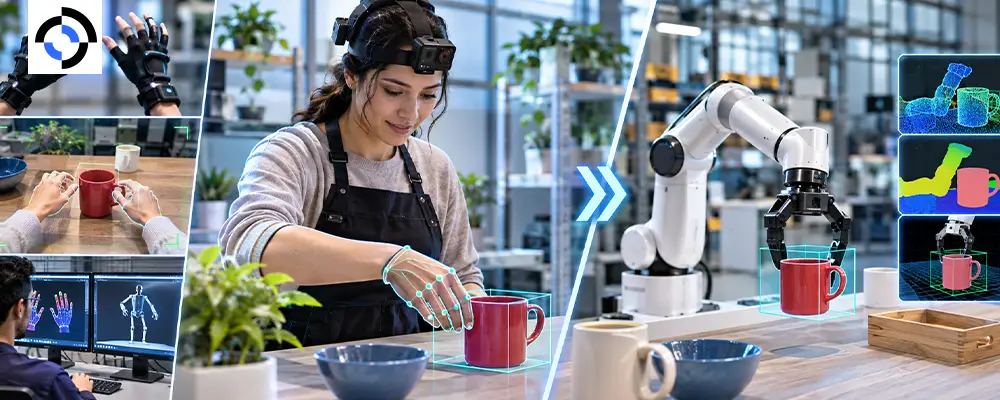
An old proverb, often attributed to Confucius, says: “I hear and I forget. I see and I remember. I do and I understand.” Robots learn much the same way. Show a policy enough skilled human performances and it begins to understand the task, which is why human demonstration data collection has become the backbone of modern imitation learning.
Sourcing it well is harder than it looks. Cameras, gloves, grippers and headsets each produce different data, and not all of it transfers to your robot. This guide walks through the main capture methods, what to specify, how to handle the embodiment gap, and how to choose between building, crowdsourcing and hiring a provider.
Four ways to capture human demonstrations
| Method | What you get | Trade-off |
| Egocentric and wearable cameras | First-person video of real tasks in real places | Cheap and diverse, but needs pose estimation and retargeting; see first-person video datasets |
| Motion capture gloves or camera hand tracking | Precise hand and finger pose | Richer dexterity data, with cost and setup trade-offs covered in gloves vs camera tracking |
| Handheld demonstration grippers | Gripper-space actions without a robot | Closer to robot action space; see handheld grippers |
| Physical or VR demonstration | Task execution with richer control signals | Higher setup cost; compare in VR teleoperation vs physical demonstration |
Most serious programs combine two or more, using cheap breadth for pretraining and richer capture for fine-tuning.
Define what each demonstration must contain
Demonstration data for imitation learning is only useful if it matches what your model consumes. Before collection, decide:
- The target embodiment: which robot, gripper and action space the data must eventually serve
- The signals: hand pose, object pose, wrist and head cameras, depth, audio, language instructions
- The labels: task name, success outcome, segment boundaries and operator ID
- The format: a consistent schema, as described in our guide to imitation learning dataset structure
For manipulation, hand-object interaction data and wrist vs head camera placement are two decisions worth settling early.
Plan for retargeting and the embodiment gap
A person folding a towel uses five fingers and a wrist range most robots cannot match. Human demonstration datasets for manipulation therefore need retargeting, the process of mapping human motion onto robot-executable trajectories. Retargeting maps poses reasonably well but cannot invent a strategy your hardware cannot perform. Read our guide to cross-embodiment retargeting and the human demonstration vs teleoperation comparison before choosing a method, and keep a smaller teleoperated set on your own robot to anchor the final policy.
Build diversity in from day one
An enormous dataset of one operator in one room teaches a narrow skill. Plan variation across operators, scenes, objects and lighting from the start, and measure it. Our post on demonstration diversity shows how many variations a skill needs, and data diversity scoring gives you a way to track coverage.
Handle consent and privacy properly
Human demonstration means filming people, often in homes or workplaces. Require informed operator consent, clear data-use terms, face and background handling where needed, and defined retention policies. Our post on consent and privacy in egocentric capture outlines what to include. Skipping this step creates legal and reputational risk that no amount of data volume can offset.
Build, crowdsource or hire a provider
- Build in-house if you need tight control and have the people to run capture, QA and tooling. Our build vs buy analysis shows the true cost.
- Crowdsource for breadth and speed across many environments, accepting more variance. See crowdsourced vs in-house collection.
- Hire a managed provider when you need quality, consistency and scale together, with a managed robotic data workforce handling operations.
A provider checklist: Can they show a sample with full metadata? Do they report QA and reject rates? Can they run several capture methods? Do they handle consent end to end? Can they deliver in your format and region?
Where Roborax fits
Roborax runs human demonstration data collection through dedicated teams, crowdsourced contributors or a hybrid model, with documented consent, structured metadata and QA on every batch. We pair demonstration capture with teleoperation on your target robot, so breadth and embodiment-specific quality arrive together.
“Human demonstrations give a robot its priors. A well-planned program makes sure those priors are ones it can actually use.” — Roborax data operations team
Frequently asked questions
Q: Is human demonstration data enough to train a robot?
A: Usually not on its own. It is excellent for breadth and pretraining, but most programs add a smaller teleoperated or on-robot set to close the embodiment gap.
Q: How much demonstration data do we need?
A: It depends on task difficulty and diversity. Begin with a pilot, measure policy improvement as you add scenes and operators, and scale where returns justify it.
Q: Which capture method is best for dexterous tasks?
A: Hand tracking with gloves or high-quality cameras captures finger detail best, but retargeting to your gripper still determines how much of it is usable.
If you are planning a demonstration program, tell us what you are training and we will recommend a capture mix, volume and QA plan to match.