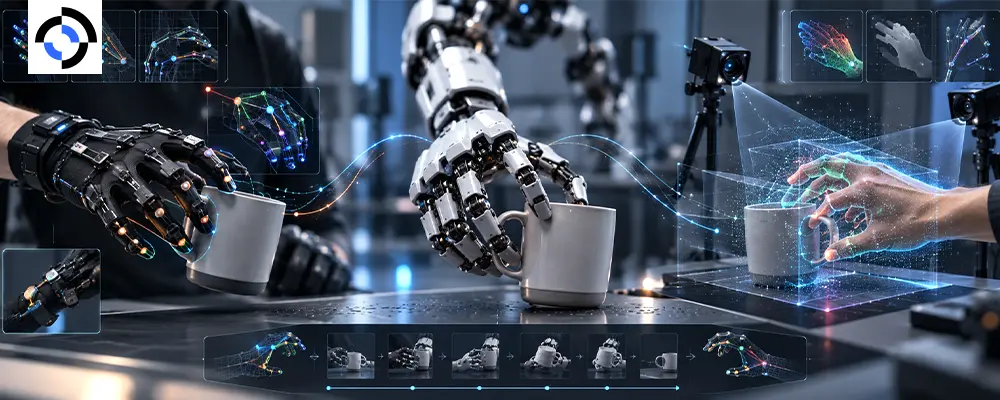
Every dexterous robot hand starts with a human one. Before a policy can close five fingers around a mug, someone has to show it how, and the quality of that showing depends on how well you can measure a human hand. Two approaches dominate: motion capture gloves worn on the hand, and camera-based hand tracking that infers pose from video.
Choosing between them shapes your cost, your throughput and the ceiling on what your robot learns. This guide compares both for hand tracking for robot learning, so you can match the capture method to the task.
Why hand pose capture sets the ceiling
A dexterous demonstration only teaches what the recording preserves. Researchers behind the T-800 data glove note that the fidelity of recorded human motion sets “an upper bound on robotic performance.” If fingertip positions are noisy, delayed or missing during contact, the robot inherits those gaps. Hand pose capture is not a peripheral choice. It is the first quality gate in your pipeline.
Motion capture gloves: strengths and limits
Gloves measure the hand directly using inertial sensors, electromagnetic sensing or flex sensors. Their biggest advantage is occlusion immunity. The authors of the HumDex system point out that vision-based tracking suffers severe self-occlusion during object interaction, while inertial gloves keep capturing complex grasps even when the hands are hidden.
The costs are real: purchase price per operator, calibration per wearer, drift in inertial units, and a glove that changes how an object feels, which can alter the very grasp you are trying to record.
Camera-based hand tracking: strengths and limits
Vision methods estimate hand and wrist pose from RGB or depth video. They need no instrumentation, which makes them easy to deploy across many contributors and compatible with wearable cameras and egocentric capture. The trade-off is robustness. The DexWild team observes that visual estimators are easy to deploy but their “performance degrades significantly under occlusion,” which is unavoidable in manipulation. An earlier thesis comparing glove-based and vision-based control of a bionic hand likewise found the vision method less accurate.
Gloves vs camera-based tracking
| Criterion | Motion capture gloves | Camera-based tracking |
| Occlusion robustness | High | Low to medium; degrades when hands are hidden |
| Accuracy during grasps | Higher, but drift needs calibration | Variable; weakest in contact |
| Setup per contributor | Fit and calibrate | Minimal |
| Hardware cost at scale | Higher | Lower |
| Effect on natural grasp | Can alter feel | None |
| Best fit | Fine in-hand manipulation, contact-rich dexterity | Broad scene coverage, intent and pretraining data |
A hybrid is often the right answer
Many recent systems combine approaches: a lightweight glove for fingertips and a visual or marker-based tracker for the wrist, since several authors report that decoupling wrist and finger tracking improves accuracy. For production programs the pattern is the same. Use glove capture for the dexterous core of a task and camera tracking for volume and scene diversity, then reconcile the two with a small paired set.
What to log with every hand-tracking episode
- Fingertip and wrist poses, with confidence values
- Raw sensor streams, so data can be reprocessed as algorithms improve
- Synchronized video (see multi-camera synchronization)
- Calibration records and wearer ID
- Contact events where instrumented, as discussed in our posts on hand-object interaction data and tactile sensing data
From tracked hand to robot hand
Tracking is half the job. Human fingertip positions must be mapped onto the robot hand’s joints, and each hand’s workspace differs. Our guide to dexterous manipulation data collection covers what the robot hand needs beyond pose, and our post on motion retargeting in robotics covers the mapping step.
How Roborax approaches hand pose capture
Roborax selects the capture method from the task, not the other way round. For fine in-hand dexterity we specify glove-based capture with per-wearer calibration. For broad household coverage we use camera-based and wearable-camera collection with confidence scoring. Every episode passes through our robotics data QA pipeline, where tracking dropouts and calibration drift are flagged before data reaches your team.
The bottom line
Gloves buy accuracy where hands are hidden. Cameras buy scale where they are not. The strongest human demonstration datasets use each where it is strongest, log enough to reprocess later, and treat hand pose capture as the quality gate it is.
Frequently asked questions
Q: Can camera tracking replace gloves?
A: For coarse grasps and large-scale pretraining, often yes. For fine in-hand manipulation, gloves remain the safer choice.
Q: Do gloves need calibration for every wearer?
A: Yes. Hand size and sensor placement vary, so calibrate per wearer and per session.
Q: How do we validate tracking accuracy?
A: Compare against an optical motion-capture reference on a sample of episodes, the approach used in published hand-tracking evaluations.
Q: Which method costs less?
A: Cameras cost less per contributor. Gloves can cost less overall when tracking dropouts during contact would otherwise force re-collection.
Not sure which capture method suits your dexterous task? Tell us what you are training and Roborax will recommend a capture plan and run a calibrated pilot.
Related reading
- Dexterous manipulation data collection
- Hand-object interaction data
- Tactile sensing data for dexterous robots
- Ego pose estimation data
- Wearable camera data collection
- Multi-camera synchronization for robot learning
- Human demonstration vs teleoperation data
- First-person video datasets for robot learning