
Warehouse Picking Robots: What Your Training Data Strategy Is Missing
Warehouse robot training data programs consistently underperform their lab benchmarks in production. The reason is almost never the model architecture. It is almost always a
Home / Data services / Multimodal sensor capture
RGB-D, LiDAR, IMU, tactile, force/torque, audio, thermal, and event cameras. Microsecond alignment across all eight modalities.
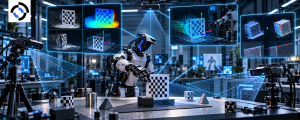
Multimodal sensor capture is the synchronized recording of multiple sensor streams — RGB-D cameras, LiDAR, IMUs, tactile arrays, and audio — aligned to microsecond precision. The result is a single fused frame per timestep: every modality in lockstep.
Getting four sensor types to agree on a timestamp is harder than deploying any one of them. We own the full stack so you skip the integration pain.
Why outsource capture?
Building a multi-sensor rig, calibrating it, and maintaining sync is a full-time job. We do it across dozens of deployments so each one costs you less.
μs-level cross-modal alignment.
4+ modalities per capture session.
99.7% frame integrity rate.
Where we collect
41+ delivery centers across 12 countries. Every program runs from a Roborax hub near your target time zone.
Asia Pacific
India · Philippines
Americas
USA · Canada · Colombia · Jamaica · El Salvador · Belize
EMEA
UK · Albania · Kosovo · Morocco
Synchronized streams ready to drop straight into your perception or fusion pipeline.
Color + depth at 60 fps, calibrated intrinsics and extrinsics per camera.
Continuous 3D scans aligned with camera frames, in your robot frame.
Accel + gyro at 200 Hz, drift-corrected and bias-calibrated.
GelSight and pressure grids, time-locked per grasp frame.
6-axis F/T sensors at wrist or fingertip, synced with joint state.
Contact mics and ambient arrays for acoustic event detection.
Infrared heat maps for material and contact classification.
Asynchronous pixel events for high-speed motion capture.
A four-step protocol that delivers training-ready bag files at the end.
Match your model’s input modalities. Rig built from inventory or custom.
Hardware triggers + software time-sync. End-to-end validation.
Continuous logging with on-rig integrity checks. Drift flagged in real time.
Time-aligned, model-ready dataset. ROSbag, MCAP, or your custom format.
Best-in-class hardware. Pipeline-agnostic output.
D435 / D455 RGB-D
Puck / Alpha Prime
Pandar series
IMU sequences
Tactile arrays
Packaging
FAQ
From the blog
Sim-to-Real Transfer: Why Synthetic Data Alone Falls ShortThe role of real sensor data in closing the sim-to-real gap.
Tell us the modalities and the scene count. We propose a rig and a schedule in two days.
FROM THE FIELD

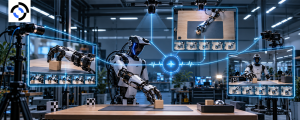
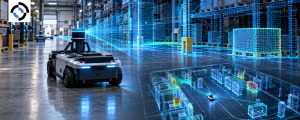
Warehouse robot training data programs consistently underperform their lab benchmarks in production. The reason is almost never the model architecture. It is almost always a

Surgical robot training data has requirements that no general-purpose robotics data program is built to meet out of the box. Sub-millimeter precision, HIPAA compliance, and

A robotics data quality assurance pipeline is not a checklist or a review meeting. At production scale, robotics data quality requires automated validation, per-operator metrics,

Robot data annotation is not image labeling with a different name. The temporal structure of robot trajectories, the grounding in physical task semantics, and the

Sim-to-real robot training with synthetic data is one of the most powerful techniques in embodied AI — and one of the most misunderstood. The gap

The embodied AI training data problem is structurally different from the language model data problem. Language models learned from the internet. Embodied AI must learn
Seven services. One synchronized pipeline.
VR and leader-follower robot control logging.
In-person task demos for imitation learning.
Bounding boxes, segmentation, action labels.
Domain-randomized scenes and sim transfers.
Held-out test sets and success-rate scoring.
Rare scenarios your policy will face in production.