
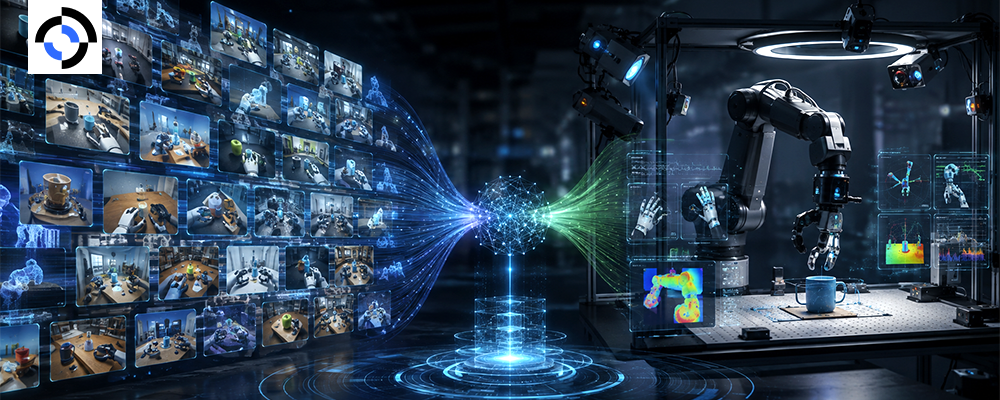
Every robotics team eventually asks whether to license an existing corpus or commission bespoke robotic manipulation datasets. Framed as a choice it produces bad decisions, because the two are answers to different questions.
This guide covers what each is genuinely good for, how to evaluate a dataset before buying it, when bespoke capture is unavoidable, and the layered pattern most working programmes converge on.
They are not competing purchases
The framing of “buy or collect” suggests two routes to the same destination. They are not. Off-the-shelf data and bespoke capture do different jobs at different stages, and most working programmes use both.
Public and licensed corpora build representations: what objects look like, how scenes are structured, how humans move through the world. Bespoke capture supplies grounding: what your robot should do, on your hardware, in your environment.
A model trained only on the first cannot act. A model trained only on the second is narrow and expensive.
What each is actually good for
| Off-the-shelf | Bespoke | |
|---|---|---|
| Cost per hour | Low | High |
| Time to first data | Immediate | Weeks |
| Scene diversity | Very high | Limited by budget |
| Embodiment match | Rarely yours | Exactly yours |
| Action label quality | Variable, often absent | Exact by construction |
| Task relevance | Approximate | Precise |
| Failure coverage | Usually filtered out | Whatever you choose |
| Exclusivity | None | Yours |
The exclusivity line matters commercially. If your competitors can buy the same corpus, it cannot be your advantage. It can be your foundation, which is a different thing.
How to evaluate a dataset you are considering buying
- Ask for one complete episode, not a highlight reel. Everything you need is in the raw record.
- Check whether action labels exist and in what convention. Video without actions is perception data, whatever the listing says.
- Count unique object instances, not categories. Five hundred hours across eleven objects is narrow.
- Ask what fraction are failures. Zero means the set was cleaned, and the recovery behaviour is gone.
- Check timestamp integrity. Independently stamped streams, or an assumed constant rate that hides dropped frames.
- Confirm licensing and consent provenance, particularly for footage of real people in real homes.
- Test poolability against your own schema before you buy, per dataset structure.
Most of these are covered in more depth in what makes a first-person dataset usable.
When bespoke is unavoidable
- Your gripper is unusual. Action labels from a parallel jaw do not transfer to a multi-fingered hand, per dexterous manipulation.
- Your objects are specific. Proprietary parts, branded packaging, or clinical instruments appear in no public corpus.
- Your environment is unusual. A particular factory line, vehicle interior, or clinical suite.
- You need contact data. Force and torque are almost never present in licensed sets.
- You need the failure tail. Public sets are cleaned; your edge cases are yours.
- Confidentiality applies. Some environments cannot be captured by a shared workforce at all.
The layered pattern
- Public corpora for representation. Broad visual and physical priors, at near-zero marginal cost.
- Licensed or partner data for breadth in your domain, where it exists and matches closely enough to help.
- Bespoke capture for grounding on your embodiment, objects, and tasks.
- Fleet intervention data for the tail, once deployed, per the intervention loop.
Spend increases down that list and so does specificity. The mistake is skipping the top and paying bespoke prices for generic competence, or skipping the bottom and expecting a purchased corpus to teach embodiment-specific control.
For a programme built on that layering, our humanoid foundation model case study documents a 3x sample-efficiency result.
Frequently asked questions
Can we start with off-the-shelf and add bespoke later?
That is the normal path. Fix your log schema before the bespoke phase so both sources can be pooled rather than maintained separately.
How much cheaper is licensed data really?
Dramatically per hour, and the comparison misleads. Compare cost per unit of policy improvement, where a small volume of exactly-matched bespoke data frequently outperforms a large volume of approximate data.
Do public datasets carry usable action labels?
Some robot-specific corpora do. General egocentric video almost never does, which is why it supports pretraining rather than control.
Who owns bespoke data?
Settle it in the contract before collection. Ownership, exclusivity, and whether the vendor may reuse it are separate questions, and vendors answer them very differently.
Buying broad and collecting narrow is nearly always right. The failure mode is expecting either half to do the other’s job. If you want a data mix sized against your model target, tell us what you are training.