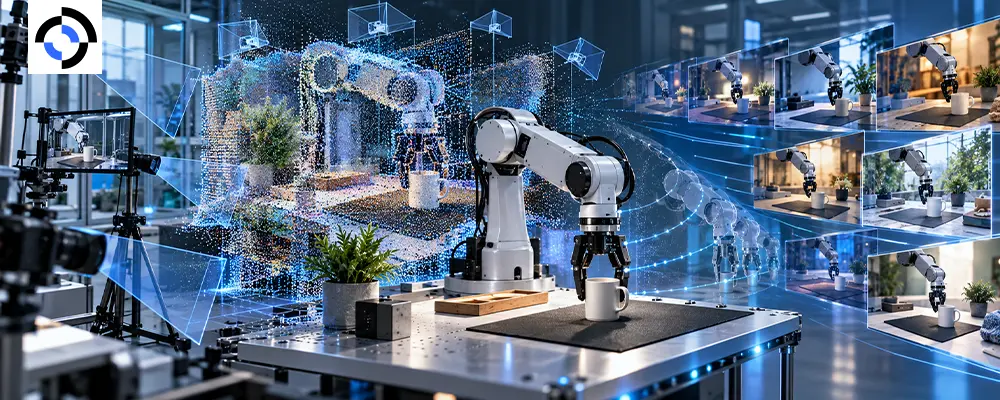
Collecting a real demonstration costs operator hours, hardware time and a scene. Synthetic data augmentation robotics teams now use can multiply what one demonstration is worth: new viewpoints, new lighting and new backgrounds, all from footage you already have. Two techniques lead the way: Gaussian splatting for rebuilding scenes in 3D, and generative video for rewriting appearance.
This guide explains how Gaussian splatting and neural rendering work for robot data, what generative video for robots can and cannot change, and how to keep photorealistic synthetic data honest.
Why augment real footage instead of simulating from scratch
Classic simulation builds worlds from assets and renders them with a graphics engine. Learned rendering starts from real captures, so the output looks like the real sensor and inherits real texture, wear and clutter. That shrinks the visual domain gap, the main weakness of purely simulated imagery.
Augmentation has a hard limit. It can change what the camera sees, but the actions in the original demonstration must still be valid for the new image. That single constraint decides which edits are safe.
Gaussian splatting for robot data
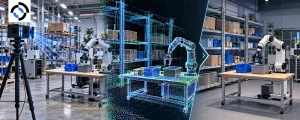
3D Gaussian splatting represents a scene as millions of small, semi-transparent colored Gaussians that render quickly from any viewpoint. In the original paper, Kerbl and colleagues combine “state-of-the-art visual quality while maintaining competitive training times” with real-time rendering. For robotics, that enables three uses:
- Novel-view augmentation: render a demonstration from shifted or additional camera poses so a policy tolerates changes in camera placement.
- Scene editing: move, add or remove objects in a reconstructed scene.
- Real-to-sim backgrounds: use splat-reconstructed scenes as photoreal visuals in simulation, an alternative to textured meshes in the digital twin pipeline.
The caveat is that splats model appearance, not physics. They carry no mass, friction or collision geometry unless you attach it. That is fine for visual augmentation and insufficient on its own for contact-rich simulation.
Generative video for robots
Video diffusion models and world foundation models can restyle footage: change the time of day, swap a counter surface, replace the background or add distractors. Generative video for robots is strongest at appearance changes that leave geometry and motion intact.
Its weaknesses sit exactly where robotics is sensitive: temporal consistency, object permanence and physical plausibility. A generated cup can drift, a gripper can deform, and contact can look wrong in a way no viewer would notice but a policy would learn from. Our overview of world models and robotics data covers the broader picture.
What is safe to change
| Edit | Risk to action labels | Verdict |
| Lighting, time of day, color grade | Low | Generally safe |
| Background and textures away from the workspace | Low | Generally safe |
| Distractor objects outside the manipulation path | Low to medium | Safe if placed outside reach |
| Camera viewpoint shift | Medium | Safe in a modest range, verified against calibrated geometry |
| Object shape, size or position | High | Actions no longer match; avoid or relabel |
| Gripper or arm appearance | High | Breaks embodiment cues; avoid |
| Contact, motion or physics | Very high | Avoid generating |
A guardrail checklist
- Keep actions fixed to the source demonstration and augment pixels only.
- Preserve embodiment. Do not let a model repaint the robot.
- Check temporal consistency with automated flicker and identity checks, then human spot review.
- Tag every augmented frame with its source and edit type in the schema.
- Validate on real held-out data. A gain on an augmented test set proves nothing.
- Cap the share. A heavy augmented share without real anchors drifts toward artifacts. Our guide to the real and synthetic data mix shows how to find the cap.
Where this fits in a data program
Treat learned augmentation as a multiplier on real data, not a replacement for it. A sound sequence: collect a strong, diverse real core, apply visual augmentation to broaden appearance and viewpoint, use simulation and domain randomization for dynamics variation, and keep contact-critical data real.
Roborax supports that full chain, from real collection to synthetic and sim-to-real augmentation, with source tags and schema compatibility built in so augmented and real episodes pool cleanly.
Frequently asked questions
Q: Does Gaussian splatting replace meshes in simulation?
A: Not for physics. Splats give excellent appearance, while meshes still supply collision geometry and physical properties. Hybrid pipelines use splats for rendering and meshes for dynamics.
Q: Can generative video create new demonstrations?
A: Not reliably. It can produce plausible-looking footage, but matching actions and physically consistent contact are not guaranteed. Use it to augment real demonstrations, not to invent them.
Q: How do we know augmentation is helping?
A: Compare policies trained with and without it on real held-out episodes, across several seeds. If real performance does not improve, drop it.
Augmentation multiplies good data and magnifies bad data in equal measure. If you are deciding where learned rendering fits in your pipeline, tell us what you are training and we will help design the real core, the augmentation plan and the validation set.
Related reading
External reference