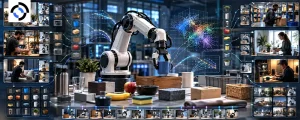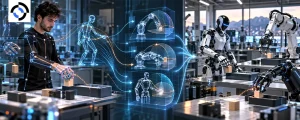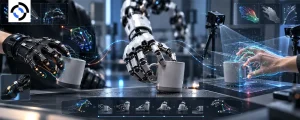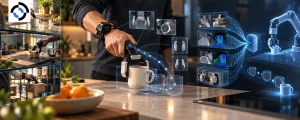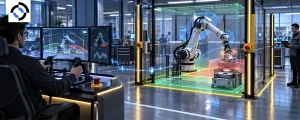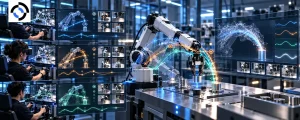
Robot learning depends on data, but collecting high-quality robot data in the physical world can be expensive, slow, and difficult to scale. Every new task, environment, sensor configuration, and edge case can require additional demonstrations or carefully controlled experiments.
This is where digital twin robotics is changing the way teams approach robot data collection. Instead of treating simulation as a final testing step, robotics teams can create a virtual representation of the robot, environment, sensors, and tasks—and use it to determine what data needs to be collected before physical deployment.
For robotics companies building autonomous systems, manipulators, AMRs, humanoids, and Physical AI applications, this creates a more systematic digital twin data strategy.
What Is a Digital Twin in Robotics?
A digital twin is a virtual representation of a physical system that can reproduce relevant aspects of its behavior, environment, sensors, and operating conditions.
In robotics, this can include:
- Robot geometry and kinematics
- Sensors such as cameras, LiDAR, IMUs, and force sensors
- Workspace or facility layouts
- Objects and environmental conditions
- Robot trajectories and actions
- Physics and collision behavior
- Task-specific interactions
- Failure and edge-case scenarios
The National Institute of Standards and Technology (NIST) describes digital twins for robot systems as virtual representations that can support activities such as designing, testing, commissioning, operating, and reconfiguring robotic systems.
The important shift is that the digital twin is not simply a visualization. It becomes an experimental environment for deciding which robot data should be collected, how much is needed, and under which conditions.
Why Robot Data Collection Needs Better Planning
Traditional robot data collection often starts with physical trials. Engineers deploy a robot, record demonstrations, identify weaknesses, collect additional examples, and repeat the process.
That approach can become inefficient when the number of variables increases.
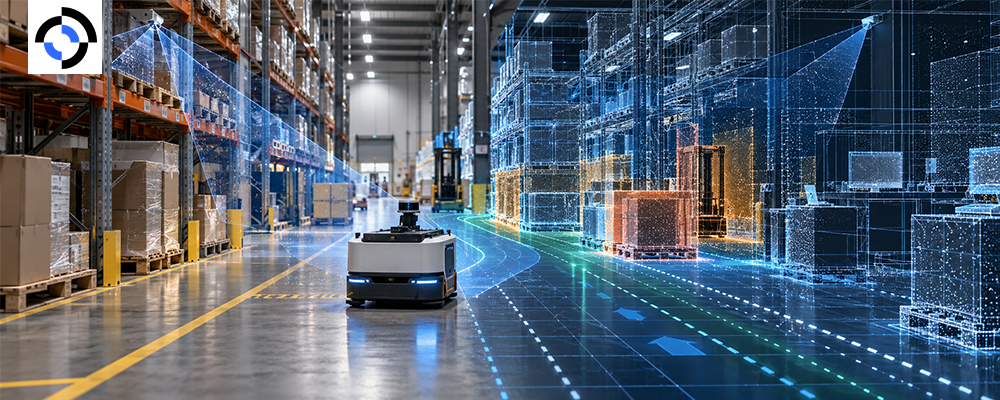
Consider a warehouse robot navigating around people. Data may need to cover different lighting conditions, object arrangements, pedestrian movements, camera viewpoints, speeds, floor surfaces, and unexpected obstacles.
Testing every combination physically may require substantial time and operational resources.
A virtual robot environment allows teams to explore these combinations before deciding which scenarios deserve real-world data collection.
This makes simulation useful not only for generating synthetic data but also for answering a more fundamental question:
What real-world data are we missing?
Digital Twins as a Robot Data Planning Layer
A practical digital twin workflow can begin with the physical robot and its operating environment.
The team creates a virtual representation, configures sensors, defines target tasks, and establishes measurable performance criteria. Simulation can then expose the robot to different operating conditions.
For example, a manipulation system may be evaluated across:
- Different object shapes and sizes
- Object positions and orientations
- Lighting conditions
- Gripper approaches
- Collision scenarios
- Occlusions
- Surface variations
- Failed grasp attempts
The resulting performance data can reveal where the robot’s policy or perception system performs poorly.
Those weaknesses become priorities for additional data collection.
This turns robot simulation planning into a feedback mechanism for physical data acquisition rather than an isolated engineering activity.
From Simulation to Synthetic Data Generation
Modern robotics simulation platforms increasingly combine digital twins with synthetic data generation.
NVIDIA describes Isaac Sim as a framework for robotics simulation, testing, and synthetic data generation in physically based virtual environments. Its workflows can incorporate CAD, URDF, real-world captures, robot models, sensors, and configurable simulation scenes.
This enables teams to generate controlled variations of a scenario.
For example, if a vision model struggles to identify an object when partially occluded, the digital twin can systematically vary:
- Occlusion percentage
- Object orientation
- Camera position
- Lighting
- Background
- Object texture
- Distance from the robot
Rather than collecting hundreds of randomly selected examples, the team can deliberately generate data around the failure boundary.
That is a much more targeted approach to dataset development.
Digital Twins Can Reveal Data Gaps Before Deployment
One of the most valuable applications of a digital twin is identifying underrepresented scenarios.
Suppose a robot performs well in simulation under normal conditions but fails when an object is close to another object. The issue suggests a potential gap in the training distribution.
The team can then collect targeted real-world demonstrations involving cluttered scenes.
This creates a loop:
Simulate → Identify weakness → Prioritize physical data → Retrain → Validate → Update simulation
Over time, the digital twin becomes part of a continuous digital twin data strategy.
Instead of collecting data simply because more data appears beneficial, teams can connect data acquisition to measurable model weaknesses.
Supporting Sim-to-Real Generalization
The ultimate objective is not to create a robot that performs perfectly inside a simulator. It is to develop behavior that transfers reliably to physical hardware.
This is the challenge of sim-to-real generalization.
Simulation can introduce controlled variation through parameters such as lighting, textures, object placement, sensor noise, friction, motion, and environmental conditions. Such variation can help models avoid becoming overly dependent on a narrow simulated environment.
NVIDIA notes that synthetic data and domain randomization can be used to vary factors such as lighting, location, color, texture, and background while generating robotics training data.
However, simulation should complement—not automatically replace—real-world data.
The most effective strategy is often a hybrid dataset containing carefully selected physical observations alongside scalable synthetic examples.
The Business Value of Simulation-Led Data Planning
The scale possible through simulation can be substantial.
In one NVIDIA workflow for humanoid robot learning, a synthetic motion-generation pipeline produced 780,000 synthetic trajectories, equivalent to approximately 6,500 hours of human demonstration data, in about 11 hours. NVIDIA reported that combining synthetic and real data improved GR00T N1 performance by 40% compared with using real data alone.
The example illustrates the potential of simulation as a data multiplier.
More importantly, it demonstrates why digital twins should be considered part of the data architecture—not merely a visualization or testing tool.
Building a Practical Digital Twin Data Strategy
Robotics teams can structure their approach around five stages:
1. Define the physical operating environment
Capture robot geometry, sensors, workspace characteristics, objects, and task requirements.
2. Establish priority scenarios
Identify normal operating conditions, difficult cases, failures, and safety-critical situations.
3. Generate controlled variations
Use simulation to explore environmental, sensor, object, and behavioral variations.
4. Identify data gaps
Compare simulated performance and existing real-world results to determine where additional data is required.
5. Close the sim-to-real loop
Collect targeted physical data, retrain the robot model, validate performance, and continuously update the digital twin.
This creates a data pipeline that becomes increasingly informed by actual robot performance.
How Roborax Supports Simulation-Driven Robot Data Collection
At Roborax, we view robotics data collection as more than simply recording demonstrations. The objective is to create datasets that reflect the complexity robots encounter in real operating environments.
Our robotics data workflows can support simulation-led planning, synthetic and real-world dataset development, robot demonstrations, edge-case coverage, sensor data, and task-specific training requirements.
By connecting virtual robot environment design with targeted physical data collection, robotics teams can prioritize the scenarios that matter most and build datasets designed for robust robot learning.
Conclusion
Digital twins are becoming an important foundation for modern robot development because they allow teams to experiment before committing resources to physical trials.
For data teams, their value goes even further. A well-designed digital twin can identify data gaps, prioritize difficult scenarios, generate controlled variations, support synthetic datasets, and inform targeted real-world collection.
The future of robot data collection is therefore unlikely to be purely physical or purely synthetic. It will increasingly combine both through intelligent simulation and continuous validation.
For robotics teams pursuing reliable sim-to-real generalization, the digital twin can become the planning layer that connects simulation, data collection, model training, and real-world deployment.
Build better robot datasets with a strategy designed around the way robots actually learn. Partner with Roborax to develop scalable robotics data collection and training-data workflows tailored to your Physical AI and automation requirements.
Frequently asked questions
Q: Is a digital twin the same as a simulation environment for training?
A: They can be built from the same underlying model, but planning use focuses on scenario and coverage estimation, while training use focuses on generating usable synthetic episodes at scale — the goals shape how detailed and physically accurate the twin needs to be.
Q: How accurate does a digital twin need to be for planning purposes?
A: Accurate enough to reveal real occlusion, lighting, and layout patterns — millimeter-level geometric accuracy usually isn’t necessary for planning, though it becomes more important if the same twin is used to generate training data.
Q: Can a digital twin replace a site visit?
A: No. It reduces how much needs to be discovered during a site visit, but real environments have variation — people, wear, seasonal change — that a twin built at one point in time won’t capture.
Planning a large-scale capture program without a model of the deployment environment usually means discovering gaps mid-program. Talk to Roborax about scoping your next collection effort properly from the start.
- Related reading
External reference