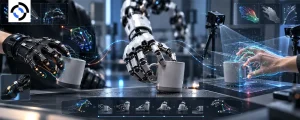
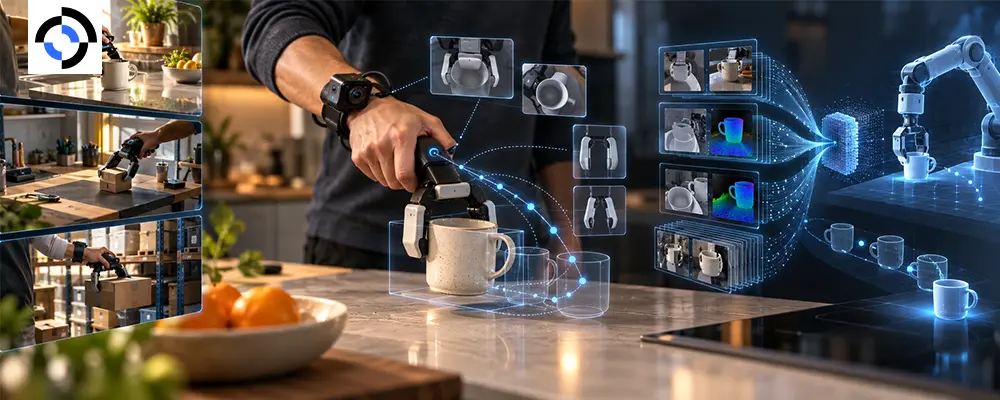
What if you could collect robot training data without a robot in the room? A handheld demonstration gripper makes that possible. A person holds a gripper-shaped tool fitted with a camera, performs the task in a kitchen, a warehouse or a living room, and the system records a full manipulation trajectory. No robot to ship, no cell to build, no teleoperation rig to calibrate.
This approach, popularized by UMI-style data collection, has changed how teams think about scalable demonstrations. This guide explains how robot-free data collection works, what it does well, where it breaks, and how to fold it into a production data program.
What a handheld demonstration gripper is
The Universal Manipulation Interface (UMI) pairs hand-held grippers with careful interface design to enable what its authors call “portable, low-cost, and information-rich data collection.” In practice, the tool is a 3D-printed parallel-jaw gripper with soft fingers and a single wrist-mounted camera. Pose is typically recovered from the camera’s own motion, and gripper width is tracked so a policy knows when to open and close.
Because the data is expressed as end-effector trajectories rather than joint angles, the resulting policies are hardware-agnostic. UMI’s authors report deployment across multiple robot platforms from the same human demonstrations.
Why teams adopt robot-free data collection
- Speed to scale. Operators work in parallel without waiting for robot time, and the hardware is cheap enough to deploy by the dozen.
- Environmental breadth. Collection happens in real homes, shops and warehouses, where robots rarely go and where scene diversity lives.
- Lower cost per demonstration. There is no robot depreciation, safety cell or on-site technician. Our guide to cost per trajectory shows how to model the difference.
- Natural human motion. Operators use their own hands and pace, so fatigue and style look different from teleoperation, as covered in our comparison of human demonstration vs teleoperation data.
Where handheld grippers fall short
Honest limits matter. The data carries no robot-side proprioception and no contact forces, so force-sensitive tasks need extra instrumentation. Operators are also tied to the gripper’s morphology: the DexWild authors note that handheld grippers simplify retargeting but limit the diversity of captured behavior, which is why multi-finger dexterity calls for other tools. The target robot’s kinematic limits still apply, so demonstrations must be filtered for reachability. And observation-to-action latency must be matched at deployment, which is why UMI’s policy interface includes inference-time latency matching.
Handheld grippers, teleoperation and bare-hand video
| Method | Robot needed | Cost per hour | Scene breadth | Best for |
| Handheld gripper (UMI-style) | No | Low | Very high | Pick-and-place, pouring, folding, bimanual routines with parallel-jaw grippers |
| Teleoperation | Yes | Higher | Limited by robot logistics | Contact-rich, force-sensitive, embodiment-specific skills |
| Bare-hand video | No | Lowest | Very high | Pretraining, intent and scene priors; needs retargeting |
Most mature programs blend all three.
Quality controls for scalable demonstrations
- Calibrate every unit. Camera intrinsics, gripper-width mapping and mounting offsets drift. Check them each session, and keep streams aligned using the practices in our guide to multi-camera synchronization.
- Verify tracking. Reject episodes with pose loss or scale drift before they enter the dataset.
- Check embodiment feasibility. Filter demonstrations the target robot cannot reach or whose speeds exceed its limits.
- Script the task. Fix the start state, object set and success criteria with a task script.
- Review at episode level. Combine automated checks with human review, as in our robotics data QA pipeline.
Where it fits in your data pipeline
Use handheld data for breadth: many scenes, many objects, many operators. Use teleoperation for depth on contact-rich or embodiment-specific skills. Use a small on-robot set to measure the gap between the two. Then evaluate on held-out scenes with the approach in our guide to embodied AI policy evaluation.
How Roborax runs robot-free collection
Roborax treats handheld capture as one lane in a blended data strategy. Contributors capture handheld demonstrations across varied homes and workplaces, as described in our comparison of crowdsourced vs in-house collection, while dedicated teams cover tasks that need a real robot in the loop. Every episode is checked for tracking quality and embodiment feasibility before delivery, and output arrives in the formats your stack expects, as covered in our guide to trajectory data formats.
The bottom line
Handheld demonstration grippers will not replace robots in the loop. They make the broad, cheap, scene-diverse part of the data problem tractable, so scarce robot time goes where only a robot will do. Treat them as a high-volume lane with strict QA, not a shortcut around it.
Frequently asked questions
Q: Do I need a robot to use a handheld demonstration gripper?
A: Not for collection. You need one at deployment, and ideally a small robot-in-the-loop set to validate transfer.
Q: Is UMI-style data collection only for parallel-jaw grippers?
A: Mostly. It targets parallel-jaw end effectors. Multi-finger hands need gloves or hand tracking.
Q: How does handheld data compare with teleoperation data?
A: It trades contact and force richness for scale and scene diversity. The best programs combine both.
Q: How many demonstrations does each task need?
A: Diversity usually beats volume, so spread demonstrations across scenes and objects before adding repeats. See our guide to demonstration diversity.
Want to test robot-free collection on your task? Tell us what you are training and Roborax will scope a handheld pilot with a robot-in-the-loop validation set.
Related reading
- Human demonstration vs teleoperation data
- Wearable camera data collection
- First-person video datasets for robot learning
- Robot training data cost per trajectory
- Trajectory data for robotics: formats
- Multi-camera synchronization for robot learning
- Crowdsourced vs in-house data collection for robotics
- Teleoperation task script design