
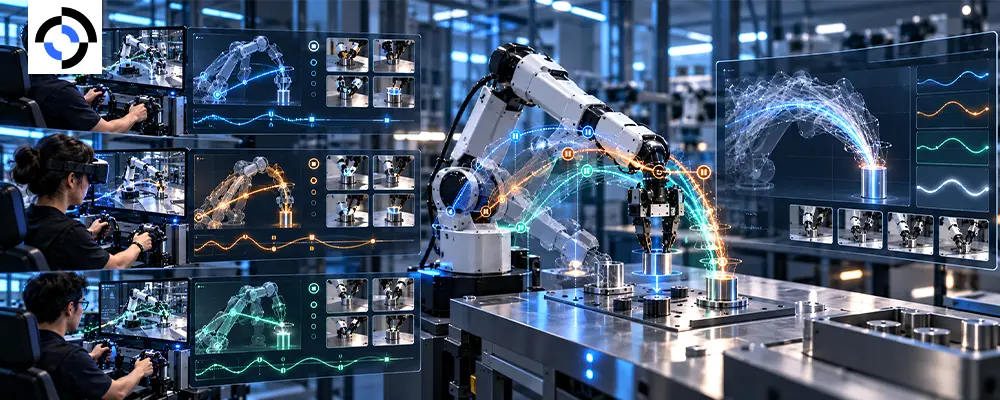
Two operators, one robot, one task. The first sweeps wide and slow. The second cuts corners and speeds up at the end. Both succeed, and both get logged as correct. Pool their episodes and you have trained a policy on a blend of two styles that neither operator actually performs.
That blend is the quiet cost of teleoperation operator variability. This guide explains where demonstration style bias comes from, how it distorts imitation learning data quality, and how to measure and manage it in multi-operator data.
What operator variability looks like in a dataset
Operators differ in speed, path shape, approach angle, pause length, grip timing and the way they recover from a miss. Some differences reflect skill. Others are pure habit. Neither is wrong, but each becomes a pattern the policy can absorb. The researchers behind the robomimic benchmark noted that “Human demonstrations can differ substantially,” and their study traced a strong dependence on the quality of the demonstrations they collected from operators of mixed ability. Operator variability in teleoperation datasets occurs when different human operators perform the same robotic task using different movement patterns, speeds, force levels, or control strategies. For example, while grasping an object, one operator may approach it slowly and adjust the robot’s position several times, whereas another may complete the task with fewer movements. As a result, teleoperation data can contain inconsistent demonstrations, action trajectories, and task execution patterns. Moreover, differences in operator experience, reaction time, and decision-making can introduce additional variation. Therefore, identifying and managing operator variability through standardized protocols, consistent labeling, and rigorous quality checks helps create reliable robotic training datasets and enables AI models to learn more generalizable manipulation and control behaviors.
Why style bias hurts behavior cloning
Behavior cloning learns an average. When two demonstrators solve the same state differently, a standard regression policy can output the midpoint: a motion neither operator used, and sometimes one that collides with the object. This is mode averaging, and it shows up as hesitation, jitter or confident motion that misses.
Variability also leaks in as behavior cloning noise. A tired operator’s tremor, an over-gripping habit, or an operator who always leads their inputs gets copied alongside the intent. Our posts on operator fatigue and latency budgets cover two common sources.
Policies that model multimodal action distributions cope better with multi-operator data, but only when styles are consistent within each episode and labeled across the dataset. Better algorithms reduce the damage; they do not replace clean data.
Four sources of variability
| Source | Example | Effect on data | Control |
| Style | Wide arcs vs. direct paths | Multimodal actions, mode averaging | Task scripts; style tags |
| Skill | Novice retries, expert does not | Mixed-quality demonstrations | Qualification gates; quality scoring |
| State | Fatigue late in a shift | Drift in smoothness and speed | Session caps; scheduled breaks |
| Interface | Different rigs or latency | Systematic action offsets | One calibrated rig per task; log the interface |
How to measure operator variability
You cannot manage what you do not log. Record an operator ID and session ID on every episode, then compute per-operator distributions for:
- Episode duration and idle time
- Path length and smoothness (jerk)
- Gripper close timing relative to contact
- Retry and recovery count
- Success rate by task variant
Compare the variance between operators with the variance within each operator. If the first dominates, you have a style problem. If the second dominates, you have a consistency or fatigue problem. Different cures apply.
How to control style bias in multi-operator data
- Script the task. A clear task script fixes the sequence, start state and success criteria.
- Train and qualify operators. Our guide to remote operator training covers calibration and certification.
- Cap any one operator’s share. No single style should dominate a training split.
- Keep style as metadata. Tag operator and strategy, then filter, weight or condition on them during training.
- Score and filter. Apply automated and human checks, as in our robotics data QA pipeline, before data reaches the training set.
When variability helps
Not all variation is noise. Strategy diversity can improve robustness when it is intentional, labeled and balanced: different grasp approaches for the same object, for example, or different routes around an obstacle. The failure is accidental variability that nobody measured. Deliberate diversity is a feature of a good dataset, and a system for teleoperation quality at scale is built to tell the two apart.
How Roborax manages operator variability
Roborax runs teleoperation with dedicated, managed operator teams, so operator identity, training history and session conditions are part of the dataset instead of an afterthought. Every episode carries operator and interface metadata, and reviewers score consistency before delivery, so your team receives data it can slice by style, skill and session.
The bottom line
Operators are the most flexible sensors in your data pipeline and the least calibrated. Measure them, script them, label them and cap them, and variability turns from hidden bias into a controllable variable.
Frequently asked questions
Is multi-operator data worse than single-operator data?
Not inherently. It improves coverage and robustness when styles are labeled and balanced, and it hurts when they are mixed blindly.
How many operators should a dataset include?
Enough to avoid dependence on one person, and few enough to train and review each one properly. Start small and widen as your quality metrics hold.
Can we fix style bias after collection?
Partly. Metadata makes it possible to filter, reweight or condition on operator. Variability that was never logged cannot be recovered.
Does a better algorithm remove the problem?
Multimodal policy classes help, but they still depend on clean, labeled data. Multimodal policy models enable AI systems to interpret and respond to different types of inputs, including text, images, audio, and video. However, their performance still depends on the quality of the data used during training. Therefore, clean, accurately labeled, and well-structured datasets are essential for helping these models learn meaningful relationships across different modalities. For example, in robotics, aligning camera footage, sensor readings, and action labels allows a model to understand its environment and select appropriate actions. Similarly, in autonomous driving, synchronized video, LiDAR, and sensor data help AI systems interpret complex road conditions. Moreover, inconsistent labels, missing information, or misaligned data can introduce errors, ultimately affecting model reliability. Consequently, combining high-quality data collection with expert annotation and rigorous quality assurance is critical to developing dependable multimodal AI systems. Algorithms do not replace quality control.
Wondering how much of your dataset is really one operator’s habits? Tell us what you are training and Roborax will audit your operator mix and build a plan that controls it.
Related reading
- Teleoperation data collection
- Operator fatigue and robot data quality
- Hiring and training remote robot operators
- How to write a teleoperation task script
- Scaling teleoperation data collection without losing quality
- Behavior cloning training data
- Imitation learning dataset structure
- Managed robotic data workforce