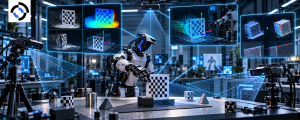

Warehouse Picking Robots: What Your Training Data Strategy Is Missing
Warehouse robots underperform in production not because of the model, but because training data missed the edge cases that matter.
Home / Data services / Synthetic and sim-to-real
Isaac and MuJoCo scene generation, domain randomization, and validated sim-to-real bridging.
Synthetic data is generated inside physics simulators like Isaac Sim and MuJoCo — domain randomization varies lighting, textures, object shapes, and camera poses across thousands of scenes so your policy trains on diversity it could never see in a real lab.
We build the scenes, run the randomization, and validate that sim-trained policies transfer to your hardware before you see a bill for real data.
Why outsource sim data?
Scene authoring and domain randomization tuning is specialized work. We maintain the asset library and sim infrastructure so your ML team stays focused on architectures.
10,000+ scenes generated per day.
5 randomization dimensions per scene.
91% sim-to-real transfer validated.
Where we collect
41+ delivery centers across 12 countries. Every program runs from a Roborax hub near your target time zone.
Asia Pacific
India · Philippines
Americas
USA · Canada · Colombia · Jamaica · El Salvador · Belize
EMEA
UK · Albania · Kosovo · Morocco
Four synthetic outputs designed to close the sim-to-real gap, not widen it.
Domain randomization across textures, lighting, physics, and object placement.
Identical scenes captured in sim and reality for direct gap measurement.
Controlled-variable runs for ablations and curriculum design.
Synthetic generated to match your real-world statistics.
A pipeline that ends with sim-to-real metrics, not just rendered frames.
Build the parameterized scene with your team. Variables and ranges locked.
Domain randomization sweeps across textures, lighting, physics, and asset variants.
Batch generation with quality gates. Failed sims rejected, not shipped.
Sim-to-real metrics against held-out real captures. Transfer rate reported per batch.
NVIDIA Isaac, MuJoCo, Genesis, and custom Blender pipelines.
NVIDIA stack
DeepMind stack
Asset creation
Custom physics
Sim bridge
Your pipeline
FAQ
Isaac Sim, Mujoco, PyBullet, Gazebo, and Genesis. We can also work in custom proprietary simulators if you share access.
Through domain randomisation, photorealistic rendering, and blending synthetic data with real-world capture in proportions tuned to your transfer benchmarks. We measure transfer quality and iterate until targets are met.
Yes. We systematically generate failure-inducing scenarios — lighting extremes, occlusion patterns, novel object placements — that are underrepresented in real-world capture and critical for robust policies.
We run transfer benchmarks on a held-out real-world test set and report the delta between sim-trained and real-trained policy performance. You get a quantified quality score with every synthetic batch.
From the blog
Sim-to-Real Transfer: Why Synthetic Data Alone Falls ShortDomain randomization helps, but real data remains essential.
From the blog
From Imitation Learning to RL: How Your Data Strategy ChangesWhat changes in your data needs as you move from IL to RL.
Tell us the task and the gap. We come back with a templated scene plan and transfer targets.
FROM THE FIELD

Warehouse robots underperform in production not because of the model, but because training data missed the edge cases that matter.

Sub-millimeter precision, HIPAA compliance, and credentialed operators — surgical robot data has requirements general robotics programs cannot meet.

Robotics data quality is not a review meeting. At production scale it is automated validation, per-operator metrics, and same-day feedback loops.

Robot annotation is not image labeling with a new name. Temporal structure and task semantics demand distinct tooling and annotator qualification.

Simulation offers unlimited training data at zero cost. The sim-to-real gap is a structural problem, not a rendering one.

Language models scaled on internet data. Embodied AI must build its data from the physical world — and that changes everything.
Seven services. One synchronized pipeline.
VR and leader-follower robot control logging.
In-person task demos for imitation learning.
RGB-D, LiDAR, force, and tactile streams.
Bounding boxes, segmentation, action labels.
Held-out test sets and success-rate scoring.
Rare scenarios your policy will face in production.