
Warehouse Picking Robots: What Your Training Data Strategy Is Missing
Warehouse robot training data programs consistently underperform their lab benchmarks in production. The reason is almost never the model architecture. It is almost always a
Home / Data services / Teleoperation
VR, exo, and bilateral leader-follower rigs. The shortest path from human intent to robot training data.
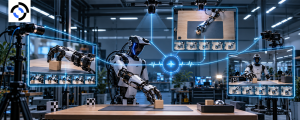
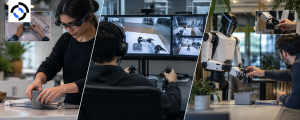
Teleoperation is the process of a human operator controlling a robot in real time — through VR headsets, exoskeletons, or leader-follower rigs — while every joint position, force reading, and camera frame is logged at high frequency. The result is egocentric demonstration data: the exact trajectories a policy needs to learn the task.
Building a teleop program in-house means sourcing rigs, hiring operators, and standing up QA — months before a single trajectory ships. We eliminate that ramp.
Why outsource teleop?
Your ML team should be training policies, not debugging rigs. We handle collection so you ship models faster.
4 weeks from scoping call to production data.
12 active pods across three continents.
99.4% SLA on delivery timelines.
Where we collect
41+ delivery centers across 12 countries. Every program runs from a Roborax hub near your target time zone.
Asia Pacific
India · Philippines
Americas
USA · Canada · Colombia · Jamaica · El Salvador · Belize
EMEA
UK · Albania · Kosovo · Morocco
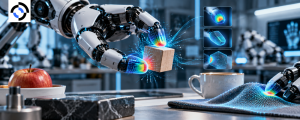
Every teleoperation session produces the four primitives a VLA or manipulation policy actually trains on.
Full kinematic logs at 30Hz, per-joint position, velocity, and torque.
Tool-center-point pose in your robot frame, calibrated per-rig.
Wrench data from force-torque sensors, time-aligned to joints.
Wrist + scene cameras, frame-perfect with joint timestamps.
Four weeks. Same process whether you bring your rig or use ours.
Recreate your rig in our pod, or set up the program on yours. Calibration captured.
Two-week training on your tasks and your acceptance criteria. Gold-set bar locked.
Small-batch collection with daily QA review. Criteria adjusted before scale.
Full pod producing trajectories against SLA. Daily throughput dashboard.
Bring your stack or use ours. Either way the output is the same format.
VR teleop
Leader-follower
UR3 / UR5e / UR10e
Research arm
Tactile gloves
Pipeline standard
FAQ
From the blog
How to Scale Teleop Data Collection Without Losing QualityScaling without sacrificing data consistency or operator accuracy.
From the blog
VR Teleop vs. Physical DemonstrationWhich method produces better training data and when.
Tell us the rig, the task, and the volume. Four weeks to production.
FROM THE FIELD

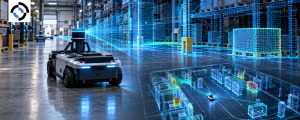
Warehouse robot training data programs consistently underperform their lab benchmarks in production. The reason is almost never the model architecture. It is almost always a

Surgical robot training data has requirements that no general-purpose robotics data program is built to meet out of the box. Sub-millimeter precision, HIPAA compliance, and

A robotics data quality assurance pipeline is not a checklist or a review meeting. At production scale, robotics data quality requires automated validation, per-operator metrics,

Robot data annotation is not image labeling with a different name. The temporal structure of robot trajectories, the grounding in physical task semantics, and the

Sim-to-real robot training with synthetic data is one of the most powerful techniques in embodied AI — and one of the most misunderstood. The gap

The embodied AI training data problem is structurally different from the language model data problem. Language models learned from the internet. Embodied AI must learn
Seven services. One synchronized pipeline.
In-person task demos for imitation learning.
RGB-D, LiDAR, force, and tactile streams.
Bounding boxes, segmentation, action labels.
Domain-randomized scenes and sim transfers.
Held-out test sets and success-rate scoring.
Rare scenarios your policy will face in production.