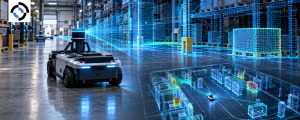

Warehouse Picking Robots: What Your Training Data Strategy Is Missing
Warehouse robots underperform in production not because of the model, but because training data missed the edge cases that matter.
Warehouse data covers the full pick-pack-place cycle across real SKU diversity — boxes, polybags, bottles, fragile items, and mixed-bin clutter. Each demonstration logs the grasp type, place pose, and success/failure outcome so your policy learns the right strategy per object category.
Why outsource warehouse data?
Your warehouse runs on uptime. We collect alongside operations or in dedicated staging areas without disrupting your fulfillment SLAs.
50+ SKU categories.
24/7 collection capability.
4 active warehouse customers.
Where we collect
41+ delivery centers across 12 countries. Every program runs from a Roborax hub near your target time zone.
Asia Pacific
India · Philippines
Americas
USA · Canada · Colombia · Jamaica · El Salvador · Belize
EMEA
UK · Albania · Kosovo · Morocco
Four streams covering the actual variation that breaks pick-and-place policies in production.
Trajectories across grasp, transit, and placement with success/failure labels.
Coverage across deformable, slippery, transparent, and oversized items.
Bagged, boxed, blister-packed, polybagged — the variation real fulfillment centers see.
Mis-picks, dropped items, jammed orientations — captured deliberately for retraining.
A pipeline designed for real fulfillment center conditions, not benchtop demos.
Operate in a partner facility or your own. Lighting, racking, and conveyor matched.
Operators trained on your SKU catalog with category-specific acceptance criteria.
Continuous capture during shift hours. Daily throughput report.
Targeted re-capture of failure modes flagged from your production policy.
Industrial arms plus the integrators that ship them into real warehouses.
Industrial arm
Industrial arm
Collaborative
Integrator
Integrator
AMR
Four verticals. One data partner.
Whole-body trajectories across 24 platforms.
Long-horizon tasks in real environments.
Procedure-grade demos on surgical platforms.
Bounding boxes, segmentation, action labels.
Rare scenarios your policy faces in production.
RGB-D, LiDAR, force, and tactile streams.
FAQ
We adhere to OSHA guidelines for warehouse safety, client-specific site protocols, and — where relevant — HIPAA for any healthcare logistics environments. All on-site operators are safety-briefed before entry.
We schedule capture sessions around your operational windows. For 24/7 facilities we run capture during low-traffic periods and can work overnight if needed.
We do not require WMS integration for data collection. For programs where task design needs to reflect real order profiles, we can accept anonymised task feeds from your WMS to generate realistic pick lists.
Piece-picking, case-picking, kitting, palletising, depalletising, and returns processing across a range of SKU types — from small consumer electronics to bulky goods.
From the blog
Warehouse Picking Robots: What Your Training Data Strategy Is MissingTraining data for deformable items, conveyor tasks, and edge cases.
Tell us the SKU mix and the throughput target. Four weeks to first production batch.
FROM THE FIELD

Warehouse robots underperform in production not because of the model, but because training data missed the edge cases that matter.

Sub-millimeter precision, HIPAA compliance, and credentialed operators — surgical robot data has requirements general robotics programs cannot meet.

Robotics data quality is not a review meeting. At production scale it is automated validation, per-operator metrics, and same-day feedback loops.

Robot annotation is not image labeling with a new name. Temporal structure and task semantics demand distinct tooling and annotator qualification.

Simulation offers unlimited training data at zero cost. The sim-to-real gap is a structural problem, not a rendering one.

Language models scaled on internet data. Embodied AI must build its data from the physical world — and that changes everything.