
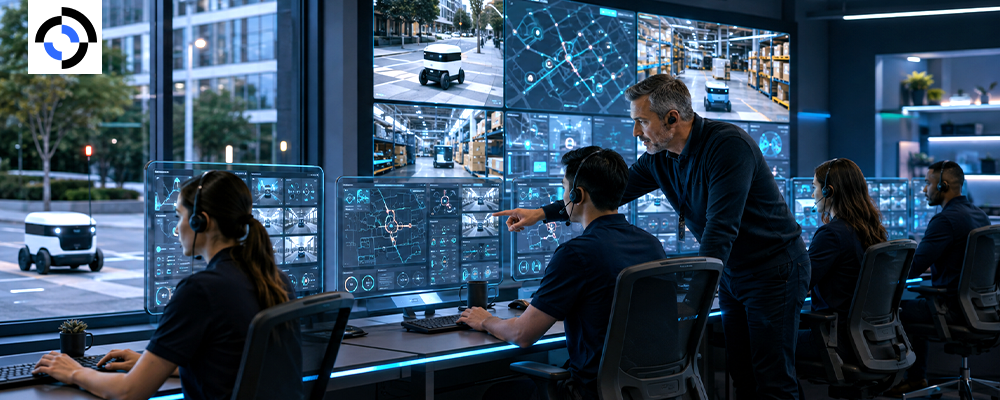
Remote robot operations lives or dies on the people doing it, and most teams hire for the wrong profile. Remote robot operator training starts with understanding what the role actually demands, which is closer to dispatch work than to driving or engineering.
This guide covers what genuinely predicts performance, how to test for it in selection, an onboarding curriculum that reflects the real work, realistic ramp times, and how to keep people effective in a role where the hard moments are rare by design.
The role is not what the job title suggests
“Robot operator” sounds technical, and people assume the hire is an engineer or a driver. In practice the work is closer to dispatch or air traffic control: long stretches of monitoring, punctuated by moments requiring a fast, correct, procedural response.
Hiring for the wrong mental model is the most expensive mistake in this function. Engineers get bored and leave. Drivers over-trust their instincts through a degraded video feed. The people who last are those comfortable with sustained attention and disciplined about following a runbook when improvising feels faster.
What actually predicts performance
| Attribute | Why it matters | Predictive strength |
|---|---|---|
| Procedural discipline | Follows escalation rules under pressure | Strongest single predictor |
| Situational awareness from partial data | Builds an accurate picture from limited feeds | Strong |
| Sustained vigilance | Stays effective through quiet periods | Strong |
| Calm communication | Handles anxious passengers and the public | Strong for customer-facing fleets |
| Spatial reasoning | Judges clearances and geometry remotely | Moderate |
| Technical background | Understands why the robot stopped | Helpful, frequently overrated |
| Driving experience | Vehicle intuition | Weak; sometimes counterproductive |
The last row is worth dwelling on. Confident driving instincts applied through a delayed, narrow video feed produce exactly the over-correction that causes remote-control incidents. The instinct is calibrated for information the operator does not have.
Selection that tests the real thing
- A monitoring task with a rare event. Forty minutes of low activity with one thing that requires action. This tests vigilance, which an interview cannot.
- A degraded-feed scenario. Poor video, high latency, incomplete telemetry. Watch whether they slow down or push on.
- A runbook adherence test. Give a situation where the procedure is slower than an obvious shortcut, and see which they take.
- Concurrent events. Three situations at once. You are testing prioritisation, not throughput.
- A communication exercise with an anxious or hostile counterpart, for fleets with public or passenger contact.
Score these on process as well as outcome. An operator who reached the right answer by ignoring procedure is a future incident, and this is the same principle behind our operator quality framework.
An onboarding curriculum that reflects the work
- How the autonomy behaves. Why the robot stops, what it can and cannot perceive, and what its requests mean. An operator who does not understand the system will misread its questions.
- The severity model and the clocks. Learned before tooling, because this is the framework everything else hangs on.
- Runbook drills on recorded incidents. Replay real events from your own logs rather than invented scenarios. Your intervention history is your training corpus, per the intervention loop.
- Degraded-condition practice. Bad link, partial video, stale telemetry. Train for the conditions that produce incidents, not the ones that do not.
- Load drills. Multiple concurrent events, so the first time procedure is tested under pressure is not in production.
- Logging discipline. Root cause vocabulary and resolution classification, practised until it is automatic, because it happens at the moment attention is lowest.
- Supervised live work with a mentor reviewing every event before independent operation.
Ramp to independent operation on supervision duties is typically measured in days rather than weeks, which is one of the reasons this function scales geographically more easily than data collection does. Authorisation for bounded remote control should take considerably longer and be a separate gate.
Skill decay is the quiet problem
In a well-functioning fleet, serious incidents are rare. That is the goal, and it creates a training problem: operators may go months without handling a genuinely difficult event, and their ability to handle one decays.
- Recurrent drills on a schedule, using recent real incidents from across the fleet, not just ones an individual saw.
- Rotate exposure. Operators who only ever work quiet zones never build the pattern library.
- Assess periodically, not just at onboarding. Track scores over time so decay is visible before it matters.
- Debrief real events as a group. One operator’s difficult night becomes everyone’s training material.
- Watch for automation complacency. As autonomy improves, vigilance falls, which is precisely when the rare event arrives.
Credentialed and regulated environments raise the bar further. Our surgical robot case study reports a 67 percent reduction in tissue contact errors in a setting where operator credentialing and recurrent assessment were requirements rather than good practice.
Retention, and why it is a data problem
Operator turnover is not only a staffing cost. Every departure takes accumulated situational knowledge with it, and consistency across operators is what makes intervention data comparable over time.
What helps, in rough order of impact: rotation between monitoring and lower-intensity work within a shift; a visible progression path into senior tiers and quality roles; measuring people on resolution quality and escalation accuracy rather than on raw event counts; and honest shift patterns, since sustained night monitoring degrades both wellbeing and performance. Distributing coverage across delivery locations so most operators work daytime hours addresses that last point directly.
The measurement point matters. Scoring operators on how few interventions they make encourages them to wait longer before acting, which improves the metric and worsens the service, as covered in intervention rate.
Frequently asked questions
How long does it take to train a remote operator?
For monitoring and assistance duties, days rather than weeks, assuming the runbook and severity model are already clear. Authorisation for bounded remote control should be a separate, later gate with its own assessment.
Should operators come from a driving background?
Not preferentially. Dispatch, air traffic control, security monitoring, and contact-centre escalation backgrounds map onto the work better. Driving instincts calibrated for direct feedback can mislead through a delayed feed.
Can the same people do data collection and remote operations?
Some can, and the skill profiles differ enough that most specialise. Teleoperation for collection rewards smooth consistent motion; remote operations rewards judgement and procedural discipline under pressure.
How do we keep skills sharp when incidents are rare?
Recurrent drills built from real recorded incidents across the whole fleet, periodic reassessment, and group debriefs. Rarity is the goal and the training problem at the same time.
The tooling gets most of the attention and the people determine the outcome. If you want a selection and training model built for your fleet and its risk profile, tell us how your fleet is instrumented, or read more about our remote operations work.