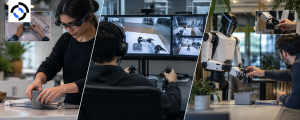
Choosing between VR teleoperation and physical demonstration for robot training data is one of the first decisions every robotics team faces. Both work. They do not work equally for every task.
Two approaches to VR teleoperation and robot training by example
Imitation learning requires demonstrations. The question every robotics team faces early is how to collect them: through a VR-based teleoperation interface where a remote operator controls the robot, or through physical kinesthetic demonstration where a person guides the robot arm directly by hand.
Both approaches produce training data. They do not produce equivalent training data. Understanding the differences — and when each is appropriate — can save months of retraining cycles.
What VR teleoperation does well
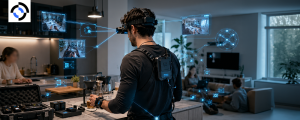
VR teleoperation scales. Once your teleoperation stack is built and your operator pool is trained, you can run dozens of simultaneous sessions across multiple robots without requiring physical access to the hardware. For teams targeting high demonstration volume — tens of thousands of episodes per week — VR teleop is the only practical path.
VR teleop also captures consistent action representations. The robot’s joint states are controlled through a defined interface, which means the action space is predictable and clean. Filtering and augmentation pipelines are easier to build when the data format is uniform.
Remote operators can be recruited, screened, and calibrated at scale. A specialist operator pool for precision manipulation tasks can be maintained globally rather than requiring on-site headcount.
What physical demonstration does well
Physical kinesthetic demonstration captures something VR teleoperation fundamentally cannot: direct force and contact information. When a human physically guides a robot arm through a task, the contact dynamics — the compliance, the reaction to unexpected resistance, the subtle adjustments when the object moves unexpectedly — are embedded in the trajectory in a way that VR teleoperation, filtered through control latency and haptic abstraction, cannot replicate.
For tasks where contact matters — inserting a connector, picking a deformable object, transferring a fragile item between hands — physical demonstrations tend to produce policies that generalize better to real contact conditions. The demonstrator is operating with the same physics the deployed robot will face.
Physical demonstration also avoids the sim-to-teleop gap. VR interfaces impose an abstraction layer between the human’s intent and the robot’s action. For tasks requiring fine motor precision at the millimeter scale, that abstraction layer introduces noise that can be difficult to filter.
The practical trade-offs
Scale: VR teleop wins. Physical demonstration requires a trained demonstrator physically present at the robot. VR teleop can be done anywhere with the right hardware setup.
Contact quality: Physical demonstration wins. Force and contact information is richer and more natural.
Latency artifacts: Physical demonstration wins. VR teleop introduces control latency that creates artifacts in time-sensitive manipulation tasks.
Task coverage: VR teleop wins. You can demonstrate tasks on robots located in multiple facilities from a single operator location.
Operator fatigue: Physical demonstration is more fatiguing per session but involves richer sensory feedback, which often produces higher per-demonstration quality. VR teleop operators can run more sessions per day but quality degrades without structured breaks.
Cost per demonstration: VR teleop is lower cost at scale. Physical demonstration has higher per-demonstration cost due to physical access requirements.
When to combine both
The most effective data strategies often use both. A common pattern: collect an initial seed dataset via physical demonstration — 50 to 200 high-quality episodes that capture the full contact dynamics of the target task. Train a baseline policy. Then scale collection via VR teleop, using the physical demonstration baseline as the quality reference for automated filtering.
Physical demonstrations set the quality ceiling. VR teleop provides the volume to approach it.
Task-type decision guide
Use physical demonstration when: the task involves fine contact (assembly, insertion, deformable object handling), the end-effector trajectory requires sub-millimeter precision, or you are in early-stage exploration where you need to understand the task dynamics before designing a teleop interface.
Use VR teleoperation when: you need more than 1,000 demonstrations, the task can be reliably executed through a VR interface without critical contact loss, or your team does not have consistent physical access to the robot hardware.
The choice is not ideological — it is a function of your task type, your scale requirements, and where you are in your development cycle.
The choice between VR teleop and physical demonstration is a function of your task type, scale requirements, and development stage — not ideology. If you’re scoping a collection program and not sure which method fits, see how we staff dedicated teleop teams or tell us the task and we’ll recommend one.