
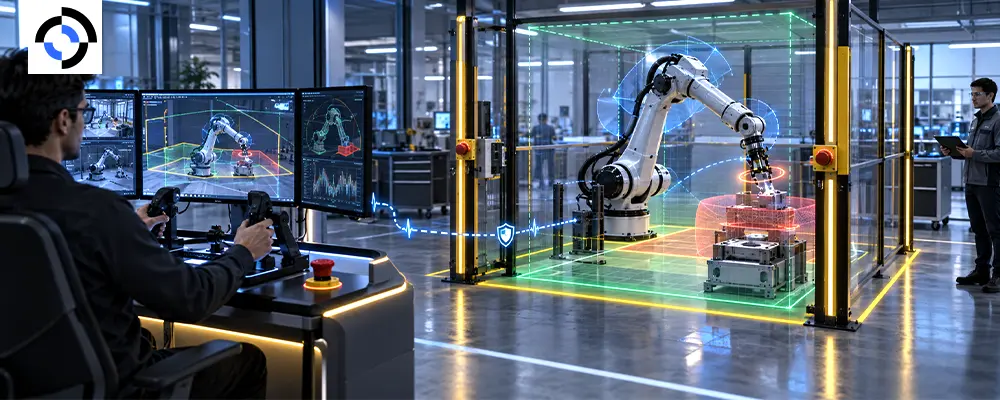
A teleoperation session that injures a person, snaps a gripper or drives an arm into a fixture fails twice. It fails on safety, and it fails on data, because an interrupted or corrupted episode is rarely usable. Teleoperation safety is not overhead on a data program. It is a precondition for data quality.
This guide sets out the safety layers that protect people, hardware and datasets during robot data collection: joint limits, collision checks and e-stop protocols, and how to log them so safety events become signal rather than noise.
Why teleoperation safety is a distinct problem
Autonomous robots run software that engineers have reviewed. Teleoperated robots run on live human commands, delivered across a network, from someone who may be tired, distracted or unable to feel the room. Every one of those factors raises the odds of an unsafe command, and the person closest to the robot is often a technician rather than the operator.
A layered model: four lines of defense
No single control is enough. Safe robot demonstrations come from independent layers, so that a failure in one is caught by the next.
| Layer | Examples | Catches |
| Command | Joint limits, velocity and acceleration caps, workspace boundaries | Out-of-range or abrupt operator input |
| Perception | Collision checks, self-collision, force and torque thresholds | Contact the operator did not intend or cannot see |
| Supervisory | Watchdogs, heartbeat and link-loss behavior, mode management | Network drops, frozen interfaces, stale commands |
| Hardware | E-stops, protective stops, enabling devices | Everything else, regardless of software state |
Joint limits: constrain before you command
Hard limits are the mechanical edge. Soft limits sit inside them and keep operators away from singularities, cable strain and awkward configurations. Add velocity, acceleration and jerk caps so a sudden leader movement cannot become a sudden follower movement. One data detail matters here: when the system clamps a command, the executed action differs from the operator’s intent. Log both, or your action labels quietly become wrong.
Collision checks and collision avoidance in teleop
Collision avoidance teleop checks proposed motions against a model of the robot and its surroundings before executing them, and force-torque thresholds act as the last software line when the model is wrong. Some systems add shared autonomy that nudges commands away from obstacles. That helps safety but changes what the demonstration means, so record whether assistance was active and what it altered.
E-stop protocols that work in practice
An emergency stop must be a hardware function within reach of both the operator and a floor technician, and it must never depend on the teleoperation software being healthy. Test it at the start of every shift, not once at commissioning.
International standards set the benchmark. A SICK engineer explained that the revised ISO 10218-1:2025 now defines a performance level for each safety function, such as “emergency stop, safe speed monitoring or safe position limitation.” Industry bodies describe the 2025 revisions as making functional safety requirements “more explicit rather than implied.” The update also adds a normal-stop function, intended to reduce routine misuse of the e-stop, which matters on collection floors where the red button gets pressed for convenience.
ISO 10218 targets industrial robots, so research rigs and humanoids may sit outside its formal scope. It remains the most useful reference for structuring your own risk assessment.
Make safety events part of the dataset
Stops are information. Tag every episode with its stop type, trigger and recovery, and keep the aborted episode rather than deleting it. A labeled near-miss is a failure example, and it feeds the same intervention data loop that helps teams train recovery behavior. Silent deletion throws away the cases your robot most needs to learn from.
Pre-session safety checklist
- Test every e-stop and confirm the robot halts safely.
- Verify the correct joint limits and workspace boundaries are loaded.
- Clear and mark the robot’s reach envelope.
- Confirm link-loss behavior against your latency budget.
- Brief the operator and floor staff on stop signals and who may reset.
How Roborax builds safety into collection
At Roborax, safety checks are part of the teleoperation workflow rather than a separate sign-off. Operators are trained on stop procedures through our operator training approach, sessions begin with a standard checklist, and aborted episodes are tagged and reviewed through our QA pipeline. For work on industrial platforms, we align with the customer’s own site safety requirements.
Frequently asked questions
Q: Do joint limits reduce data quality?
A: Well-tuned soft limits improve it by keeping operators in the robot’s reliable workspace. Log clamped commands so labels stay accurate.
Q: Who should have e-stop access?
A: The operator and an on-floor technician, with a clear rule for who may reset. Remote-only e-stops are not enough.
Q: Does collision avoidance bias demonstrations?
A: It can, because the robot executes something other than the operator’s command. Log the assistance state and both commands.
Q: Is ISO 10218 mandatory for research robots?
A: Not always. Scope depends on the robot and the jurisdiction. Use it as a framework and run your own risk assessment.
Safe data is usable data. If you are scaling teleoperation and want safety built into the workflow from day one, tell us what you are training and Roborax will scope the collection plan with you.
Related reading
- Teleoperation data collection
- Teleoperation latency budgets
- Hiring and training remote robot operators
- From intervention to training data
- Autonomy handover design
- Industrial teleoperation data
- Operator fatigue and robot data quality
- Robotics data QA pipeline