Most remote operations tooling is built for what a human does once they have control. Far less attention goes to the seconds either side of that: the transfer of authority itself. Autonomy handover design is where a surprising share of incidents originate.
This guide covers what actually has to transfer besides control, why handing authority back is riskier than taking it, how to bound what an operator may do, and how to log handovers so they become evidence rather than mystery.
The moment nobody designs
Enormous effort goes into the autonomy stack and into the remote operations tooling. The join between them, the instant when authority moves from software to a person and back again, is usually the least designed part of the system and the place where incidents concentrate.
The reason is that both sides assume the other has it covered. The autonomy team assumes a human will understand the situation. The operations team assumes the robot will be in a sensible state. Neither assumption survives contact with a robot that has stopped because it is confused.
What has to transfer, not just control
Handing over control is trivial. Handing over understanding is the hard part, and it is what determines how long resolution takes.
| What transfers | Why it matters |
|---|---|
| What the robot was trying to do | Intent, without which the scene is ambiguous |
| Why it stopped | The robot’s own reason, in plain terms |
| What it believes it sees | Perception state, including what it is uncertain about |
| What it has already tried | Prevents the operator repeating a failed approach |
| The seconds before the stop | Causes precede symptoms |
| Current authority and limits | What the operator is permitted to do right now |
| Link quality | Whether the operator can trust what they are seeing |
Most stacks give the operator a live video feed and little else, so the first thirty to ninety seconds of every intervention is spent reconstructing context. Across a fleet, that reconstruction time frequently exceeds the decision time by a wide margin, which makes it the cheapest thing to optimise, as noted in intervention rate.
Handing control back is the riskier direction
Taking control is a deliberate act. Returning it often is not, and the return is where things go wrong.
- State mismatch. The robot resumes with a world model built before the intervention, which is now stale.
- Silent resumption. Autonomy re-engages without the operator clearly registering that it has, so nobody is really supervising.
- Mid-manoeuvre return. Control reverts partway through a motion the policy did not plan and cannot complete.
- Immediate re-request. The robot hits the same situation and stops again, producing a loop that looks like several incidents and is one.
The fix is to treat return as an explicit transaction: the robot confirms it has a current, valid plan, the operator confirms release, and the system logs both. Automatic reversion on a timer is convenient and is exactly how mid-manoeuvre handbacks happen.
Bound what the operator may do
An operator granted unlimited authority over a moving robot is relying entirely on their own judgement through a degraded feed. Bounding authority is not distrust; it is compensating for information they do not have.
- Speed caps well below autonomous operating speed, because the operator lacks the perception the policy has.
- Steering and motion limits, so a single over-correction cannot produce a large movement.
- Duration limits, after which control reverts or must be re-authorised. Long remote-control sessions are a signal that a field dispatch was the right call.
- Geofenced authority. What is permitted in a loading bay differs from what is permitted on a live carriageway.
- Preserved safety layers. Collision avoidance and emergency stop remain active during remote control instead of disabling them to let the operator work.
- Tiered authorisation. Bounded recovery available to tier one; anything wider requires a senior operator, per incident triage.
That fifth point is the one most often compromised. Disabling safety systems so the operator can move the robot past an obstacle removes the last defence at precisely the moment human judgement is least reliable. If the safety layer is blocking necessary recovery, the layer needs redesigning, not switching off.
Fail-safe in both directions
Two link-loss cases matter, and they are not symmetric.
Loss during autonomy is straightforward: the robot continues or stops safely under its own policy, which is what it was built to do.
Loss during remote control is the dangerous one. The robot is executing human commands and its driver has vanished mid-motion. It must reach a safe state on its own, immediately, and never continue on the last received command. Any design where a dropped link leaves the robot in motion under stale instructions is a design fault rather than a network problem.
Latency visibility belongs here too. An operator who cannot see the delay will act as though there is none, which is the failure pattern described in teleoperation latency budgets.
Log the handover as its own event
Teams usually record handovers, if at all, as a timestamp within a larger incident. Logged properly they are one of the most diagnostic records you hold.
- Trigger: robot-requested, operator-initiated, or rule-fired
- Autonomy state at handover: intent, perception, and uncertainty at that instant
- Time to acknowledge and time to first operator action, tracked separately
- Authority level granted, and whether it was escalated during the event
- Operator actions, in the same convention as your other action data, per trajectory formats
- Return conditions: what the robot confirmed before resuming
- Re-request within a short window, which identifies loops rather than repeat failures
These fields are what let a handover become training signal rather than an operational footnote, which is the argument in from intervention to training data.
What we run
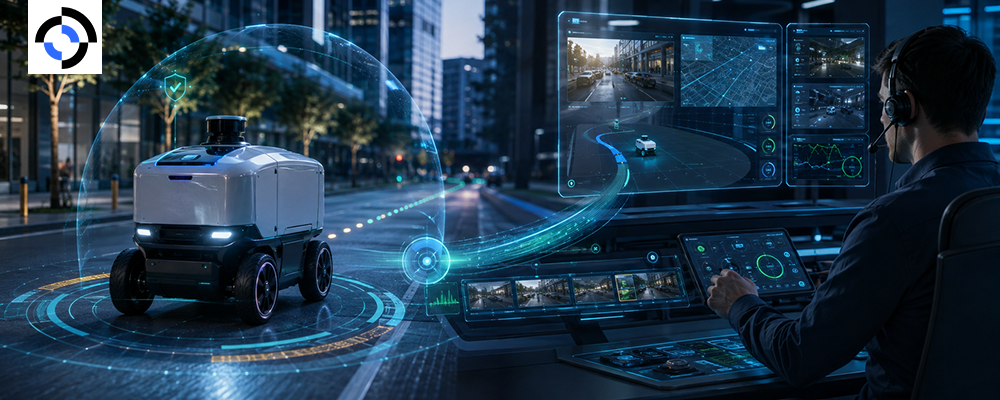
We provide remote monitoring and intervention for an autonomous mobility company operating sidewalk delivery robots and self-driving passenger vehicles. Two handover practices do most of the work: buffering sensor data from well before the trigger, so operators inherit context rather than reconstructing it, and treating the return of control as an explicit confirmed transaction rather than a timer expiring.
For a programme that reached production quickly under live operating constraints, our mobile manipulation case study covers a 90-day path from cold-start to production.
Frequently asked questions
Should the robot or the operator initiate handover?
The robot, wherever possible. A robot that requests help understands why it is stuck and explains its reasoning. Operator-initiated handovers start from an outside observation and take longer to resolve.
How long should a remote control session last?
Short, with an explicit limit. Long sessions usually mean the situation needed a field dispatch rather than more remote effort, and the duration cap is what surfaces that.
Can safety systems be disabled during remote control?
They should not be. Human judgement through a delayed feed is exactly when those layers matter most. If a safety layer prevents legitimate recovery, redesign the layer rather than adding an override.
What happens if the operator and the robot disagree?
Define it in advance rather than at the moment. In most designs, the robot retains veto authority over motion that violates its safety constraints and logs the disagreement as a signal that the policy or constraint needs review.
Handover is a few seconds of system behaviour that determines how a large share of your incidents end. If you want yours reviewed before it is load-bearing, tell us how your fleet is instrumented, or read more about our remote operations work.