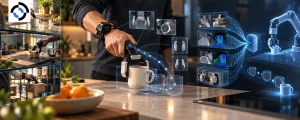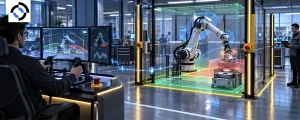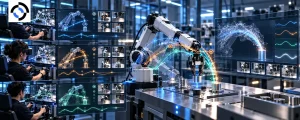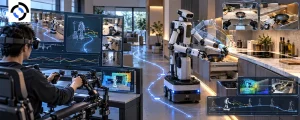
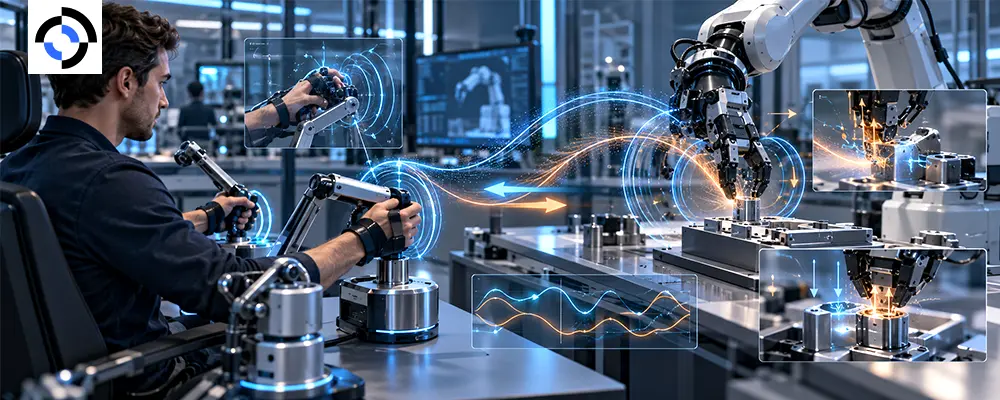
When collecting robot demonstrations, teams often focus on what operators see and how precisely they control the robot. But in contact-rich tasks, another factor can significantly influence data quality: what operators feel. Haptic teleoperation uses force feedback to help operators perceive contact, resistance, pressure, and changes in grip while controlling a robot remotely. This additional sensory information can make delicate manipulation, insertion, and assembly tasks more controlled and consistent.
For robotics teams developing imitation learning and Physical AI models, the key question is whether force feedback produces better robot training data—and whether the improvement justifies the added hardware, integration, and control complexity. In this guide, we explore how haptic feedback influences demonstration quality, where it delivers the greatest value, and how to evaluate its impact on your robotic training data before investing in a dedicated teleoperation setup.
Ask a robotics team how they collect demonstrations and they will describe what the operator sees. Far fewer will describe what the operator feels. That gap matters. Haptic teleoperation returns contact forces to the person driving the robot, and it changes how they grip, push, insert and release.
The real question for any data program is whether those changes produce better robot demonstration quality or just a more expensive rig. This guide covers what force feedback changes, what the evidence says, and how to decide for your own task mix.
Roborax Teleoperation Services for High-Quality Robot Training Data
Collecting reliable robot demonstrations requires more than a capable teleoperation interface. Robotics teams need consistent operator inputs, synchronized sensor recordings, and task-specific demonstrations that reflect real-world contact, movement, and manipulation challenges. Roborax provides robot teleoperation data collection services to help AI and robotics teams build high-quality training datasets for manipulation, assembly, object handling, and other complex robotic tasks. By aligning data collection workflows with model training objectives, our approach helps capture meaningful demonstrations that support robot learning and policy development.
For contact-rich applications, incorporating force-torque measurements alongside robot commands and state information can provide additional context about how a robot interacts with its environment. Whether your project requires dexterous manipulation, precision insertion, or human-guided demonstrations, Roborax can help structure teleoperation workflows around your technical requirements, data quality standards, and target tasks. Explore our robot teleoperation services to learn how purpose-built demonstration data can support the development of more capable and reliable robotic systems.
What haptic teleoperation changes in a demonstration
Most teleoperation interfaces are one-way. The operator moves a controller, the robot follows, and video is the only sensory return. Bilateral teleoperation closes the loop: forces measured at the follower are reflected to the leader device, so the operator feels resistance, contact and slip. Force feedback teleop is really a spectrum, from full force reflection through a leader arm to simple vibrotactile cues on a handheld controller.
The effect on data is direct. Without feel, operators compensate with vision and caution. They over-grip, hesitate before contact, or push until something visibly gives. Each compensation is recorded as the correct action, and imitation learning reproduces it faithfully. Our guide to force-torque sensor data covers capturing the signal; this post covers whether to return it to the operator.
What the evidence says
Published results are encouraging but early. The Cornell-led FACTR team built a low-cost bilateral leader-follower system with force feedback and reported a 64.7% improvement in task completion rate and an 83.3% gain in ease of use in a user study. Their premise is that “Humans rely heavily on this force feedback” in contact-rich work, which standard teleoperation withholds. A separate wrench-control study reached a similar view, crediting force-feedback teleoperation for “capturing the operator’s deliberate force regulation.”
Treat the numbers as directional. Most haptic studies use small task sets and few operators, and several authors say so themselves. What generalizes is the mechanism: operators with force feedback regulate contact deliberately, so the dataset records intent rather than guesswork.
Where force feedback improves demonstration quality
Gains concentrate where contact carries the task:
- Insertion and assembly. Operators feel the rim of a connector and stop forcing it.
- Fragile and deformable objects. Grip force becomes deliberate rather than defensive.
- Wiping and surface contact. Consistent pressure is nearly impossible to judge from video.
- Tool use. Contact through a tool is almost invisible on camera.
In these cases demonstrations tend to show lower peak forces, fewer retries and smoother contact transitions, which is exactly what a behavior cloning policy needs to copy.
Where it does not pay for itself
Free-space pick-and-place and vision-dominated tasks gain little. The robot also needs a force or torque signal to reflect, so a platform without sensing has nothing to render. Haptic loops are latency-sensitive too: delay can make reflected force feel wrong or destabilize the control loop, so set your latency budget before buying hardware. A noisy or late cue is worse than none, because operators learn to ignore it.
Choosing among teleoperation interfaces
| Interface | What the operator feels | Relative cost | Best fit |
| Unilateral (VR controllers, 3D mouse) | Video only | Low | Free-space tasks, breadth |
| Vibrotactile handheld | Coarse contact intensity | Low to medium | Contact detection, light-touch tasks |
| Bilateral leader-follower | Reflected forces at the leader | Medium to high | Insertion, fragile and deformable objects |
For rig trade-offs, see our comparison of GELLO vs ALOHA.
How Roborax decides
At Roborax, we treat interface choice as a data-quality decision, not a hardware preference. Our dedicated teleoperation teams follow four steps before committing a program to a rig:
- Audit the contact content of the task list.
- Pilot with and without feedback, using the same operators.
- Compare peak force, retry rate, completion time and, where possible, downstream policy success.
- Log force alongside commands so the signal stays usable whichever interface wins.
Every episode then passes through our robotics data QA pipeline, so contact quality is measured, not assumed.
The bottom line
Force feedback does not make operators better. It makes their intent visible in the data. For contact-rich work, that is often the difference between a policy that forces a connector and one that feels its way in. For free-space tasks, a simpler rig and a stronger QA process will usually beat a more expensive one. Decide with a pilot, not a preference.
Frequently asked questions
Q: Does force feedback always improve imitation learning data?
A: No. It helps most on contact-rich tasks and adds little to free-space motion. Pilot on your own tasks before standardizing on hardware.
Q: Is vibrotactile feedback enough?
A: For contact detection, often yes. It conveys intensity but not direction or stiffness, so insertion tasks still benefit from true bilateral force reflection.
Q: Does haptic teleoperation slow operators down?
A: Briefly. Expect a short ramp-up, then fewer retries. Measure episode time after the learning curve, not on day one.
Q: What should we log?
A: Commanded and measured forces, joint state, gripper state, timestamps and the feedback mode used, so datasets from different interfaces can be pooled later.
Not sure whether your task mix justifies bilateral hardware? Tell us what you are training and Roborax’s teleoperation team will size the interface and operator plan against it.
Related reading
- Teleoperation data collection
- Force-torque sensor data in teleoperation
- GELLO vs ALOHA: choosing a teleoperation rig
- Teleoperation latency budgets
- Operator fatigue and robot data quality
- Dexterous manipulation data collection
- Behavior cloning training data