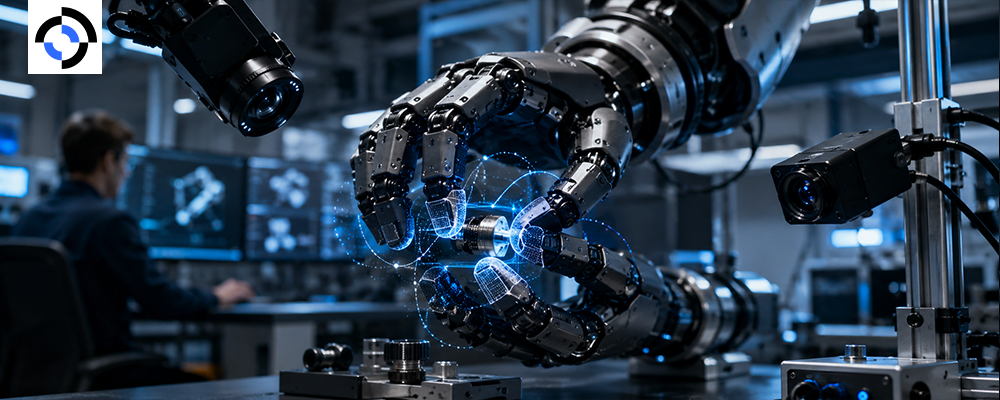
Most robot manipulation data is collected with a two-finger gripper on rigid objects. That covers a useful fraction of real tasks and misses everything requiring an object to move within the hand. Dexterous manipulation data collection is a different discipline with different sensors, different failure modes, and a much higher cost per episode.
This guide covers what actually makes a task dexterous, the six signals you have to record, why retargeting human hands works less well than it sounds, and three collection approaches that do work.
What makes a task dexterous
Dexterity is not the same as precision. A robot placing a component to within a fraction of a millimetre is precise. A robot that opens a jar, turns a key, or separates a single sheet from a stack is dexterous.
The distinguishing property is in-hand control: the object moves relative to the fingers during the task, and the fingers apply different forces in different directions at the same time. A two-finger parallel gripper cannot do this at all. It can hold or release, and nothing in between.
This matters for data because the capture requirements scale with the number of independently controlled contact points, not with the difficulty of the task as a human perceives it.
What you have to record
| Signal | Why it is needed | Consequence if missing |
|---|---|---|
| Per-finger joint angles | The action label itself | No in-hand behavior can be learned at all |
| Fingertip contact state | Which fingers are touching, when | Grasp phase boundaries become guesswork |
| Contact forces per digit | How hard each finger presses | Cannot distinguish stable grip from crushing |
| Object pose relative to hand | Whether the object is moving in-hand | Regrasping and reorientation are invisible |
| Wrist wrench | Total force and torque at the tool | External constraints are undetectable |
| Close-range wrist video | Visual context for contact | Occlusion loses the critical moment |
Notice how much of this is force rather than vision. Dexterous manipulation is a contact problem wearing a vision problem’s clothes, which is why force-torque instrumentation is non-negotiable here rather than a nice-to-have.
The retargeting problem, in detail
The obvious way to collect dexterous data is to record a human hand and map it onto a robot hand. This works far less well than it sounds, for three separate reasons.
Kinematic mismatch
Human hands have far more degrees of freedom than most robot hands, distributed differently. Mapping is lossy and the loss is not uniform: it concentrates in exactly the fine motions that make a task dexterous.
Contact mismatch
Human skin is compliant, high-friction, and rich in tactile feedback. Rigid robot fingertips slip where a human hand grips. A retargeted pose can be geometrically correct and physically unstable.
Strategy mismatch
This is the deepest problem. Humans use strategies that depend on having human hands, such as bracing an object against the palm while repositioning two fingers. There is no retargeting of a strategy the hardware cannot execute; there is only a failed imitation of it.
The practical implication is that human hand capture is excellent for learning what the task looks like and unreliable for learning how the robot should do it. The distinction runs through our comparison of human demonstration and teleoperation data.
Three viable collection approaches
- Teleoperate the actual hand. Slowest and most reliable. Action labels are exact and every recorded motion is executable by definition. Glove or headset-based hand tracking drives the robot hand directly.
- Human capture plus physical validation. Record humans at high throughput, retarget, then verify on hardware which trajectories are actually reproducible and discard the rest. Cheaper than full teleoperation, more honest than raw retargeting.
- Simulation with real contact calibration. Generate volume in simulation, using real force traces to calibrate contact models. Contact is where simulators diverge most, so the calibration data is what makes this credible. See sim-to-real transfer.
Most programs blend all three, weighted by how much in-hand manipulation the task actually requires.
What headset teleoperation does and does not solve
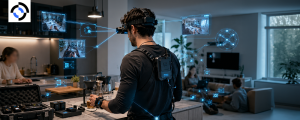
In our everyday household task capture for a humanoid robotics developer building general-purpose home and service robots, hand tracking through a headset drives the robot directly. That removes the strategy mismatch entirely, because the operator can only command motions the robot can perform.
It does not remove the feedback problem. The operator feels nothing. They cannot sense slip, they cannot feel when a grip is marginal, and they compensate by gripping harder than necessary. Every one of those over-grips is recorded as the correct action.
Three mitigations work in practice: instrument the robot hand with force sensing regardless of whether the operator can feel it, display grip force visually so the operator has some channel, and screen episodes on force profile rather than outcome alone. More on the wider programme in VR headset teleoperation for everyday tasks.
Fine contact control is where instrumentation pays back. Our surgical robot case study reports a 67 percent reduction in tissue contact errors.
Frequently asked questions
Do we need a multi-fingered hand to collect useful data?
Only if you intend to deploy one. Data collected on a five-fingered hand does not transfer usefully to a parallel gripper, and vice versa. Collect on the embodiment you will ship.
Are tactile sensors worth the cost and fragility?
For genuine in-hand manipulation, yes. For pick-and-place with occasional regrasping, wrist-level force sensing usually suffices. The cost is as much in maintenance as in purchase, because fingertip sensors wear.
How much dexterous data is enough?
Considerably more per task than for parallel-gripper work, because the action space is larger and contact states multiply. Expect the object-instance dimension to dominate, since grip strategy varies by shape and material more than by task.
Can we start with a simple gripper and upgrade later?
You can, but the data does not carry over. Plan the transition as a fresh collection rather than a migration, and use the early phase to settle task definitions rather than to build a corpus.
Dexterous data is the most expensive category to collect and the least forgiving of shortcuts in instrumentation. If you are planning in-hand manipulation work and want the sensor and capture plan reviewed, tell us what you are building.