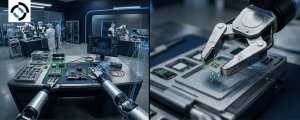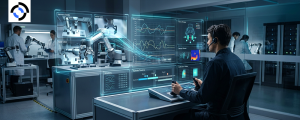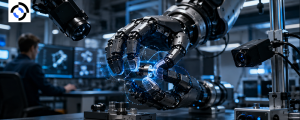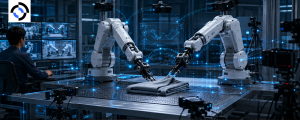
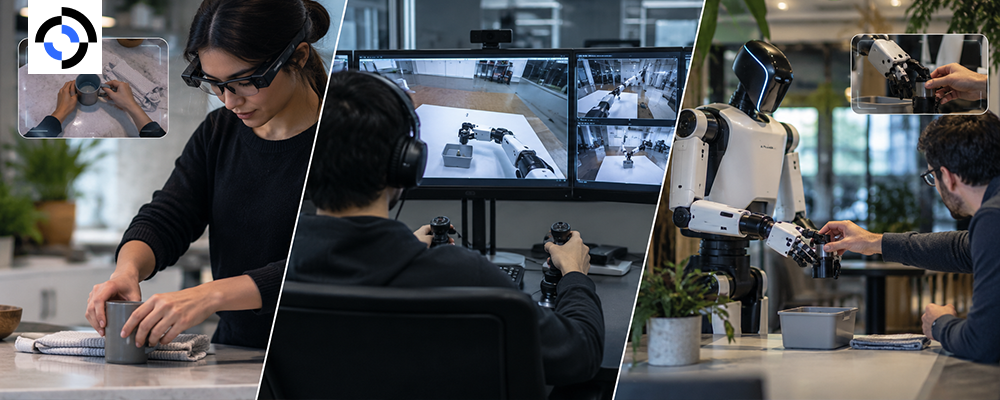
Two teams can both say they collect robot training data and mean completely different things. The human demonstration data vs teleoperation data distinction decides what your action labels mean, what they cost, and whether your robot can physically reproduce them.
This guide compares the two directly, sets out the specific trap in each, introduces a third category most teams never budget for, and shows how to combine all three without a schema migration later.
The core difference: who was holding the tool
In human demonstration, a person performs the task with their own hands while sensors record them. In teleoperation, a person drives the robot and the robot performs the task. The observable behavior looks similar. The data is fundamentally different.
The distinction that matters is the embodiment of the action label. Human demonstration gives you a record of what a human body did. Teleoperation gives you a record of what your robot did. Everything below follows from that.
Side by side
| Dimension | Human demonstration | Teleoperation |
|---|---|---|
| Who acts | The person | The robot |
| Action label | Human pose; needs retargeting | Robot commands; exact |
| Throughput | High; limited only by people | Low; limited by robot hardware |
| Cost per episode | Lower | Higher |
| Scene diversity | Easy; go anywhere | Hard; robot must be there |
| Dexterity ceiling | Full human dexterity | Limited by the gripper |
| Physical plausibility | May be impossible for the robot | Guaranteed achievable |
| Embodiment gap | Significant | None |
| Best used for | Pretraining, breadth, priors | Fine-tuning, deployment behavior |
The trap in human demonstration data
Human capture is cheaper and faster, so it is tempting to build a program entirely on it. The trap is physical plausibility.
A person folding a towel uses five fingers, wrist rotation beyond most robot joints, and both hands in continuous coordinated contact. A two-finger gripper cannot reproduce that motion, and no amount of retargeting invents a strategy the hardware can execute. The demonstration is real, correct, and unreachable.
The result is a policy trained toward a target it cannot hit, which usually shows up as confident motion that fails at contact. Retargeting fidelity is the whole ballgame here, and it is why dexterous manipulation capture is a specialist problem rather than a camera problem.
The trap in teleoperation data
Teleoperation has the opposite weakness. The action labels are exact, but they encode the operator’s compensations as well as their intent.
Operators working without force feedback over-grip. Operators working under latency lead their inputs. Operators who are fatigued move less smoothly. All of that is recorded as if it were the correct way to perform the task, and imitation learning faithfully reproduces it. Our posts on force-torque capture, latency budgets, and operator fatigue each cover one variant of this.
Teleoperation data is not automatically clean. It is automatically executable, which is a different guarantee.
The third category nobody plans for
There is a third kind of human-in-the-loop data, and most teams do not budget for it because it arrives from operations rather than from a data program.
Intervention data is generated when a robot running autonomously encounters something it cannot handle, a human steps in, resolves it, and autonomy resumes. We produce this continuously for an autonomous mobility company operating sidewalk delivery robots and self-driving passenger vehicles.
| Demonstration data | Intervention data | |
|---|---|---|
| Trigger | Scheduled collection | Autonomy failure in the field |
| Distribution | What you chose to collect | What actually breaks |
| Volume | Controllable | Whatever the fleet produces |
| Cost | A line item | Already being paid as operations |
| Value per episode | Moderate | Very high; these are the real edge cases |
The strategic point is that intervention data is the only source that samples the true failure distribution rather than your guess at it. Deliberate long-tail capture is an attempt to approximate what a deployed fleet gives you for free, if you instrument for it.
How to combine all three
- Human demonstration for breadth. Wide task coverage, many environments, many object instances. Accept the retargeting loss.
- Teleoperation for the target embodiment. Smaller volume, exact labels, on the hardware you deploy.
- Intervention data for the tail. Instrument your fleet so failures become a training input rather than a support ticket.
- Keep the schemas compatible. Three sources are only an advantage if they can be pooled. Fix the action convention and metadata early, per log design.
- Weight by training stage. Breadth early, embodiment-specific data late, tail data continuously.
Most teams run one source, discover its specific weakness after a few months, and then bolt on a second with an incompatible schema. Planning for all three at the outset costs almost nothing and saves a migration.
Our humanoid foundation model case study covers a programme built on a deliberate mix of these sources, reaching 3x sample efficiency.
Frequently asked questions
Which is cheaper per usable episode?
Human demonstration is cheaper to collect and more expensive to make usable, once retargeting and validation are counted. Teleoperation costs more up front and arrives closer to trainable. Compare total cost to a trained policy, not cost per hour.
Can retargeting close the embodiment gap completely?
No. It can map poses reasonably well and cannot invent a strategy the hardware supports when the human strategy depends on human anatomy. Grippers with fewer degrees of freedom lose the most.
Is teleoperation data always better?
For the robot you deploy, yes, on quality per episode. It is far more expensive per episode, so most programs cannot afford breadth from teleoperation alone. See VR teleoperation vs physical demonstration.
How do we start capturing intervention data?
Add structured fields to your remote operations tooling: trigger type, time to acknowledge, resolution type, root cause. Most fleets already log the event and discard the structure that would make it trainable.
Each source has a specific weakness and none of them is a general solution. If you are deciding how to split a data budget across the three, tell us what you are training and we will size the mix against it.