Most teams add touch after a policy fails at contact. By then, the demonstrations are already collected without it. Tactile sensor data collection is cheap to plan and expensive to retrofit, because the signal only helps if it arrives at the right rate, with the right timestamps and the right context.
Our earlier guide explained why tactile sensing data matters for dexterous robots. This one is the field manual: what to capture, how to log it, and where motion capture gloves and human demonstration datasets fit.
Capture decisions you cannot fix later
Five choices are locked in the moment collection starts:
| Decision | Why it matters | Question to settle first |
| Sensing modality | Pressure arrays, shear sensors and vision-based tactile sensors produce different data shapes | What must the robot feel: contact, slip or texture? |
| Sampling rate | Slip and contact onset happen fast; low rates blur them | What is the shortest event worth labelling? |
| Spatial layout | Placement decides which contacts are visible | Fingertip, palm or both? |
| Calibration baseline | Raw readings drift with wear, temperature and mounting | Is a zero-load baseline logged per episode? |
| Contact context | Readings mean little without object and grasp state | Which metadata travels with each episode? |
What to log at every timestep
A useful tactile episode carries more than the sensor array:
- Raw sensor values stored losslessly, plus any calibrated or derived channels
- A zero-load baseline and the sensor layout version
- Wrist force/torque, joint state and end-effector pose
- Hand pose for human demonstrations, plus RGB or RGB-D video
- Event labels: contact onset, slip, release, failure and recovery
- Operator, object and material identifiers
Log raw first and derived second. Filters change; raw data lets you rebuild them. Every channel should share one time base, as covered in our guide to multimodal sensor synchronization.
Where gloves fit in human demonstration datasets
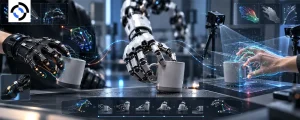
Gloves let people demonstrate dexterous tasks anywhere, at human speed. Motion capture gloves record finger joint angles for hand pose capture. Tactile gloves record pressure across the hand. MIT’s scalable tactile glove packed 548 sensors onto a knitted glove costing about US$10 and recorded 135,000 frames of full-hand pressure maps across 26 objects. As co-author Subramanian Sundaram put it, “Robots don’t have that rich feedback.”
| Source | What it records | Strength | Limit |
| Motion capture glove | Finger joint angles, hand pose | Fast, scalable dexterous demonstration | No contact information |
| Tactile glove | Pressure across the hand | Rich human grasp signatures | Embodiment gap to robot sensors |
| Robot-side tactile | Robot fingertip contact | Exact target embodiment | Slower and costlier |
The catch is embodiment. A human fingertip pressure map is not what your robot’s sensor will read, and a joint-angle stream says nothing about contact. The gap we describe in human demonstration vs teleoperation data applies to touch as well. Use gloves for breadth and priors, then collect robot-side tactile data on the hardware you deploy.
The trap: pressure maps with no events
The common failure is volume without structure: terabytes of pressure frames, no contact-onset labels, no failed grasps, and compression aggressive enough to erase the micro-slip you cared about. A pressure map that cannot be tied to an action at the right instant is just a picture. Record failures deliberately. Dropped objects, slips and recoveries are the examples a policy learns the most from.
A tactile logging checklist
- Define events first. Decide which contact events need labels before choosing sensors.
- Fix rates and a time base. Test alignment with a tap or a drop.
- Log a baseline. Capture a zero-load reading at the start of each episode.
- Store raw and calibrated channels. Include sensor ID and layout version.
- Record failures and recoveries alongside successes.
- Pair human and robot data. Use glove data for breadth and robot-side tactile data for the target embodiment.
How Roborax approaches it
Roborax runs tactile collection as part of a wider embodied-AI data pipeline. Our multimodal sensor capture service supports tactile arrays and force/torque sensing alongside RGB-D, IMU and audio, while our human demonstration and teleoperation programs supply the hand pose and robot-side signals that tactile data needs for context. Quality assurance catches missing frames, sensor drift and timestamp errors before a dataset ships.
Frequently asked questions
Q: Do I need tactile data if I already log force/torque?
A: Often, yes. A wrist force/torque sensor gives one net wrench. Tactile arrays show where contact occurs across a fingertip or palm.
Q: Are motion capture gloves enough for dexterous demonstration?
A: They capture hand pose, not touch. They suit breadth and priors, but contact-rich tasks need tactile channels as well.
Q: What sampling rate should I use?
A: Record at the sensor’s native rate and downsample later. Set the floor by the shortest contact event, such as slip onset, that you need to label.
Planning a dexterous data program? Share your sensor stack and task and we will scope a tactile capture plan with you.
Related reading
- Tactile Sensing Data for Dexterous Robots
- Dexterous Manipulation Data Collection
- Force-Torque Sensor Data in Teleoperation
- Hand-Object Interaction Data
- Human Demonstration Data vs Teleoperation Data
- Human demonstration data collection
- Multimodal Sensor Synchronization: Hardware Triggers, PTP and Timestamp Drift
External reference
- Learning the signatures of the human grasp using a scalable tactile glove (MIT CSAIL, Nature 2019)
- Sensor-packed glove learns signatures of the human grasp (MIT News)