
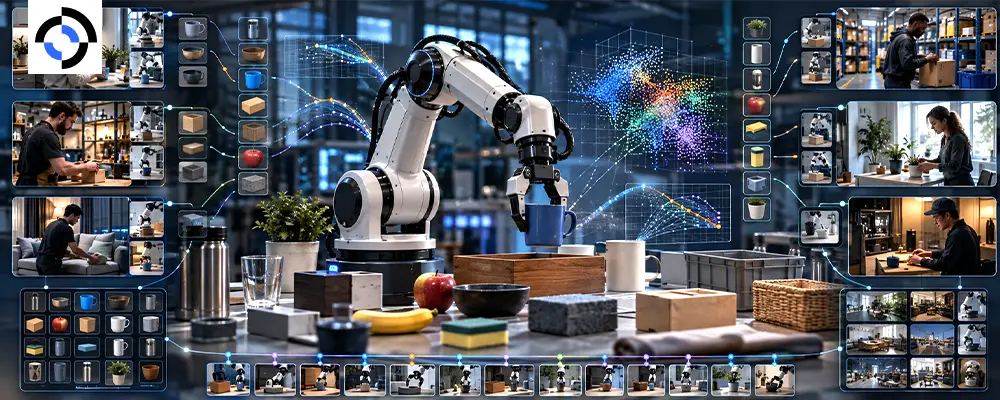
Ask how much data a robot skill needs and most teams answer with a single number: 500 demonstrations, 1,000, maybe 5,000. It is the wrong unit. Two datasets with the same demonstration count can produce wildly different policies, because one was collected by one operator in one lab with one mug, and the other across many hands, rooms and objects.
Demonstration diversity, not raw volume, separates a policy that works in the demo from one that works on Monday morning. This guide breaks down how many operators, scenes and object variations a skill needs, and how to budget for them.
What the evidence says
The clearest result comes from a large study of data scaling in imitation learning. Its authors found that generalization follows a roughly power-law relationship with the number of environments and objects, and that diversity is “far more important than the absolute number of demonstrations.” Once demonstrations per environment or object pass a threshold, extra ones have minimal effect. Using that insight, they report that four data collectors working for one afternoon gathered enough data for policies on two tasks to reach about 90% success in novel environments with unseen objects.
Handheld-gripper work points the same way. The UMI authors report that policies “zero-shot generalize to novel environments and objects” when trained on diverse human demonstrations.
These are results on specific tasks and policy classes, so treat them as a planning prior, not a law. The direction is robust, though: coverage beats repetition.
The four axes of demonstration diversity
| Axis | What varies | Why it matters | Illustrative starting point* |
| Operators | Hands, speed, style, handedness | Prevents single-operator habits from becoming policy behavior | 3–5 qualified operators per skill |
| Scenes | Rooms, lighting, backgrounds, clutter, layouts | The biggest driver of generalization to new places | 10–20+ distinct environments |
| Objects | Shape, size, texture, weight, material | Covers the category rather than one instance | 10–30 variants per object category |
| Conditions | Start poses, placement, distractors | Robustness to small perturbations | Randomized every episode |
*These are planning heuristics, not guarantees. Validate them with a pilot and a held-out evaluation.
Spend on breadth first, then depth
Because returns on extra demonstrations per scene fall off, budget in this order. Widen scenes and objects until held-out performance stops improving. Then add operators to cover style. Only then add repeats for hard cases. A useful test: if you cannot name the new variation an extra batch of demonstrations introduces, you are probably buying repetition.
Five common mistakes
- Counting demonstrations instead of coverage. Report scenes, objects and operators alongside episode counts.
- Diversity by accident. Uncontrolled variation gets lost, so tag every episode with scene, object and operator IDs.
- Single-site collection. One lab, however large, is one scene. Background and lighting leak into the policy.
- Ignoring the long tail. Transparent, reflective and deformable objects need deliberate capture.
- Evaluating on training scenes. Hold out scenes and objects, as described in our guide to embodied AI policy evaluation.
How to measure diversity
Treat diversity as a measurable property, not an impression. Track counts per axis, coverage of planned variation cells, and the spread of image or scene embeddings. Our guide to data diversity scoring walks through the metrics, and our post on domain randomization shows how synthetic variation can supplement real-world breadth, not replace it.
Real-world breadth at an affordable cost
Breadth is expensive when every scene needs a robot. Portable capture helps: handheld demonstration grippers and wearable cameras let contributors record in many real environments cheaply, while teleoperation covers skills that need a robot in the loop. Model the mix with our cost-per-trajectory guide.
How Roborax designs diversity into collection
Roborax plans diversity before the first episode. We turn your skill list into a coverage matrix of scenes, objects, operators and conditions, assign collection to the mix of dedicated teams and distributed contributors that fills it, and tag every episode against the matrix. Our robotics data QA pipeline then flags gaps and near-duplicates, so you see coverage, not just volume. On request, we build held-out evaluation sets from scenes and objects your training data never touched.
The bottom line
Do not ask how many demonstrations a skill needs. Ask how many different situations it must survive, and collect to cover them. Plan the coverage matrix first, spend on breadth before repeats, and verify on held-out scenes. That is how demonstration diversity turns into generalization.
Frequently asked questions
Q: Is it better to collect more demonstrations or more variety?
A: Variety first. Research on imitation learning scaling shows generalization tracks the number of environments and objects, with diminishing returns on repeats past a threshold.
Q: How many operators does a skill need?
A: Enough to avoid single-operator bias, typically a handful, each qualified and tagged. See our post on operator variability.
Q: Can synthetic data replace real scene diversity?
A: It can supplement it. Sim-to-real gaps remain, so keep a real-world core and test on held-out real scenes. Our post on sim-to-real limits explains why.
Q: How do we know when we have enough diversity?
A: When performance on held-out scenes and objects plateaus as you add new variations.
Ready to plan coverage for your next skill? Tell us what you are training and Roborax will build the coverage matrix and collection plan with you.
Related reading
- Data diversity scoring for robot datasets
- Domain randomization: how much synthetic variation is enough
- Robot training data cost per trajectory
- Evaluating embodied AI policies
- Crowdsourced vs in-house data collection for robotics
- Bespoke robotic manipulation datasets
- Imitation learning dataset structure
- Operator variability in teleoperated datasets
External reference
- Data Scaling Laws in Imitation Learning for Robotic Manipulation (arXiv)
- Data scaling laws project page
- Universal Manipulation Interface (RSS 2024)