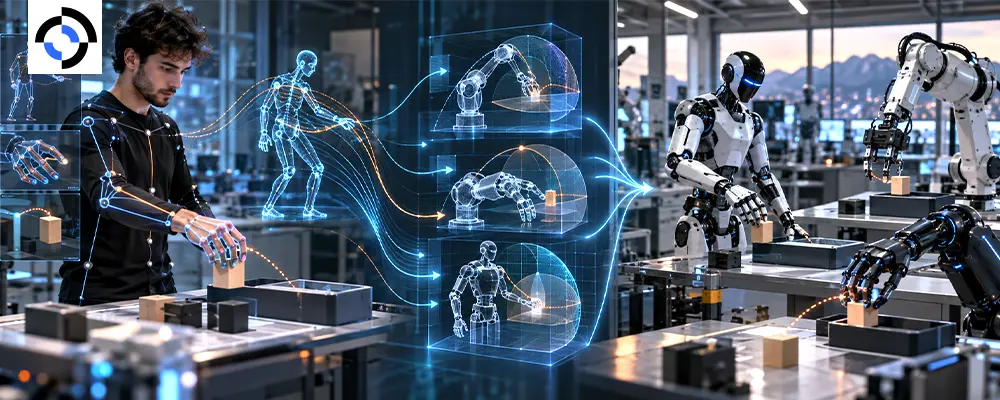
A human demonstration is the richest teacher a robot can have, and the hardest to use directly. Human arms have different link lengths than robot arms. Human hands have different degrees of freedom than robot grippers. A humanoid has joint limits, balance constraints and a mass distribution no person shares. The data is real; the body is wrong.
Motion retargeting in robotics is the step that bridges that gap. This guide explains how cross-embodiment transfer works, where retargeted trajectories go wrong, and how to build a conversion pipeline that produces robot-executable data you can trust.
What motion retargeting does
Retargeting is human-to-robot mapping: converting a recorded human motion into joint commands or end-effector trajectories that a specific robot can execute. Teams usually work at one of three levels, and the level you pick decides what can go wrong.
| Level | What is mapped | Typical use | Main risk |
| End-effector pose | Wrist or gripper pose in task space, solved with inverse kinematics | Arms and grippers; handheld and hand-tracking data | Singularities, reachability, elbow configuration |
| Fingertip or hand | Fingertip positions to robot hand joints | Dexterous hands | Different thumb workspace, self-collision |
| Whole-body | Full-body pose to humanoid joints | Humanoids | Balance, foot contact, self-penetration |
Why the embodiment gap bites
Researchers working on humanoid motion tracking call the embodiment gap “the first major hurdle” for making 3D human motion data useful for humanoid learning. The standard fix is kinematic retargeting, which can leave artifacts such as foot sliding, ground penetration and self-penetration in the reference trajectories. Their experiments found that these artifacts significantly reduce policy robustness, particularly for dynamic or long sequences.
A separate group working on kinodynamic retargeting argues that purely kinematic methods ignore system dynamics and can produce “dynamically infeasible transitions.” Geometry alone is not enough once balance and contact matter.
Five failure modes in trajectory conversion
- Scale mismatch. Human limbs mapped onto shorter or longer robot links shift reach and contact points.
- Joint-limit violations. Motions that are comfortable for a person exceed a robot’s range or velocity.
- Self- and environment collision. Retargeted poses pass through the robot’s own body or the table.
- Contact drift. Feet slide or grasps float because contact constraints were never enforced.
- Temporal artifacts. Frame-by-frame solving produces velocity spikes and jitter.
A practical retargeting pipeline
- Normalize the source. Fix coordinate frames, units and time bases across capture systems. Our guide to trajectory data formats shows what to standardize.
- Calibrate the body model. Estimate operator proportions and map them to the robot’s kinematic model.
- Solve with constraints. Use inverse kinematics with joint limits, collision avoidance and contact terms instead of copying joint angles.
- Smooth and rate-limit. Enforce velocity and acceleration bounds.
- Validate in simulation. Replay trajectories in a physics simulator or digital twin before they go anywhere near hardware.
- Replay on hardware. Execute a sample on the real robot before scaling the conversion.
Retargeting for hands and humanoids
For dexterous hands, the problem is mapping fingertip positions into a different joint space. Learned retargeting is gaining ground: the GeoRT approach, for example, trains a self-supervised mapping that preserves fingertip motion direction, widens workspace coverage and avoids self-collision, without paired human-robot annotations. Our post on hand tracking for robot learning covers the capture side. For humanoids, whole-body pipelines add foot-contact and balance constraints, and the output feeds the policies described in our guide to humanoid robot training datasets.
Quality checks before data reaches training
- Reachability and joint-limit pass rate per episode
- Penetration and collision counts
- Foot-sliding and end-effector jitter metrics
- Task-success rate when trajectories are replayed in simulation
- Source-to-robot deviation, so you can see how far the conversion bent the original motion
Log the robot’s measured state alongside commands, as described in our post on proprioceptive data and joint-state logs.
How Roborax delivers robot-executable trajectories
Roborax does not hand over raw human motion and wish you luck. We capture demonstrations with the target embodiment in mind, convert them through constrained retargeting, and deliver trajectories with provenance: source pose, retargeted pose and every validation flag. Our robotics data QA pipeline rejects episodes that fail feasibility checks, and our cross-embodiment data guide explains how the same human demonstrations can serve more than one robot.
The bottom line
The value of a human demonstration is only realized once it fits the robot that will use it. Retarget with constraints, validate in simulation, keep the source data, and measure how much the conversion changed the motion. That is how human demonstrations become robot-executable data.
Frequently asked questions
Q: Is retargeting the same as cross-embodiment transfer?
A: Retargeting is one method. Cross-embodiment transfer also covers training policies on shared, embodiment-agnostic action representations such as end-effector trajectories.
Q: Can we retarget the same human data to multiple robots?
A: Yes, if you preserve the source data and pose provenance. Re-run the conversion per robot instead of converting once and copying.
Q: Do we need physics simulation for validation?
A : For humanoids and contact-rich tasks, yes. Kinematic checks alone miss dynamic infeasibility.
Q: How much data is lost in conversion?
A: Expect some. Track the reject rate and source-to-robot deviation per task, and treat a rising reject rate as a signal to revisit capture, not just the solver.
Planning to train a humanoid or multi-robot fleet on human demonstrations? Tell us what you are training and Roborax will design the capture and conversion pipeline around your target embodiment.
Related reading
- Humanoid robot training datasets
- Human demonstration vs teleoperation data
- Handheld demonstration grippers
- Hand tracking for robot learning
- Trajectory data for robotics: formats
- Digital twins for robot data collection planning
- Proprioceptive data and joint-state logs
- Lessons from 50,000 humanoid trajectories
- How to Source Human Demonstration Data for Robot Learning