A robot can see an object without understanding how it feels.
A camera can identify a cup, estimate its position, and guide a robotic hand toward it. But once the fingers make contact, vision alone cannot reliably tell the robot whether the grip is stable, whether the object is slipping, or how much force should be applied.
That is the role of tactile sensing data.
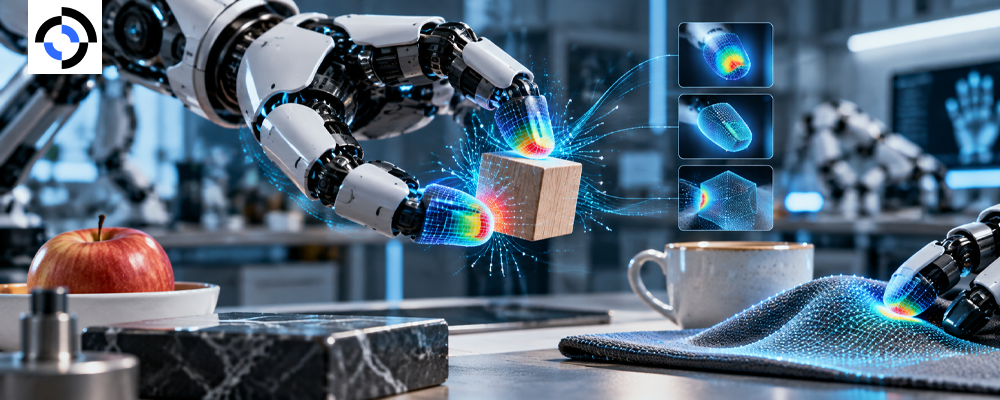
For dexterous robots, touch provides the missing layer between perception and physical action. Pressure, force, shear, vibration, contact location, and slip signals can help a robot understand what is happening at the exact point where its hardware interacts with the physical world.
As robotics moves from structured industrial environments toward humanoids, mobile manipulation, and physical AI, the ability to collect and structure this information is becoming increasingly important.
The core difference: seeing the object vs. feeling the interaction
Vision tells a robot what is around it. Tactile sensing tells it what is happening at the contact surface.
That distinction becomes critical during manipulation.
A robotic hand may visually detect a screwdriver and move toward it. But when the fingers close around the handle, the robot needs additional information to determine whether the grip is sufficient, whether the tool has shifted, and whether the fingers are applying excessive pressure.
Researchers have described tactile sensing as “the continuous sensing of variable contact forces,” with applications including contact detection, grasp stability, and force feedback for robot control.
For dexterous manipulation, this makes touch a complementary perception channel rather than simply another sensor input.
What tactile sensing data actually captures
Not all tactile datasets look the same.
Depending on the sensor technology and robotic platform, tactile sensing data can contain:
| Data type | What it tells the robot |
|---|---|
| Normal force | How strongly an object is being pressed |
| Shear force | Whether contact forces are moving laterally |
| Pressure distribution | Where contact is occurring across a surface |
| Slip signals | Whether an object is beginning to move |
| Vibration | Contact events and surface interactions |
| Texture | Physical characteristics of the contacted surface |
| Contact location | Where the robot is touching an object |
| Deformation | How the object or sensor surface responds |
This is fundamentally different from collecting a single camera frame.
A useful tactile dataset captures how contact changes over time. A robot may initially make light contact, increase pressure, detect micro-slip, and then adjust its fingers. Those temporal changes are part of the training signal.
A major review of dexterous robotic hands examined 28 tactile sensors integrated into robot hands and discussed applications including grasp stability estimation, tactile object recognition, tactile servoing, and force control.
Why touch sensor robotics matters for dexterity
Simple robotic picking can often be performed using vision and predetermined trajectories.
Dexterous manipulation is different.
A robot opening a drawer, rotating a component, inserting a connector, manipulating a cable, or handling a fragile object must continuously adapt its actions based on physical feedback.
This is where touch sensor robotics becomes valuable.
Tactile sensors can provide information when the object is partially occluded by the robot hand—a situation in which cameras may lose visibility. They can also reveal contact characteristics that are difficult to infer visually, including pressure distribution, vibration, and surface interaction.
A review of tactile sensing for dexterous in-hand manipulation concluded that advanced manipulation requires distributed tactile sensing capable of providing information about the magnitude and direction of forces at contact points.
The implication is straightforward: dexterity requires more than knowing where an object is. The robot needs to understand what happens when it touches it.
The data problem behind robotic touch
Installing tactile sensors is only the beginning.
Raw sensor streams must be synchronized with the rest of the robot’s state.
A useful training episode might contain:
- Tactile sensor readings
- Force/torque measurements
- Joint positions and velocities
- End-effector pose
- RGB or RGB-D video
- Object identity
- Manipulation action
- Contact events
- Success or failure labels
- Slip or recovery events
The timestamp relationship between these streams matters.
If a tactile signal indicating slip is recorded several milliseconds away from the corresponding robot movement, the training dataset can associate the wrong action with the observed event.
Roborax’s multimodal sensor capture workflow is designed around this problem, combining tactile arrays and force/torque sensing with RGB-D, LiDAR, IMU, audio, thermal, and event-camera streams in synchronized datasets.
Tactile data vs. force feedback data
The two concepts are closely related but should not be treated as interchangeable.
Force feedback data generally describes measurements of forces and torques acting on a robot or end-effector. Tactile sensing can provide a more localized picture of contact—potentially showing where pressure is distributed across a fingertip or palm.
For dexterous manipulation, both can be valuable.
A wrist-mounted six-axis force/torque sensor may tell a robot that an external wrench is changing. A tactile array on the fingers can provide a more localized representation of the contact pattern.
The strongest datasets therefore do not necessarily choose between force and tactile sensing. They synchronize them.
Roborax’s teleoperation service, for example, packages force profiles alongside joint trajectories, end-effector poses, and synchronized video.
What makes good data for dexterous manipulation sensors?
The quality of tactile datasets depends on more than sensor resolution.
Teams should consider at least five dimensions:
1. Temporal resolution
Fast contact events such as slip can occur quickly. The capture rate must match the physical behavior being studied.
2. Spatial coverage
A fingertip sensor may capture only a portion of the contact surface. Sensor placement should reflect the manipulation task.
3. Cross-modal synchronization
Tactile readings should align with vision, force/torque, joint state, and robot actions.
4. Contact diversity
Datasets should include different objects, materials, orientations, forces, and manipulation conditions.
5. Failure examples
A dataset containing only successful grasps can leave the model poorly prepared for slip, collision, unstable contact, or incorrect force application.
This is why dexterous manipulation sensors should be considered part of a data-collection system rather than isolated hardware components.
The trap in collecting tactile data
The biggest mistake is collecting large volumes of sensor readings without defining what the data is supposed to teach.
A terabyte of pressure maps is not automatically a useful robotics dataset.
Suppose a robot repeatedly grasps the same object using the same trajectory. The dataset may contain millions of sensor readings but very little variation.
A smaller dataset containing different object materials, grasp forces, orientations, contact points, slip events, and recovery actions may provide significantly richer learning signals.
The objective should therefore be behavioral coverage, not simply sensor volume.
Researchers increasingly describe tactile sensing as a critical technology for next-generation robots, while recent reviews point to advances in resistive, capacitive, piezoelectric, triboelectric, and vision-based tactile systems.
How to build a tactile training pipeline
A practical workflow looks like this:
- Define the manipulation task. Identify what the robot must learn—grasping, insertion, rotation, assembly, handover, or another behavior.
- Select the sensing stack. Determine whether the task requires tactile arrays, force/torque sensors, vision, proprioception, or a combination.
- Synchronize every modality. Establish a common timestamp and validate sensor alignment.
- Capture successful and failed interactions. Include slip, unstable grasps, collisions, missed contacts, and recovery behavior.
- Annotate meaningful events. Mark contact onset, contact release, slip, grasp state, force thresholds, and manipulation stages where relevant.
- Run quality assurance. Detect missing frames, sensor drift, timestamp errors, corrupted sequences, and inconsistent labels.
- Package the dataset for model training. Preserve sensor metadata and coordinate conventions so the data remains useful as the robotics stack evolves.
The result is not simply a tactile dataset. It is a structured record of how physical interaction produces robot behavior.
Where Roborax fits
Building this infrastructure internally can require sensor integration, calibration, operators, data engineers, QA processes, and significant experimentation.
Roborax approaches tactile data collection as part of a broader embodied-AI data pipeline.
Its multimodal capture capabilities include tactile arrays, force/torque sensing, RGB-D, LiDAR, IMU, audio, thermal, and event-camera streams, while its teleoperation workflows can combine force profiles with robot trajectories and synchronized video.
That matters when the objective is not merely to collect sensor readings but to create training-ready data for dexterous manipulation.
Roborax helps robotics teams turn real-world interaction into structured training data. From tactile and force/torque capture to synchronized multimodal datasets and teleoperation, our data programs are built for the demands of dexterous manipulation and embodied AI.
Have a tactile-data requirement? Talk to Roborax about your sensor stack, task, and dataset requirements.
Frequently asked questions
Why do dexterous robots need tactile sensing?
Dexterous manipulation requires information about physical contact that cameras cannot always provide. Tactile sensing can help estimate contact forces, grasp stability, slip, and surface interaction.
Is tactile data more important than vision data?
They solve different problems. Vision provides information about the external scene, while tactile sensing provides localized information at the point of contact. For many manipulation tasks, combining both is more useful than relying exclusively on either modality.
What is the difference between tactile and force/torque data?
Force/torque sensors generally measure forces and torques at a defined location, such as the wrist. Tactile arrays can provide distributed information across a contact surface. A multimodal dataset can combine both.
What should tactile datasets include?
Depending on the application, useful datasets can include pressure or force measurements, contact locations, robot state, object information, video, manipulation actions, slip events, and success or failure outcomes.
Can Roborax collect synchronized tactile and robot data?
Yes. Roborax’s multimodal sensor capture service supports tactile arrays and force/torque sensing alongside other modalities, with synchronization and dataset packaging for robotics applications.
Related Reading
For teams building robotic training-data pipelines, these Roborax resources provide useful context:
External Reference