Training robots exclusively in the physical world is expensive, slow, and difficult to scale. Every new object, environment, lighting condition, sensor configuration, and edge case can require additional data collection. Simulation changes the equation by allowing robotics teams to generate thousands—or millions—of controlled training scenarios.
But simulation introduces an important question:
How much synthetic variation is actually enough?
Too little variation can produce brittle models that perform well in simulation but struggle when deployed. Too much uncontrolled variation can create unrealistic training conditions that dilute the signal the model needs to learn.
This is where domain randomization robotics becomes valuable.
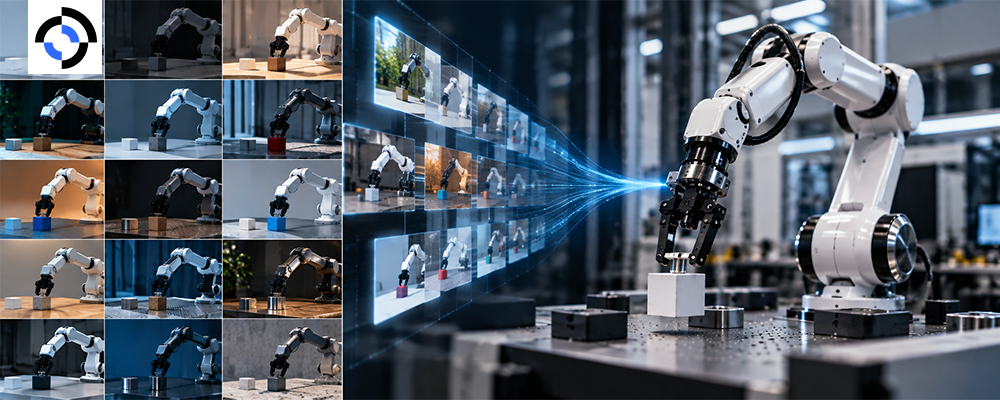
Domain randomization introduces controlled changes to simulated environments, objects, sensors, and physics so that a robot encounters a broader range of conditions during training. The objective is not simply to make simulation more diverse. It is to make the resulting model more resilient to the variations it will encounter in the physical world.
The timing matters. The International Federation of Robotics reported that 542,000 industrial robots were installed worldwide in 2024, more than double the number installed ten years earlier. The global operational stock reached approximately 4.66 million industrial robots. IFR President Takayuki Ito described the transition as marked by a “huge surge in demand.”
As robot deployment scales, the demand for scalable, high-quality training data scales with it.
What Is Domain Randomization in Robotics?
Domain randomization is a simulation strategy in which selected properties of a virtual environment are varied across training episodes.
Depending on the robot and task, teams can randomize:
- Lighting intensity and direction
- Object colors and textures
- Background environments
- Camera position and orientation
- Object dimensions and placement
- Surface properties
- Sensor noise
- Friction and mass
- Robot dynamics
- External forces
- Occlusion and visibility
The underlying idea is simple: instead of training a robot on one highly specific version of the world, expose it to a distribution of plausible worlds.
For example, a robotic arm learning to grasp objects should not always see the same object at the same angle under the same lighting. Variation encourages the model to focus on characteristics that remain useful across conditions.
That is the foundation of effective synthetic data variation.
Why Synthetic Data Variation Matters
A large synthetic dataset is not necessarily a diverse dataset.
Imagine generating one million simulated images of a robotic gripper. If the camera position, object geometry, lighting, background, and object placement remain almost identical, the model receives enormous quantities of data but relatively little new information.
Now introduce controlled variation.
Objects appear at different orientations. Lighting changes. Backgrounds shift. Camera viewpoints move. Objects have different dimensions and textures. Sensor noise changes within realistic limits.
The model now has to learn patterns that generalize across conditions.
This distinction is critical:
Data volume increases the number of examples.
Data diversity increases the range of conditions represented by those examples.
For physical AI, both matter—but they solve different problems.
The Danger of Randomizing Everything
More variation does not automatically produce better models.
Suppose a warehouse robot is trained with extreme randomization. Objects suddenly appear in physically impossible positions. Friction varies far beyond realistic materials. Cameras experience noise levels never observed on the actual hardware. Lighting ranges from realistic warehouse illumination to conditions the robot will never encounter.
The simulation may become extremely diverse while becoming less useful.
Effective domain randomization therefore requires relevant variation, not arbitrary variation.
The goal is to approximate the uncertainty of the deployment environment.
Roborax approaches synthetic robotics data with this principle in mind: randomization should have a purpose, a defined range, and a measurable relationship to real-world performance.
What Should Robotics Teams Randomize?
The right randomization strategy depends on the application, but four areas are particularly important.
1. Visual Variation
For robot perception systems, visual parameters can include:
- Lighting
- Shadows
- Textures
- Colors
- Backgrounds
- Camera viewpoints
- Object appearance
- Occlusion
Visual randomization helps reduce dependence on superficial image characteristics.
A grasping model, for example, should ideally recognize an object because of its relevant visual and geometric properties—not because every training image places it against the same background.
2. Geometric Variation
Geometry affects how robots interact with objects and environments.
Simulation can vary:
- Object size
- Object orientation
- Object location
- Workspace configuration
- Obstacle positions
- Gripper-object distance
- Surface geometry
This encourages the robot to learn spatial relationships rather than memorized coordinates.
3. Physical Variation
Physics randomization is particularly relevant to manipulation and locomotion.
Parameters may include:
- Mass
- Friction
- Damping
- Contact properties
- Joint parameters
- External forces
- Object stiffness
A robot trained only under one physical configuration may struggle when real-world conditions differ.
4. Sensor Variation
Real sensors are imperfect.
Synthetic environments can model:
- Camera noise
- Depth noise
- Motion blur
- Exposure variation
- Sensor latency
- Missing measurements
- Calibration errors
This helps prepare models for the imperfections they may encounter after deployment.
How Much Simulation Diversity Is Enough?
There is no universal number of randomized environments or simulation episodes that guarantees successful transfer.
Instead, robotics teams should define their deployment distribution first.
Ask:
- What environments will the robot operate in?
- Which objects will it encounter?
- What lighting conditions are realistic?
- What sensor errors occur in production?
- What physical properties vary?
- Which failure modes matter most?
- Which conditions are rare but safety-critical?
The answers should determine the randomization ranges.
For example, if a warehouse robot operates primarily under controlled indoor lighting, generating millions of extreme outdoor-lighting scenarios may add little value.
Similarly, if a manipulation system handles objects between 100 grams and 2 kilograms, randomizing object mass across an arbitrary range of several orders of magnitude may create unrealistic training examples.
A better workflow is:
Real-world data → Identify uncertainty → Define randomization ranges → Generate synthetic data → Train → Test on hardware → Refine
That makes domain randomization an iterative engineering process rather than a one-time simulation setting.
Measuring Sim-to-Real Generalization
The simulator is not the final judge.
The real robot is.
This makes sim-to-real generalization one of the most important measures of synthetic-data quality.
Robotics teams can evaluate:
- Task success rate
- Grasp success
- Collision rate
- Pose-estimation accuracy
- Recovery performance
- Performance on unseen objects
- Performance under unseen lighting
- Sensor robustness
- Failure frequency
- Performance degradation between simulation and hardware
A model that achieves excellent simulated performance but fails on physical hardware has not achieved useful transfer.
Conversely, a model that performs slightly less impressively in simulation but remains robust across real-world conditions may provide greater practical value. Isaac Sim offers advanced GPU-accelerated simulation and photorealistic environments, while MuJoCo excels in fast physics simulation and reinforcement learning. Gazebo provides a flexible, open-source robotics ecosystem. Comparing real-world performance across these platforms helps teams identify simulation biases and measure reliable sim-to-real generalization.
Simulation Diversity Should Be Measurable
A common mistake is treating diversity as a subjective concept.
Instead, robotics teams can track diversity across defined dimensions.
For example:
| Dimension | Possible Variables |
|---|---|
| Visual | Lighting, texture, color, background |
| Geometry | Size, orientation, position |
| Physics | Mass, friction, damping |
| Sensors | Noise, latency, dropout |
| Environment | Layout, obstacles, workspace |
| Behavior | Trajectory, speed, interaction |
This creates a simulation diversity matrix.
Rather than asking, “Did we generate enough synthetic data?” teams can ask:
“Which dimensions of our deployment environment are adequately represented, and which remain underrepresented?”
That is a much more actionable question.
Synthetic Data and Real Data Work Better Together
Synthetic data does not necessarily need to replace physical-world data.
In many robotics workflows, the two can complement each other.
Real demonstrations establish realistic behavior and operating conditions. Simulation can then expand those demonstrations into controlled variations, including scenarios that would be expensive, dangerous, or time-consuming to reproduce physically.
NVIDIA reported that its Isaac GR00T synthetic motion-generation workflow produced 780,000 synthetic trajectories—equivalent to approximately 6,500 hours of human demonstration data—in 11 hours. In that specific experiment, combining synthetic and real data improved GR00T N1 performance by 40% compared with real data alone.
These results are specific to NVIDIA’s workflow and should not be treated as a universal benchmark. However, they illustrate the potential of synthetic data to expand robotics training at a scale that physical collection alone may struggle to match.
How Roborax Approaches Domain Randomization
At Roborax, we believe the value of synthetic robotics data depends on more than the number of simulated samples generated.
It depends on whether those samples represent the right problems.
Our robotics data workflows can support:
- Synthetic training-data generation
- Domain-randomized simulation datasets
- Robot perception data
- Manipulation and navigation scenarios
- Multimodal sensor datasets
- Edge-case generation
- Failure-case datasets
- Dataset quality assurance
- Sim-to-real evaluation
- Real and synthetic data integration
The objective is to help robotics teams create datasets that are broad enough to improve generalization while remaining grounded in real-world operating conditions.
For Roborax, simulation is not simply a way to produce more data. It is a way to systematically explore the conditions under which a robot needs to perform.
The Goal Is Not Maximum Randomization. It Is Useful Randomization.
So, how much synthetic variation is enough?
The answer is not “as much as possible.”
It is enough variation to cover the meaningful uncertainty of the robot’s deployment environment while avoiding unrealistic conditions that can distract or mislead the learning system.
Effective domain randomization robotics workflows combine simulation diversity, real-world evidence, controlled parameter ranges, and hardware validation.
As the robotics industry expands, this approach becomes increasingly important. The IFR reports that global industrial robot installations are expected to reach 575,000 units in 2025, with the organization projecting that installations will surpass 700,000 units by 2028.
More robots mean more complex training requirements—and greater pressure to develop scalable ways of generating reliable robotics data.
Build More Robust Robotics Models With Roborax
Roborax helps robotics and Physical AI teams build structured, diverse, and deployment-focused training datasets across simulation and real-world environments.
Whether you need domain-randomized perception data, synthetic manipulation trajectories, multimodal datasets, or sim-to-real validation, Roborax can help you turn simulation into a more systematic training-data engine.
Ready to build synthetic datasets that reflect the real-world conditions your robots must master?
Partner with Roborax and develop the data foundation for more robust, adaptable, and deployment-ready robotic systems.
Frequently asked questions
Q: Can domain randomization fully replace real-world data?
A: Rarely for complex manipulation tasks. It reduces how much real data you need and improves transfer, but most production policies still benefit from a real-world fine-tuning or evaluation stage to close the residual gap.
Q: How do I know if I’ve over-randomized?
A: Signs include training that fails to converge, a policy that performs worse in simulation evaluation than a less-randomized baseline, or real-world behavior that looks oddly conservative or hesitant compared to what the task requires.
Q: Does domain randomization matter equally for vision and control policies?
A: Vision-based perception generally benefits from broader randomization than low-level control policies, since visual conditions vary more in the real world than the physical dynamics of a well-characterized robot and task.
If your sim-to-real transfer isn’t matching expectations, the randomization range is a common culprit. Talk to Roborax about grounding your simulation parameters in real-world measurement.
Related reading
External reference