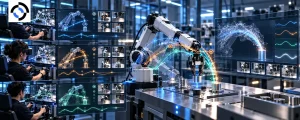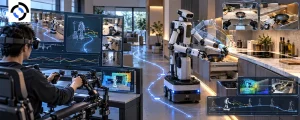
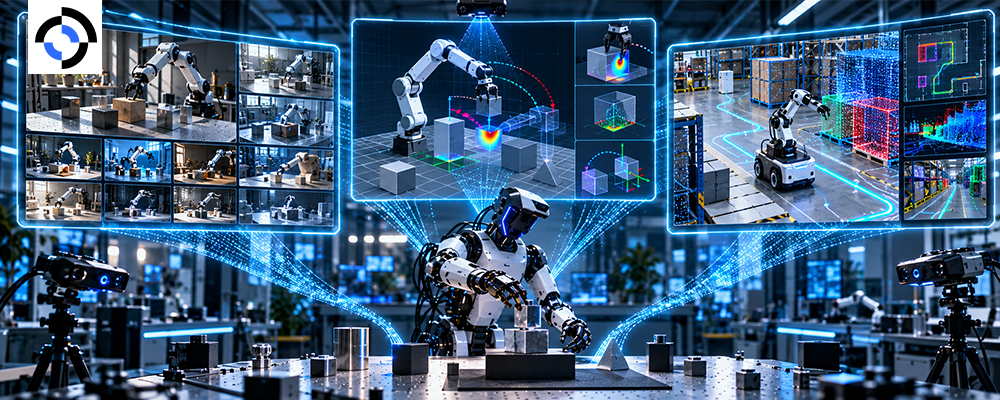
Robots are no longer being developed exclusively on physical hardware. As robotic systems become more intelligent, simulation has become a critical environment for training, testing, validating, and refining robot behavior before deployment.
The scale of robotics itself explains why this matters. The International Federation of Robotics (IFR) reported in September 2026 that the global operational stock of industrial robots reached 5.079 million units in 2025, while annual installations surpassed 603,000 units—an 11% year-over-year increase.
As more robots enter factories, warehouses, laboratories, and other real-world environments, robotics teams need simulation platforms capable of supporting increasingly sophisticated workloads.
Three names frequently appear in these conversations: NVIDIA Isaac Sim, MuJoCo, and Gazebo.
But which one should a robotics team choose?
The answer depends on the project’s objectives. A robot simulation software comparison should consider physics, rendering, sensor simulation, reinforcement learning, ROS integration, synthetic data generation, scalability, and ultimately sim-to-real generalization.
Why Choosing the Right Simulation Backend Matters
A simulation backend determines much more than how a robot looks inside a virtual environment.
It influences how accurately the system models:
- Robot dynamics and contact interactions
- Sensors such as cameras, LiDAR, and IMUs
- Environmental conditions
- Object interactions
- Motion and control
- Reinforcement-learning environments
- Synthetic training-data generation
- Software-in-the-loop and hardware-in-the-loop testing
For modern Physical AI systems, simulation is increasingly becoming part of the data pipeline itself.
NVIDIA describes a sim-first approach as one in which robots are trained, tested, and validated primarily in virtual environments before interacting with physical hardware.
That makes simulator selection a strategic engineering decision—not simply a tooling preference.
Isaac Sim: Built for High-Fidelity Robotics and Synthetic Data
NVIDIA Isaac Sim is designed for robotics simulation, testing, and synthetic data generation in physically based virtual environments. NVIDIA describes it as an open-source reference framework built using Omniverse libraries.
Its major strength is the combination of robot physics, sensor simulation, high-quality rendering, and synthetic data generation.
Isaac Sim can incorporate CAD and URDF assets, configure robot and sensor models, and generate controllable synthetic datasets. Its Replicator tools support domain randomization involving attributes such as lighting, color, reflection, position, and scene composition.
This makes Isaac Sim particularly relevant for robotics teams developing perception-heavy systems.
For example, a warehouse robot can be exposed to variations in lighting, object positions, camera conditions, and environments without requiring every scenario to be physically captured.
NVIDIA’s documentation emphasizes the purpose of domain randomization clearly: rather than forcing simulation to perfectly reproduce one real environment, teams can vary simulation parameters so policies become robust across a range of possible real-world conditions.
Isaac Sim is particularly relevant for:
- Physical AI development
- Computer vision and perception
- Synthetic data generation
- Digital twins
- Autonomous mobile robots
- Manipulation
- Robot learning
- Software-in-the-loop testing
For teams building data-intensive robot-learning pipelines, this broad ecosystem can be particularly valuable.
MuJoCo: Physics, Control, and Reinforcement Learning
MuJoCo approaches robotics simulation from a different direction.
The name stands for Multi-Joint dynamics with Contact, and Google DeepMind describes it as a general-purpose physics engine designed for research and development involving robotics, biomechanics, machine learning, graphics, and articulated structures.
Its emphasis is on fast and accurate physics simulation.
This makes MuJoCo particularly attractive for researchers working on robot control, reinforcement learning, manipulation, locomotion, and contact-rich interactions.
Instead of prioritizing photorealistic environments and large synthetic perception pipelines, MuJoCo is often used when researchers need to iterate rapidly on physical behavior and learning algorithms.
Its architecture is also designed around performance. The runtime simulation module uses preallocated low-level data structures, while models can be defined using MuJoCo’s native MJCF format or loaded from URDF.
MuJoCo is particularly relevant for:
- Reinforcement learning
- Robot control
- Locomotion
- Manipulation research
- Contact dynamics
- Algorithm development
- Physics-focused experimentation
For a team whose primary question is, “Can this policy learn the required behavior efficiently?”, MuJoCo can provide a highly focused simulation environment.
Gazebo: The ROS-Oriented Simulation Ecosystem
Gazebo has a different value proposition: deep alignment with the broader robotics software ecosystem, particularly ROS 2.
Modern Gazebo provides simulation capabilities that can be connected with ROS 2 through standardized simulation interfaces. Gazebo’s current documentation shows support for operations such as spawning entities, controlling simulation time, querying world state, and updating simulation state through ROS 2 interfaces.
That makes Gazebo useful for teams that want to test complete robotics software stacks rather than only train an individual policy.
A mobile robot, for instance, can be simulated while its navigation, perception, planning, control, and ROS 2 communication layers are evaluated together.
Gazebo is particularly relevant for:
- ROS 2 development
- Autonomous mobile robots
- Navigation
- Sensor integration
- Software-in-the-loop testing
- Robotics system integration
- Research and prototyping
For organizations already invested heavily in ROS-based development, Gazebo can fit naturally into the existing engineering workflow.
Isaac Sim vs MuJoCo vs Gazebo
| Capability | Isaac Sim | MuJoCo | Gazebo |
|---|---|---|---|
| Physics simulation | Strong | Strong | Strong |
| High-fidelity rendering | Strong | Limited focus | Moderate |
| Synthetic data generation | Strong | Limited focus | Available |
| Reinforcement learning | Strong | Strong | Supported |
| Contact dynamics | Strong | Strong | Strong |
| ROS 2 integration | Supported | Available through integrations | Strong |
| Perception workflows | Strong | Less central | Strong |
| Digital twins | Strong | Less central | Supported |
| Robot control research | Strong | Strong | Strong |
| Best fit | Physical AI & perception | Physics & learning | ROS-based systems |
The comparison illustrates an important principle: there is no universally correct simulator.
The appropriate choice depends on what the robotics team needs to accomplish.
The Role of Simulation in Sim-to-Real Generalization
One of the biggest challenges in robot learning is transferring behavior learned in simulation to physical robots.
A simulated environment can differ from reality in terms of:
- Lighting
- Textures
- Sensor noise
- Camera positioning
- Friction
- Object mass
- Dynamics
- Latency
- Environmental variability
This is where sim-to-real generalization becomes critical.
Domain randomization is one strategy for addressing this challenge. NVIDIA’s documentation describes randomizing properties such as textures, colors, lighting, camera parameters, object poses, and other environmental factors to help models generalize beyond a single simulated environment.
The goal, therefore, is not simply to create the most visually impressive simulation.
The goal is to create useful variation.
A simulation pipeline should expose a robot to the conditions it is likely to encounter after deployment while maintaining sufficient control over the training distribution.
Why Robotics Data Matters as Much as the Simulator
Selecting a simulation backend is only one component of a successful robot-learning pipeline.
The quality of the resulting training data matters just as much.
Robotics teams need carefully structured datasets containing demonstrations, sensor streams, trajectories, annotations, environmental variations, failure cases, and evaluation scenarios.
This is where Roborax brings additional value.
Roborax helps robotics and Physical AI teams build data pipelines around simulation, teleoperation, robot demonstrations, perception, sensor data, and training workflows. By combining simulation-generated information with real-world data, teams can develop datasets designed around actual robot-learning requirements rather than treating simulation as an isolated development environment.
Whether the workflow uses Isaac Sim for synthetic perception, MuJoCo for reinforcement learning, Gazebo for ROS-based validation, or multiple backends across different development stages, Roborax can help turn those environments into structured, training-ready data assets.
Choosing a Simulation Backend for Your Robotics Project
A practical decision framework looks like this:
- Choose Isaac Sim when high-fidelity environments, sensor simulation, synthetic data, and Physical AI workflows are central to the project.
- Choose MuJoCo when physics, robot control, reinforcement learning, and rapid algorithm experimentation are primary requirements.
- Choose Gazebo when ROS/ROS 2 integration, system-level testing, navigation, and robotics software validation are central.
And in sophisticated robotics programs, using more than one simulator can be completely reasonable. Different environments can support different stages of development.
Build Better Robot Training Data With Roborax
Simulation is becoming an essential layer in modern robotics development—but simulation alone does not create intelligent robots.
The real advantage comes from connecting simulation, data, learning, validation, and real-world feedback into a continuous development loop.
At Roborax, we help robotics teams develop high-quality training-data pipelines for Physical AI, robot learning, perception, teleoperation, and simulation-driven development.
Ready to build simulation-ready datasets for your next-generation robot? Connect with Roborax to turn simulated and real-world robot data into structured training assets designed for reliable AI and better sim-to-real performance.
Frequently asked questions
Q: Can I switch simulators mid-program without losing prior work?
A: Physics and rendering assets generally don’t transfer directly between simulators, but task definitions, data schemas, and evaluation benchmarks can often be ported with some adaptation. Budget for a real migration cost either way.
Q: Which simulator is best for humanoid robots?
A: Isaac Sim has become a common choice for humanoid work given its scale and integration with large-scale synthetic data pipelines, though MuJoCoremains strong for locomotion control research specifically.
Q: Do I need real-world data if I’m already using a high-fidelity simulator?
A: Yes. Even the best simulators have a residual reality gap. Real-world data for fine-tuning and evaluation remains necessary regardless of simulator quality.
Choosing the wrong simulation backend costs months, not days. Talk to Roborax about aligning your simulation strategy with your actual task bottleneck and validating it against real-world data.
- Related reading
External reference