A robot can perform the same task thousands of times without failure—and still encounter a scenario tomorrow that it has never seen before.
A misplaced object. A sudden obstruction. Sensor noise. A reflective surface. Unexpected friction. A partially occluded target. A human entering the robot’s path at the wrong moment.
These rare failure scenarios are difficult to capture through conventional data collection because they are, by definition, uncommon. Yet they can have an outsized impact on robot reliability and safety.
This is where synthetic data robot failures and simulation-driven training become increasingly important. By recreating unusual conditions virtually, robotics teams can expose AI systems to failure modes that may be expensive, dangerous, or practically impossible to reproduce repeatedly in the physical world.
Why Rare Failures Create a Data Problem for Robotics
Real-world robotics data is inherently constrained.
A physical robot requires hardware, operators, facilities, sensors, maintenance, and significant operating time. Intentionally causing failures adds another layer of complexity. Teams cannot simply make a robot crash, drop an object, encounter an unexpected pedestrian, or experience a sensor malfunction thousands of times to build a training dataset.
The result is often an imbalance: enormous amounts of normal operating data, but comparatively little data describing unusual conditions.
Synthetic data changes this equation.
NVIDIA notes that synthetic data can deliberately include “rare but crucial corner cases” that may otherwise be impossible to collect at scale.
For robotics teams, this means failures can become designed data-generation targets rather than events teams simply wait to observe.
What Is Rare Event Data Generation?
Rare event data generation is the deliberate creation of uncommon but operationally important scenarios inside a simulated environment.
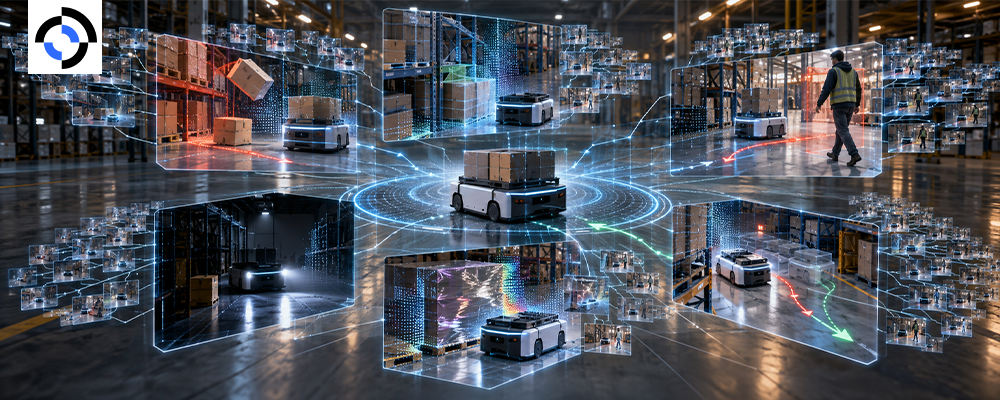
Imagine an autonomous mobile robot operating in a warehouse. A standard dataset might contain thousands of examples of clear aisles, correctly positioned pallets, stable lighting, and predictable pedestrian movement.
A failure-oriented synthetic dataset could introduce:
- Unexpected obstacles appearing in navigation paths
- Partially occluded objects
- Low-light or high-glare environments
- Sensor noise and temporary degradation
- Moving workers or vehicles
- Objects placed outside expected positions
- Slippery or variable surfaces
- Control latency
- Unusual object orientations
- Multiple simultaneous disturbances
The objective is not to generate randomness for its own sake. The objective is to create meaningful variation around realistic failure modes.
That distinction is critical.
Edge Case Simulation: Turning Unlikely Events Into Training Data
Effective edge case simulation begins with real-world knowledge.
Robotics teams can use deployment logs, teleoperation records, QA reports, incident data, operator feedback, and hardware testing to identify where systems struggle. These failure modes can then be reconstructed in simulation and systematically varied.
For example, suppose a robotic arm repeatedly fails to grasp a glossy object.
Instead of generating thousands of identical synthetic images, a simulation pipeline can vary:
- Object: size, shape, material, mass and orientation
- Environment: lighting, background, clutter and surface conditions
- Camera: position, exposure, occlusion and noise
- Robot: joint tolerances, latency, actuator characteristics and calibration
- Interaction: friction, contact points and object movement
One observed failure can therefore become an entire family of training scenarios.
This is one of the strongest advantages of simulation: the team can explore the neighborhood around a failure, not merely reproduce the original event.
Domain Randomization Makes Synthetic Failures More Useful
A major technique for improving synthetic training data is domain randomization.
Instead of creating one perfectly modeled virtual environment, developers expose models to controlled variations in physical and visual parameters.
OpenAI’s robotics research demonstrated the principle by randomizing simulator dynamics and showing that policies could generalize to substantially different real-world dynamics.
OpenAI also reported an experiment in which a grasp-planning system trained on millions of procedurally generated objects achieved more than 90% success on previously unseen realistic objects in simulation and 80% success in real-world grasp attempts.
These results illustrate an important concept: synthetic data becomes valuable when it teaches the model to handle variation, rather than memorize a narrow environment.
As NVIDIA’s robotics guidance explains, domain randomization can vary elements such as lighting, textures, object placement and environments to support real-world generalization.
Synthetic Data for Robot Safety Simulation
Some scenarios are simply too risky to reproduce repeatedly with physical hardware.
This is where robot safety simulation becomes particularly valuable.
A simulation environment can test what happens when:
- A person unexpectedly enters a robot’s workspace
- A navigation route becomes blocked
- A sensor produces corrupted observations
- An object falls into the robot’s path
- A grasp fails during manipulation
- Control latency increases
- Multiple sensors provide inconsistent information
These scenarios allow teams to evaluate perception, planning and control responses without repeatedly exposing people or expensive equipment to physical risks.
NVIDIA describes simulation as a way to capture rare scenarios that can be dangerous to collect in the real world and use them for software-in-the-loop testing and validation.
Simulation therefore becomes more than a training environment. It becomes a controlled failure laboratory.
The Sim-to-Real Generalization Challenge
Synthetic data has enormous potential, but generating more simulated data does not automatically create a better robot.
The fundamental challenge is sim-to-real generalization.
A simulator is still an approximation of reality. Real robots experience sensor imperfections, actuator variability, friction differences, mechanical tolerances, latency and environmental conditions that may not be perfectly represented in simulation.
NVIDIA explicitly warns that over-randomization or physically inaccurate assets can produce models that perform well on synthetic data but fail in the real world. It recommends continuous validation against real-world holdout datasets.
Roborax takes this principle seriously: synthetic and physical data should reinforce each other rather than exist in isolation.
Real-world failures identify what needs to be simulated. Simulation expands coverage around those failures. Physical validation then determines whether the learned behavior actually transfers.
A Practical Synthetic Failure Data Pipeline
A robust workflow can follow this cycle:
1. Capture real-world failures
Collect robot logs, teleoperation data, QA findings and deployment incidents.
2. Classify failure modes
Group failures according to perception, navigation, manipulation, sensing, control and environmental conditions.
3. Reconstruct scenarios digitally
Build simulation environments that reproduce the relevant conditions.
4. Introduce controlled variation
Randomize parameters such as lighting, object placement, friction, sensor noise, latency and environmental configuration.
5. Generate multimodal data
Produce RGB, depth, segmentation, bounding boxes, trajectories and other required annotations.
6. Train and evaluate models
Use synthetic data for training and reserve unseen scenarios for evaluation.
7. Validate on physical robots
Test whether improvements survive real-world conditions.
8. Feed new failures back into simulation
Every meaningful physical failure becomes another opportunity to expand the synthetic scenario library.
This creates a continuously improving data flywheel.
Why Robotics Teams Need More Than Synthetic Data
Synthetic data should not be viewed as a replacement for real-world collection.
Instead, the strongest robotics programs use a sim-plus-real strategy.
Roborax’s own analysis of sim-to-real transfer emphasizes that real-world data plays two critical roles: fine-tuning models and anchoring synthetic distributions to actual deployment conditions.
This is particularly important for manipulation and contact-rich tasks, where small physical differences can produce significant behavioral changes.
The goal is therefore not to generate the largest synthetic dataset possible.
The goal is to generate the right synthetic dataset—one that targets meaningful uncertainty and complements real-world evidence.
How Roborax Helps Build Failure-Ready Robotics Data
At Roborax, we approach synthetic data generation as part of a broader Physical AI data strategy.
Our robotics data workflows can help teams translate difficult deployment scenarios into structured simulation and training requirements. From perception edge cases and manipulation failures to navigation challenges and safety-critical scenarios, the emphasis is on generating data that addresses specific model weaknesses.
With the right combination of simulation, domain randomization, annotation, real-world data and validation, robotics teams can move from reactive failure handling toward proactive robustness engineering.
Build More Robust Robots With Roborax
Rare failures should not remain invisible until deployment.
With synthetic data robot failures, targeted edge case simulation, scalable rare event data generation, controlled robot safety simulation, and rigorous sim-to-real generalization workflows, robotics teams can test more possibilities before putting systems into the physical world.
Roborax helps robotics companies build high-quality training and evaluation datasets for Physical AI, including simulation-driven data, robot perception, manipulation, teleoperation and real-world validation workflows.
Ready to turn your robot’s rare failures into valuable training data? Talk to Roborax today and build a failure-focused data strategy for your next robotics system.
Frequently asked questions
Q: How many synthetic examples does a rare failure mode need?
A: It depends on the complexity of the failure and how much visual and physical variation matters for generalization, but most teams find diminishing returns well before matching the volume of their common-case data — the goal is coverage of the variation, not raw volume parity.
Q: Can synthetic data alone solve the long-tail problem?
A: No. It scales coverage of known failure modes efficiently but can’t discover failure modes nobody has anticipated. Real-world intervention data remains essential for discovering what’s actually in the tail.
Q: How do you validate that synthetic failures are realistic?
A: Compare synthetic scenario outcomes against real recorded examples of similar events where available, and have domain experts review synthetic scenarios for physical plausibility before they enter a training set at scale.
If your policy keeps failing on the same class of rare event, talk to Roborax about building a targeted synthetic and real data strategy around it.
Related reading
External reference