Every autonomous fleet generates a stream of moments where the policy gave up and a human took over. Most organisations treat these as operational incidents to be closed. They are the most precisely targeted training data you will ever own.
This guide covers what makes intervention data different from collected demonstrations, exactly what has to be logged for it to be trainable, the eight-step loop from incident to retrained policy, and why most fleets discard it without meaning to.
What intervention data is
An intervention is what happens when an autonomous system stops coping. The robot is running on its own policy, something exceeds its competence, a human steps in, the situation is resolved, and autonomy resumes.
Every one of those events is a labelled example of the policy’s boundary. It records the exact state where the model failed, what a competent human did instead, and whether that worked. No deliberate collection programme produces that, because you cannot schedule a surprise.
Why it is the most valuable slice you own
| Collected demonstrations | Intervention data | |
|---|---|---|
| What it samples | Situations you predicted | Situations that actually occur |
| Difficulty distribution | Chosen by you | Chosen by reality |
| Relationship to failure | Mostly successes | Failures by definition |
| Marginal cost | A budget line | Already paid as operations |
| Volume control | You decide | The fleet decides |
| Freshness | Ages as the world changes | Continuously current |
The cost line is the one that should get attention. If you run a fleet with remote supervision, you are already paying people to handle these events. Turning that into training data is a logging change, not a new budget.
Deliberate long-tail capture is an attempt to guess the distribution a deployed fleet hands you for free.
What has to be logged
Most fleets record that an incident happened. Far fewer record it in a form a model can learn from. The difference is a handful of fields.
- Trigger type. Did the robot request help, did a monitor intervene, or did a rule fire automatically?
- Autonomy state at handover. What the policy believed and intended at the moment it stopped coping. This is the single most diagnostic field and the most commonly missing.
- Full sensor buffer around the event. Not just the moment of failure but the seconds before it, where the causes usually sit.
- Operator actions during resolution. Recorded as actions in the same convention as your demonstration data, per trajectory formats.
- Resolution type. Guided, remotely driven, escalated to a field team, or self-resolved.
- Time to acknowledge, resolve, and resume. Operational metrics that double as data quality signals.
- Root cause from a controlled vocabulary: perception, planning, hardware, environment, third party.
- Outcome and whether the same situation recurred later.
The action-convention point is what makes intervention data poolable with demonstrations. Logged in a different format, it becomes a separate dataset nobody merges.
The loop, end to end
- Detect. The robot requests help or a monitor spots trouble.
- Resolve. A human handles it, and the resolution is recorded as structured actions rather than free text.
- Classify. Root cause assigned from a fixed vocabulary at resolution time, while context is fresh.
- Cluster. Group similar events. One robot stuck at one kerb is an anecdote; two hundred stuck at similar kerbs is a training target.
- Prioritise. Rank clusters by frequency multiplied by cost. Not every failure deserves a fix.
- Supplement. For high-priority clusters, collect deliberate demonstrations of that specific situation, because interventions alone are usually too few per cluster.
- Retrain and evaluate against the cluster as a named benchmark, per evaluation benchmarks.
- Measure the intervention rate for that cluster afterwards. That is the only honest proof the loop worked.
Step six is the one teams skip. Interventions tell you what to collect; they rarely supply enough volume to fix it by themselves.
Why most fleets throw this away
Not through carelessness. The reasons are structural.
- Operations and ML report to different people. The incident log is a support artifact, not a data asset, so nobody specifies it as one.
- Free-text notes. “Robot stuck near entrance” cannot be clustered or counted.
- Short buffers. Sensor data is retained for minutes for debugging, then discarded before anyone asks for it.
- No shared action convention between the remote-operations stack and the training pipeline.
- Success is defined as resolution. Once the robot is moving again, the ticket closes and the learning opportunity closes with it.
Fixing this is mostly a schema and retention decision made once, not an ongoing cost.
What this looks like in practice
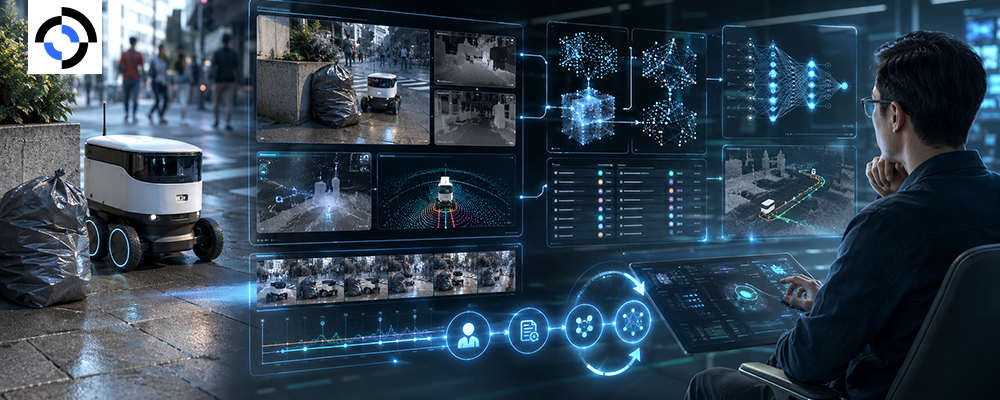
We run remote monitoring and intervention for an autonomous mobility company operating sidewalk delivery robots and self-driving passenger vehicles. Robots operate in public space, where the tail is wide: construction, crowds, weather, pets, delivery vans, people who move the robot by hand.
Three things make the data usable rather than merely voluminous. Root cause is assigned at resolution time by the operator who handled it, not reconstructed later. The sensor buffer extends well before the trigger, because causes precede symptoms. And escalation runs on a clock rather than on judgment, which keeps event handling consistent enough that the resulting data is comparable across operators and shifts.
For a programme where edge-case coverage moved a real metric, our warehouse policy case study tracks deformable-item success from 61 to 84 percent.
Frequently asked questions
Is intervention data enough to retrain a policy on its own?
Rarely. It is excellent at telling you which situations matter and usually too sparse per situation to fix them. Use it to target deliberate collection rather than to replace it.
How long should we retain sensor buffers?
Long enough to cover the lead-up, which is longer than debugging requires. Retention is a cost decision, and discarding the seconds before a failure removes most of the diagnostic value.
Does this work without a deployed fleet?
Not in this form. Pre-deployment, the closest equivalent is running the policy under supervision in realistic conditions and logging every takeover the same way.
Who should classify root cause?
The operator who resolved it, at the time, from a short fixed list. Retrospective classification by someone who was not there is slower and less accurate.
A fleet in the field is a data collection programme that is already funded. The only question is whether its output is structured enough to train on. If you are running remote operations and want the logging schema reviewed, tell us how your fleet is instrumented.