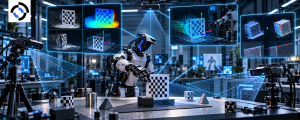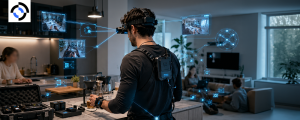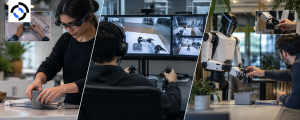
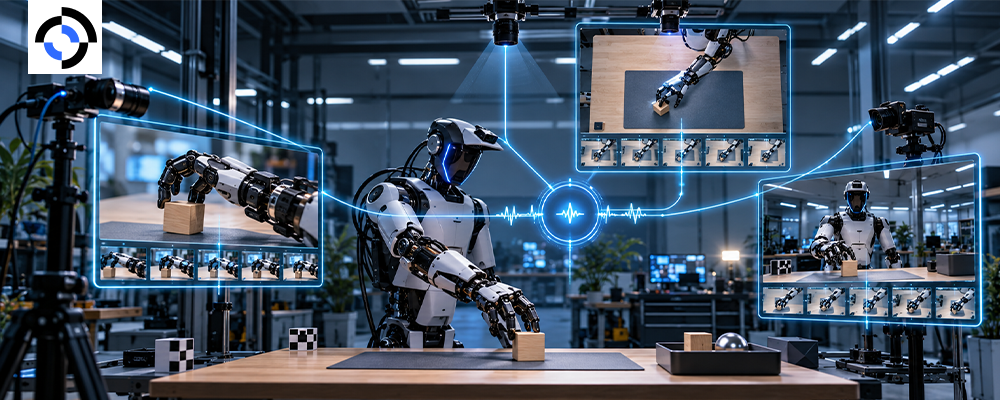
A robot may have excellent sensors, sophisticated actuators, and a powerful learning model—but if the data used to train that robot is poorly synchronized, the entire learning pipeline can become unreliable.
Modern robot learning increasingly depends on multimodal data: multiple camera perspectives, robot joint states, depth, tactile signals, force measurements, and action trajectories. Bringing these streams together requires more than simply recording them simultaneously. The data must share a reliable temporal reference, consistent spatial calibration, and sufficient metadata to preserve the relationship between what the robot saw, what it did, and what happened physically.
This is where multi-camera robot data synchronization becomes a critical component of Physical AI and robotic learning pipelines.
This post covers why synchronization drifts, how to measure it, and what a properly synchronized capture rig looks like in production.
Why Multi-Camera Synchronization Matters for Robot Learning
Robotic tasks are inherently three-dimensional. A single camera rarely captures every relevant interaction.
During a manipulation task, a wrist-mounted camera might capture the gripper approaching an object, while an overhead camera records the complete workspace. A side camera may reveal an object being occluded by the robot arm, while another viewpoint captures the human demonstrator’s actions.
When these synchronized video streams are aligned with robot state and action data, they provide a substantially richer representation of the same event.
Recent robotics datasets demonstrate the growing importance of this approach. The AIST Bimanual Manipulation Dataset contains more than 10,000 episodes covering over 100 tasks, with multi-view recordings and synchronized multi-camera views alongside precise joint tracking.
Similarly, the HABIT dataset uses five synchronized RGB cameras across robot and human viewpoints and contains 10,563 episodes representing 164 hours of manipulation data.
These examples reflect a broader shift: robot learning is moving from isolated sensor recordings toward coordinated, multimodal experiences.
The Robotics Industry Is Scaling—and So Are Data Requirements
The scale of robotics deployment makes reliable training infrastructure increasingly important.
According to the International Federation of Robotics (IFR), the global operational stock of industrial robots reached approximately 5.08 million units in 2025, while annual installations exceeded 603,000 units, an 11% increase year over year.
As Jane Heffner, President of the IFR, stated:
“Industrial automation is progressing at high speed.”
The growth of robotics is occurring alongside advances in machine vision, AI, sensing, and increasingly autonomous systems. For developers building robots that must operate outside tightly controlled environments, high-quality training data is becoming a foundational engineering requirement.
What Is Multi-Camera Robot Data Synchronization?
Multi-camera robot data synchronization is the process of aligning recordings from multiple cameras to a common temporal reference so that frames from different viewpoints correspond to the same real-world event.
For example, suppose a robot grasps an object at timestamp T.
At that precise moment:
- Camera 1 captures the gripper-object interaction.
- Camera 2 captures the robot’s overall posture.
- Camera 3 captures the object’s movement.
- Joint sensors record the robot configuration.
- A force/torque sensor records physical contact.
- The control system records the action command.
If these streams are offset by even a small amount, the resulting training sample may associate the wrong visual observation with the robot’s action or physical response.
For imitation learning, behavioral cloning, teleoperation datasets, and Vision-Language-Action models, these temporal relationships can be extremely valuable.
Camera Calibration Is the Spatial Foundation
Synchronization answers when an event happened. Calibration helps determine where it happened.
Accurate camera calibration robotics workflows establish the geometric relationship between cameras, robots, and the surrounding workspace.
Important calibration parameters can include:
- Camera intrinsic parameters
- Lens distortion
- Camera-to-camera transformations
- Camera-to-robot transformations
- Robot base coordinates
- End-effector coordinate frames
- Depth-camera alignment
- Stereo relationships
Calibration errors can cause observations from different viewpoints to disagree about object positions or robot movements.
For Roborax, calibration should therefore be treated as part of the dataset pipeline rather than a one-time camera setup task. Calibration metadata, validation measurements, and configuration versions should remain associated with the corresponding recording sessions.
Multi-View Data Collection Creates Better Training Context
Effective multi-view robotic data collection is not simply about adding more cameras.
The objective is to capture complementary information.
A well-designed robotic data collection environment may combine:
Overhead cameras
For global workspace understanding and trajectory observation.
Wrist cameras
For close-range manipulation and gripper-object interactions.
Egocentric cameras
For capturing operator or robot-centric perspectives.
Side cameras
For depth perception and occlusion recovery.
Depth or stereo cameras
For geometric reconstruction and spatial reasoning.
When these perspectives are synchronized, the resulting dataset can provide a richer description of the task than any individual camera could produce.
Connecting Vision With Force Feedback Data
Some robotic events cannot be understood through vision alone.
Consider a robot inserting a component into a narrow opening. The visual trajectory might appear correct, yet the robot could experience unexpected resistance because of a slight misalignment.
This is where force feedback data becomes valuable.
When force and torque measurements are temporally aligned with visual observations and robot actions, datasets can capture relationships between:
- Object position
- Gripper movement
- Contact events
- Applied force
- Robot joint configuration
- Successful or failed outcomes
This creates an important multimodal learning signal.
Instead of training a system only to recognize what an object looks like, developers can potentially train models to associate visual states with physical interactions.
For manipulation, assembly, insertion, grasping, and contact-rich tasks, this distinction can be particularly important.
Key Challenges in Synchronizing Robotic Data
Building a reliable synchronization pipeline requires addressing several technical problems.
Clock Drift
Independent devices may gradually develop timing differences. A recording that starts synchronized can become misaligned over longer sessions.
Frame Drops
Dropped frames can introduce hidden gaps into otherwise continuous video sequences.
Different Sampling Rates
Cameras, joint encoders, force sensors, and control systems frequently operate at different frequencies. These streams need a common temporal representation.
Calibration Drift
Camera rigs can move because of vibration, maintenance, accidental contact, or equipment changes.
Metadata Integrity
Without reliable timestamps, camera identifiers, calibration files, sensor specifications, and episode metadata, downstream users may struggle to reproduce or interpret the dataset.
Roborax addresses these challenges by treating synchronization, calibration, multimodal capture, and quality assurance as interconnected components of the robotic data lifecycle.
How Roborax Enables High-Quality Robot Learning Data
For teams developing humanoid robots, autonomous systems, manipulation platforms, warehouse robots, and Physical AI applications, the objective should not be to collect the largest possible volume of video.
The objective is to collect usable learning experiences.
Roborax helps robotics teams build structured data pipelines that can combine multi-camera recordings, teleoperation, robot demonstrations, sensor streams, action trajectories, and annotation workflows.
With carefully designed multi-camera robot data synchronization, calibrated viewpoints, synchronized video streams, multi-view data collection, and aligned force feedback data, robotics teams can create datasets that preserve the relationships modern learning systems need.
As robotics moves toward more general-purpose physical intelligence, the quality of these underlying datasets will increasingly influence how effectively models learn from real-world interaction.
Build Better Robot Learning Data With Roborax
Robotics intelligence begins with data—but not all data carries the same learning value.
A dataset in which every camera, sensor, action, and physical interaction is correctly aligned can provide a far more useful foundation for training than disconnected streams of recordings.
Roborax helps robotics innovators turn complex physical interactions into structured, synchronized, and learning-ready datasets.
Whether your project requires multi-camera demonstrations, teleoperation data, manipulation datasets, force-aware recordings, or multimodal robotic data pipelines, Roborax can help you design the data foundation required for the next generation of Physical AI.
Ready to build a more reliable robot learning pipeline? Connect with Roborax today and explore how synchronized, calibrated, multimodal robotics data can accelerate your AI development.
Frequently asked questions
Q: How much desync actually matters for training?
A: It depends on task speed and contact dynamics. A slow pick-and-place task can tolerate tens of milliseconds; a fast bimanual handoff or a task involving force feedback needs single-digit millisecond alignment to avoid teaching the model incorrect causal relationships between viewpoints.
Q: Can synchronization be fixed after collection?
A: Partially. If raw per-frame timestamps were logged accurately, post-hoc alignment can recover much of the value. If timestamps were never captured with sufficient precision, no amount of post-processing reconstructs true synchronization — this is why instrumenting for it up front matters more than fixing it later.
Q: Does synchronization matter for single-camera setups?
A: Less directly, but it still matters if that camera’s frames need to align with other modalities — force-torque sensors, joint-state logs, or audio. Cross-modal alignment follows the same principles as cross-camera alignment.
Getting multi-camera synchronization wrong is invisible until your policy underperforms and no one can say why. Tell us about your capture setup and we’ll help you design a rig with synchronization built in from day one.
- Related reading
External reference