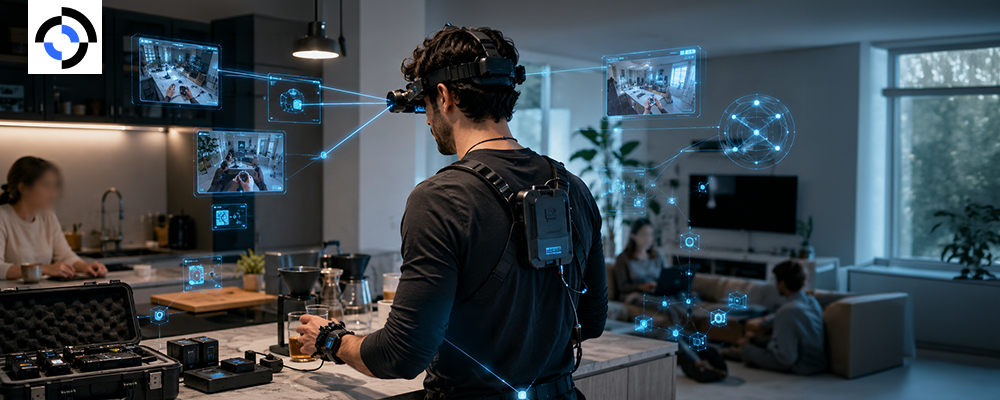
Put a camera rig on a person and you can capture data anywhere, without a robot, at a fraction of the cost per hour. That is the appeal of wearable camera data collection, and it is real. The difficulty is almost never the sensors.
This guide covers what a capture rig actually has to carry, why field logistics rather than engineering is what stalls programmes, how consent works when the camera sees other people, and the quality controls that make the output usable.
Why wearable capture exists
Robot-embodied teleoperation gives exact action labels and is limited by how many robots you own. Wearable human capture removes that ceiling: anyone with a rig can generate data, in any environment, without a robot present.
What you gain is throughput and scene diversity. What you give up is the exactness of the action label, because a human hand is not your gripper. That trade is examined in human demonstration vs teleoperation data.
For pretraining, breadth, and long-tail scene coverage, it is frequently the better purchase per usable episode.
What the rig has to carry
| Component | Purpose | Practical constraint |
|---|---|---|
| Head camera | Primary egocentric view | Stabilise it; head motion blurs badly |
| Hand or wrist cameras | Contact detail | Mounting must survive hours of movement |
| Hand and finger tracking | The action label | Gloves impair natural manipulation |
| 6-DoF pose | 3D grounding, per ego-pose | Drifts over long sessions |
| IMU | Motion between frames | Cheap; include it |
| Audio | Contact and mechanism cues | Captures bystander speech, a privacy issue |
| Local storage | Buffering in the field | Write throughput caps your frame rate |
| Battery | Session length | The real limit on a day’s collection |
Weight and comfort are not secondary considerations. A rig that is tolerable for ten minutes and painful at ninety silently shortens every session and changes how people move while wearing it, which contaminates the data.
Field logistics are the actual difficulty
The engineering is tractable. Running collection across dozens of sites and contributors is where programmes stall.
- Calibration in the field. Rigs shift. A calibration routine that requires a lab cannot be run before each session, so it has to be doable in a kitchen.
- Charging and swapping. Battery life sets the session length. Plan hot-swaps or accept short sessions.
- Data offload. Multi-camera capture fills storage quickly and home broadband uploads slowly. Physical transfer is often faster.
- Verification before people leave. Discovering a dead stream after the contributor has gone means the session is lost. Check on site.
- Rig attrition. Equipment used in real homes gets dropped, spilled on, and lost. Budget for it.
- Scheduling. Contributors in their own homes have lives. Utilisation is lower than any plan assumes.
These are why a crowdsource model needs different infrastructure from a dedicated cell, even when the sensor stack is identical.
Consent when the camera sees other people
A head-mounted camera in a real home records whoever is in that home. The contributor consented. Their family, flatmates, and visitors did not.
This is the defining difference between wearable capture and cell-based collection, and it is a design constraint rather than a paperwork exercise.
- Contributor consent covering what is captured, how long it is retained, and who sees it.
- Household consent from other adults present, obtained before capture rather than after.
- Clear no-capture zones and pause control. Contributors need an easy, obvious way to stop recording, and they must not feel penalised for using it.
- Face and identifier redaction as a pipeline stage, not a manual promise.
- Children. Most programmes exclude environments with children entirely rather than attempt to manage it.
- Withdrawal. A contributor who withdraws should have their data removable, which requires the provenance tracking to support it.
Build redaction and withdrawal in from the start. Retrofitting either into a corpus of thousands of sessions is close to impossible. Our approach is set out in operator consent and expanded in consent and privacy in egocentric capture.
Quality control at a distance
You cannot supervise a contributor in their own kitchen. Quality has to be built into the process instead.
- Automated stream checks on upload. Missing streams, dead cameras, sync drift, and dropped frames flagged before a human looks.
- A calibration ritual at session start and end, giving you a measured drift figure per session.
- Task scripts written for unsupervised use, with photographs of good and bad setups, per task script design.
- Contributor scoring over time, so consistent producers get more work.
- Sampled human review weighted toward new contributors and toward tasks with known ambiguity.
- Fast feedback. A contributor told a week later cannot correct anything; told the same day, they can.
For a programme where paired capture across sources was made to work at scale, our aerial perception case study reports a 3x detection rate from paired drone-and-ground capture.
Frequently asked questions
Is wearable data usable for manipulation policies?
For pretraining and scene understanding, yes and cheaply. For control it needs retargeting onto your embodiment, and the retargeting loss concentrates in fine motion.
How long can a contributor wear a rig?
Comfort and battery both bite sooner than expected. Plan short sessions with breaks; long sessions produce degraded data before anyone notices.
Do we need gloves for hand tracking?
They give better finger data and change how people manipulate objects, which contaminates naturalness. Camera-based tracking is less precise and less intrusive, and for most tasks that is the better trade.
How do we handle data from a contributor who withdraws?
Design for it before you start. Episode-level provenance tracking is what makes withdrawal executable rather than theoretical.
Wearable capture buys breadth cheaply and spends the saving on logistics and consent management. If you are planning a programme and want the field model reviewed, tell us what you are building.