For robots operating in the physical world, seeing an object is only the beginning. A robot must also understand how far away it is, where it sits in three-dimensional space, and how that position relates to the robot itself.
That is where depth cameras become essential.
From robotic grasping and warehouse automation to autonomous navigation and embodied AI, RGB-D sensors provide the spatial information needed to transform camera observations into actionable 3D data. But inaccurate calibration can quietly undermine the entire pipeline. A few millimeters of systematic error can affect object dimensions, point clouds, pose estimation, annotation quality, sensor fusion, and ultimately robot performance.
For data teams, therefore, depth camera calibration should not be treated as a hardware setup task performed once and forgotten. It should be an integral part of robotics data quality assurance.
Why Depth Camera Calibration Matters for Robot Learning
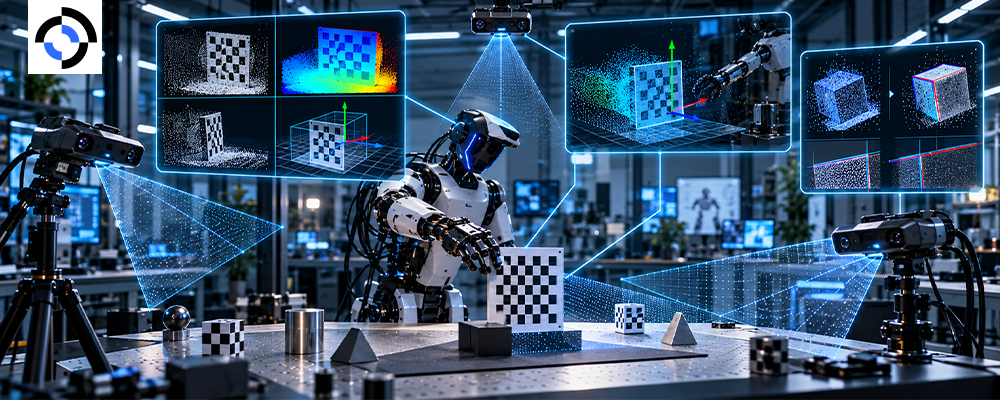
A depth camera does more than capture an image. It generates measurements that must correspond correctly to physical space.
An RGB-D camera typically combines color and depth streams, each with its own imaging characteristics. Calibration establishes the mathematical relationship between these streams and, in robotics applications, between the camera and the robot’s coordinate system.
This includes parameters such as:
- Focal length
- Principal point
- Lens distortion
- Depth scale
- Rotation
- Translation
- RGB-to-depth transformation
- Camera-to-robot transformation
If these parameters are inaccurate, a perfectly trained AI model can still receive geometrically inconsistent data.
RealSense documentation, for example, distinguishes intrinsic parameters such as focal length and distortion from extrinsic parameters involving translation and rotation. Its calibration guidance also recommends targeted calibration where feasible because it can provide more accurate and consistent results than target-less approaches.
This is why sensor calibration robotics workflows should be considered part of the data pipeline rather than an isolated engineering activity.
1. Start With a Controlled RGB-D Camera Setup
A reliable calibration process begins with a repeatable physical configuration.
Before collecting data, document the complete RGB-D camera setup, including:
- Camera model and serial number
- Lens configuration
- Resolution and frame rate
- Camera mounting height and angle
- Distance from the operating workspace
- Firmware version
- Depth scale
- Lighting conditions
- Camera-to-robot mounting position
Consistency matters because changing the physical relationship between the camera and the robot can invalidate previously established extrinsic parameters.
Environmental conditions matter as well. RealSense documentation notes that excessive shock, vibration, and extreme temperature cycling can contribute to calibration degradation.
For production robotics datasets, every physical change should therefore trigger a calibration review.
2. Understand Intrinsic vs. Extrinsic Calibration
One of the most important concepts for data teams is the distinction between intrinsic and extrinsic calibration.
- Intrinsic calibration describes the internal characteristics of the camera—such as focal length, principal point, and lens distortion.
- Extrinsic calibration establishes the camera’s position and orientation relative to another coordinate frame.
Imagine a robotic arm picking an object from a conveyor. The RGB camera identifies the object, while the depth stream determines its 3D position. If the RGB-depth relationship is incorrect, the calculated grasp location may be displaced.
Similarly, if the camera-to-robot transformation is wrong, the robot may correctly understand the object’s location in camera coordinates but move incorrectly in its own coordinate system.
That makes calibration especially important for robotic manipulation, navigation, and multi-sensor learning.
3. Calibrate RGB and Depth Together
A common data-quality mistake is to evaluate depth accuracy independently from RGB-depth alignment.
For many AI and robotics applications, what matters is whether the RGB and depth observations describe the same physical point.
Data teams should validate:
- RGB-to-depth alignment
- Depth-to-camera coordinates
- Camera-to-robot transformation
- Multi-camera registration
- Temporal synchronization where multiple sensors are involved
This is particularly important when datasets are used for object detection, 3D segmentation, pose estimation, grasp prediction, or multimodal robot learning.
A depth value can be numerically correct and still be operationally useless if it is associated with the wrong RGB pixel or coordinate frame.
4. Measure Depth Sensor Accuracy—Don’t Just Inspect It
Visual inspection is useful, but it is not enough.
Teams should establish quantitative benchmarks for depth sensor accuracy using known reference distances and surfaces.
Useful measurements include:
- Absolute depth error
- Relative depth error
- RMS depth noise
- Plane-fitting error
- Invalid-depth percentage
- Depth fill rate
- Repeatability
- Error across different operating distances
RealSense’s technical documentation provides a useful example of why quantitative calibration matters. In one documented test, an approximately 1.2% depth bias was reduced to roughly ±0.2% error around the reference distance following calibration.
The specific result should not be generalized to every camera or operating environment, but it demonstrates an important engineering principle: calibration performance should be measured against ground truth.
5. Use Appropriate Calibration Targets
Calibration targets should provide sufficient visual structure for the sensor to establish reliable geometric relationships.
For supported depth-camera workflows, targeted calibration can correct parameters involving rectification, depth scale, and RGB relationships. RealSense specifically describes targeted calibration as the recommended approach where a suitable target setup is possible.
Data teams should ensure the target:
- Covers an adequate portion of the camera’s field of view
- Is positioned at an appropriate working distance
- Contains sufficient visual features
- Remains stable during capture
- Is measured accurately when ground-truth distance is required
The target itself becomes part of the calibration system. Poor target placement or incorrect target dimensions can compromise the resulting parameters.
6. Test Real-World Failure Conditions
Laboratory calibration does not automatically guarantee production-quality depth.
Robotic environments contain difficult surfaces and conditions, including:
- Reflective metal
- Transparent objects
- Dark materials
- Textureless surfaces
- Fine structures
- Strong sunlight
- Infrared interference
- Moving objects
- Different working distances
These conditions can affect depth density and measurement consistency.
RealSense documentation notes that flat surfaces appearing “wobbly,” reduced depth density, and inaccurate physical-distance measurements can indicate calibration problems.
For data teams, these observations can become automated QA signals.
Instead of asking only, “Is the camera calibrated?”, ask:
“Does the camera continue producing reliable geometry under the conditions represented in our dataset?”
That distinction is critical for production robotics.
7. Recalibrate After Physical or System Changes
Calibration should be event-driven as well as periodic.
Consider a recalibration check after:
- Camera relocation
- Mount replacement
- Robot reconfiguration
- Physical impact
- Significant vibration
- Firmware updates
- Lens or sensor servicing
- Major environmental changes
- Unexpected increases in annotation errors
- Degradation in depth quality
Modern depth-camera platforms may provide self-calibration and quality-assessment tools. RealSense’s self-calibration workflow, for example, allows teams to compare calibration performance before committing updated calibration data, while its health-check mechanism provides an additional diagnostic signal.
This approach is valuable for robotics operations because calibration becomes a measurable maintenance process rather than a subjective visual check.
8. Preserve Calibration Metadata With the Dataset
A high-quality robotics dataset should contain more than images, videos, and annotations.
Calibration metadata should be retained alongside every relevant recording session.
Capture information such as:
- Camera serial number
- Intrinsic parameters
- Extrinsic parameters
- Depth scale
- Coordinate-frame definitions
- Firmware version
- Resolution
- Frame rate
- Calibration timestamp
- Validation measurements
This creates traceability.
If a model suddenly performs poorly on a dataset six months later, engineers can determine whether the issue originated from the model, annotation process, sensor configuration, or calibration state.
For large-scale robot learning programs, this level of provenance can significantly simplify dataset debugging and version management.
9. Make Calibration Part of Robotics Data QA
The strongest approach is to integrate calibration directly into the data pipeline.
At Roborax, we view sensor quality and dataset quality as interconnected. A robotics dataset is only as useful as the reliability of the observations from which it was created.
Automated QA can flag:
- Abnormal depth noise
- Excessive geometric error
- Low depth fill rates
- RGB-depth misalignment
- Unexpected coordinate transformations
- Calibration drift
- Configuration inconsistencies
This creates a continuous quality loop:
Capture → Calibrate → Validate → Annotate → QA → Train → Evaluate
Instead of discovering sensor problems after model training, teams can identify them before poor-quality data enters the learning pipeline.
Building Reliable Robotics Data With Roborax
The future of robotics depends on machines learning from increasingly complex physical-world data. But sophisticated models cannot compensate for unreliable sensor measurements.
Depth camera calibration is therefore more than a technical maintenance task. It is a foundation for trustworthy 3D data, accurate annotations, robust sensor fusion, and dependable robot learning.
Roborax helps robotics and AI teams build structured data pipelines for physical AI—including data collection, sensor-aware workflows, annotation, validation, and quality assurance.
Whether you’re developing robotic manipulation systems, autonomous mobile robots, warehouse automation, or next-generation embodied AI, Roborax can help turn raw sensor observations into high-quality training data engineered for real-world performance.
Build Better Robotics Data With Roborax
Ready to improve the reliability of your robot training datasets? Partner with Roborax to build scalable, quality-controlled robotics data pipelines—from sensor capture and calibration-aware QA to annotation and model-ready datasets.
- Frequently asked questions
- How often should depth cameras be recalibrated?
Intrinsics rarely, unless the camera is physically disturbed. Extrinsics and depth-baseline accuracy should be spot-checked every session, especially in field environments with temperature swings or vibration.
- Can calibration errors be corrected after data collection?
Extrinsic errors can sometimes be corrected in post-processing if you have a reliable reference (like a known fixed landmark in the scene). Depth-baseline errors generally cannot be recovered after the fact — this is why validation at capture time matters more than cleanup afterward.
- Does calibration matter equally for all task types?
No. Precision manipulation tasks are far more sensitive to calibration drift than mobile navigation or coarse pick-and-place. Match your calibration rigor to your task’s actual accuracy requirements.
If your dataset’s geometry needs to be trustworthy enough to train on, talk to Roborax about a capture program with calibration validation built into every session.
- Related reading
External reference