
Robots are becoming more capable—but capability is only as strong as the data behind it.
From autonomous mobile robots and warehouse manipulators to humanoids and intelligent industrial systems, modern robots must learn from increasingly diverse physical-world interactions. That means robotics companies need data that captures not only successful actions, but also variations in environments, human behavior, object interactions, sensor conditions, and failure scenarios.
The scale of this challenge is growing rapidly. According to the International Federation of Robotics (IFR), 542,076 industrial robots were installed globally in 2024, with the operational stock reaching approximately 4.66 million units. IFR also reports that 2025 became a record year, with annual installations surpassing 600,000 units for the first time.
As robotics deployment accelerates, companies face a strategic question: Should robot training data be collected in-house, or should teams use outsourced and crowdsourced resources?
The answer depends on the data requirement, but increasingly, a hybrid approach is emerging as the practical path forward.
Why Robotics Data Collection Is Different
Collecting data for robotics is fundamentally different from gathering conventional computer vision or text datasets.
A robot does not simply need to recognize an object. It may need to understand where an object is located, how it can be grasped, how much force is required, how the object moves, and what action should follow.
For embodied AI systems, data can include:
- Teleoperation demonstrations
- Robot trajectories
- Human demonstrations
- RGB, RGB-D, and multimodal sensor data
- Force and tactile signals
- Proprioceptive data
- Object manipulation sequences
- Navigation trajectories
- Failure and recovery scenarios
- Human-robot interaction data
Stanford’s 2025 AI Index highlights the importance of expanding robotic training data and notes that Google’s AutoRT generated 77,000 robotic trials across 6,650 unique tasks.
This illustrates a critical point: robotics teams increasingly need scale and task diversity, not merely larger versions of traditional datasets.
The Case for In-House Data Collection
In-house data collection gives robotics companies maximum control over the collection environment.
Engineering teams can directly define how robots should perform a task, what sensors should be used, which edge cases matter, and what quality thresholds the dataset must meet.
This approach is particularly valuable when working with:
- Proprietary robotic platforms
- Safety-critical applications
- Highly specialized manipulation tasks
- Sensitive environments
- Experimental hardware
- Early-stage research and development
Another major advantage is feedback speed. If engineers discover that a model struggles with a particular grasping configuration, the internal team can immediately modify the collection protocol and capture additional examples.
However, maintaining an entirely internal operation can become expensive and operationally demanding. Companies may need dedicated facilities, operators, robotics equipment, sensor systems, data managers, safety processes, and quality-control personnel.
This is where the in-house vs outsourced data decision becomes more nuanced.
The Case for Crowdsourced Robot Data Collection
Crowdsourced robot data collection provides an alternative route to scale.
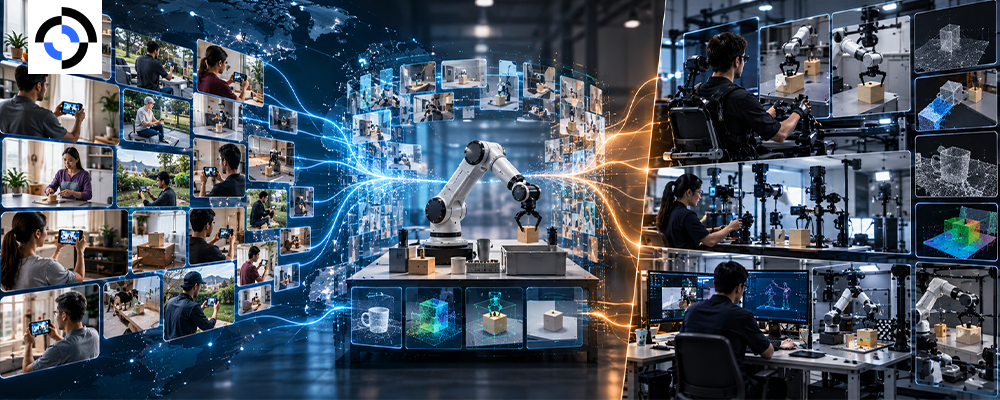
Instead of relying entirely on a fixed internal workforce and facility, robotics companies can leverage distributed contributors or specialized external teams to execute predefined collection tasks.
The biggest advantage is scalability.
A robotics company developing a household robot, for example, may eventually need data representing different homes, objects, layouts, lighting conditions, users, and interaction styles. A single laboratory cannot easily reproduce the full diversity of the physical world.
A distributed collection model can help expand that coverage.
Crowdsourcing can also help robotics teams increase collection capacity during intensive model-training cycles without permanently expanding their internal infrastructure.
But scale without governance can create another problem: inconsistent data.
Crowdsourced contributors need precise instructions, standardized protocols, task qualification, sensor checks, metadata requirements, and rigorous quality assurance. Otherwise, more data can simply mean more noise.
Building the Right Robotics Data Workforce
The real competitive advantage is not choosing between internal and external teams. It is building the right robotics data workforce for each stage of development.
Internal robotics engineers should typically retain ownership of:
- Dataset specifications
- Task definitions
- Collection protocols
- Safety requirements
- Evaluation criteria
- High-value edge cases
- Dataset validation
External or distributed teams can provide scalable support for:
- Demonstration collection
- Teleoperation
- Repetitive task execution
- Multimodal data capture
- Dataset expansion
- Initial quality screening
- Large-scale collection campaigns
This creates a model where engineering expertise remains close to the robot while operational capacity can scale when required.
As IFR notes, robotization can also create opportunities for employment and skill development in firms adopting robotics.
The implication is important: humans remain an essential component of the robotics development loop—even as robots become increasingly autonomous.
Quality Matters More Than Dataset Size
One of the biggest misconceptions in robotics is that simply collecting more demonstrations will automatically improve model performance.
It will not.
A million inconsistent demonstrations can be less valuable than a carefully designed dataset containing diverse, accurately captured, task-relevant examples.
Effective robotics data programs should therefore measure:
- Diversity: Are different environments, objects, users, and operating conditions represented?
- Consistency: Were collection procedures followed correctly?
- Coverage: Does the dataset include failures and edge cases?
- Accuracy: Are trajectories, labels, timestamps, and sensor data reliable?
- Relevance: Does the data correspond to the robot’s intended tasks?
- Traceability: Can datasets be versioned and linked back to collection conditions?
This is where professional data collection sourcing becomes strategically important.
Why a Hybrid Model Is Often the Best Choice
For many robotics companies, the choice does not need to be either/or.
A hybrid model can combine the strengths of both approaches.
An internal team can establish the task definition, collect high-value seed demonstrations, and validate the initial dataset. A specialized external partner can then scale robotic data collection across environments and contributors while operating under the same technical specifications.
The resulting workflow can look like this:
Define → Pilot → Validate → Scale → Quality Check → Retrain → Refine
This approach enables robotics teams to maintain technical control without forcing their engineers to manage every operational detail of data collection.
It also makes the dataset development cycle more responsive. As model performance reveals new weaknesses, collection requirements can be updated and additional targeted data can be generated.
Why Roborax for Robotics Data Collection?
At Roborax, we understand that robotics data is not simply a volume game. Physical AI requires data engineered around tasks, environments, sensors, robot behaviors, and real-world variability.
Our approach is designed to support robotics teams across the data lifecycle—from structured collection and teleoperation to human demonstrations, multimodal sensor capture, edge-case generation, and quality assurance.
Whether a robotics company needs a controlled internal dataset, scalable external collection, or a hybrid data pipeline, the objective remains the same: generate reliable data that helps robots learn better and generalize beyond the lab.
The robotics industry is scaling rapidly. With global robot installations crossing 600,000 units in 2025, according to IFR, the demand for scalable and high-quality training data will only become more significant.
The Future of Robotics Data Is Hybrid
The debate around crowdsourcing versus in-house collection should not be reduced to cost or headcount.
The better question is:
Which data should remain close to the robotics engineering team, and which data can be scaled through a specialized external workforce?
For proprietary, safety-critical, and experimental tasks, in-house collection can provide essential control. For broad task coverage and scalable dataset expansion, crowdsourced and outsourced approaches can provide valuable capacity.
The strongest robotics data strategies will combine both.
Roborax helps robotics teams turn that strategy into an operational data pipeline—bringing together human expertise, scalable collection, rigorous quality control, and robotics-specific workflows.
Ready to Build Better Robot Training Data?
Whether you are developing humanoids, autonomous mobile robots, warehouse systems, industrial manipulators, or next-generation Physical AI, the right data strategy can accelerate model development and improve real-world performance.
Partner with Roborax to design and scale a robotics data collection program built around your robot, your tasks, and your deployment environment.
Talk to Roborax today and start building the data foundation for your next generation of intelligent robots.
Frequently asked questions
Q: Is crowdsourced data lower quality than in-house data?
A: Not inherently — it’s more variable, which requires more QA investment to reach the same quality bar, but well-managed crowdsourcing with strong task instructions and QA can produce highly usable data, especially for human demonstration.
Q: Can crowdsourcing work for teleoperation?
A: Rarely for specialized robot hardware, since it requires training and access to equipment most distributed contributors don’t have. It’s better suited to tasks performable with commodity hardware.
Q: How do you maintain consistent quality across a hybrid program?
A: By applying the same QA pipeline, schema, and agreement metrics regardless of collection source, so the training set doesn’t carry a visible quality difference between crowdsourced and in-house episodes.
If you’re not sure which collection model fits your next data need, talk to Roborax about designing a mix suited to your task and timeline.
Related reading
- Build vs. Buy: The True Cost of Robot Data Collection
- Audio Data for Robots: When Sound Matters in Training Sets
External reference