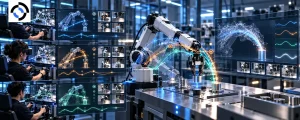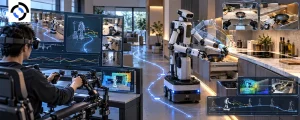
Robots have learned to see. They can recognize objects, estimate depth, track motion, and interpret complex environments through cameras and other sensors. But physical environments communicate in another powerful way: sound.
A click can indicate that a component has locked into place. A scrape can reveal contact between surfaces. A sudden impact can signal a dropped object. A motor’s changing acoustic signature can indicate altered operating conditions. Human speech can provide instructions that connect language to physical action.
As robotics moves toward embodied AI, multimodal learning, and increasingly autonomous machines, audio is becoming a valuable component of robot training data. At Roborax, we see audio not as an optional dataset layer, but as a potentially important signal for teaching robots how physical events sound, occur, and evolve over time.
Why Audio Matters in Robot Training
Most robotic training pipelines have historically concentrated on visual data, trajectories, force measurements, and other sensor streams. Vision remains essential, but it does not capture every aspect of physical interactiaon.
A camera may show a robotic gripper approaching an object. It may even capture the moment of contact. But visual information alone may not clearly reveal whether the gripper has established a stable grasp, whether two materials are rubbing, or whether a mechanical connection has clicked into position.
Sound can provide complementary evidence.
Researchers Abitha Thankaraj and Lerrel Pinto described this limitation directly in their 2023 Conference on Robot Learning paper “That Sounds Right: Auditory Self-Supervision for Dynamic Robot Manipulation,” noting that “pure vision often fails to capture high-frequency interaction.”
Their work demonstrates why audio deserves greater attention in robot-learning datasets.
The researchers collected 25,000 interaction-sound pairs across five dynamic tasks using contact microphones. Their self-supervised audio approach achieved 34.5% lower mean squared error than plain supervised learning and 54.3% lower MSE than visual training in their experiments. Their real-robot experiments also reported an average 11.5% improvement over supervised learning on audio similarity metrics.
These results do not suggest that audio should replace vision. Instead, they demonstrate the potential value of adding another sensory perspective to robot learning.
What Can Robots Learn From Sound?
Audio can encode information about events, materials, interactions, and environments that may be difficult to infer from visual data alone.
1. Contact and Manipulation Events
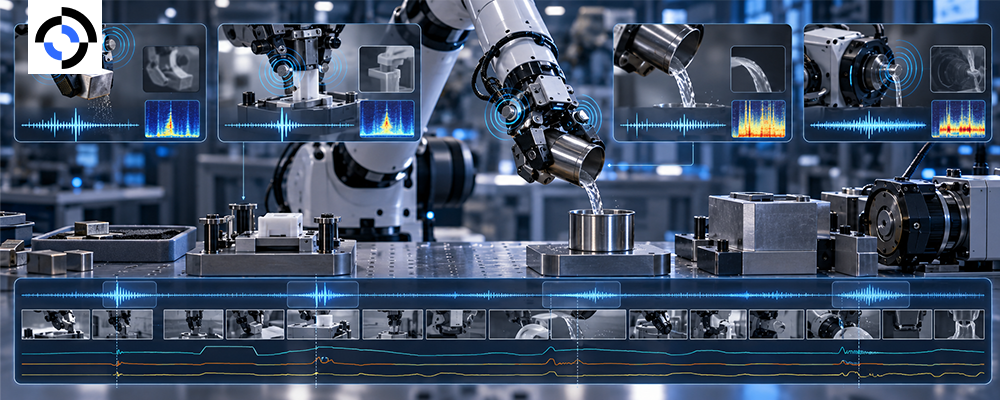
Physical interactions frequently generate distinctive acoustic signatures.
A robot opening a drawer, placing an object on a table, inserting a component, tightening a mechanism, or dropping an item can produce sounds that correlate with specific task states.
Training datasets can therefore annotate:
- Contact initiation
- Object impact
- Sliding and scraping
- Mechanical clicks
- Collision events
- Object drops
- Release events
- Task completion sounds
- Abnormal or unexpected sounds
When these labels are synchronized with robot actions and visual observations, they can help models associate acoustic events with physical outcomes.
2. Material and Surface Recognition
Sound can also reveal information about material properties.
Consider a robot tapping two visually similar objects. Their appearance may provide limited information, while the resulting acoustic response can differ substantially.
Robotic audition research has explored acoustic interaction data for tasks such as sound-source localization, separation, and auditory scene analysis. The AIRA corpus, for example, was recorded across six real-life environments with varying noise and reverberation conditions, demonstrating the importance of environmental diversity when developing robotic audio systems.
For robot-learning teams, this reinforces an important dataset principle: audio should be collected across varied environments rather than under perfectly controlled acoustic conditions alone.
Audio Becomes More Powerful When Combined With Other Sensors
The greatest opportunity is not audio in isolation. It is multimodal sensor fusion.
Imagine a robotic arm performing an insertion task.
The RGB camera captures the object and surrounding environment.
The depth stream estimates the relative geometry.
The robot’s joint data records the movement trajectory.
Force or tactile sensing captures physical contact.
The microphone records the acoustic event generated when the component reaches its final position.
Together, these signals provide a substantially richer description of the interaction.
A well-designed RGB-D camera setup can therefore work alongside audio sensors to capture both visual and geometric context. Meanwhile, disciplined sensor calibration robotics procedures help maintain consistent relationships between cameras, robot coordinates, and other sensing systems.
Even depth sensor accuracy can influence multimodal dataset quality because reliable geometric information helps contextualize where an acoustic event occurred and what physical interaction accompanied it.
At Roborax, we approach these datasets as interconnected systems rather than collections of unrelated files.
What Should Audio Training Data Include?
Recording sound is only the first step. High-value audio datasets require meaningful structure and annotation.
Depending on the application, Roborax-supported data workflows can incorporate:
Acoustic event labels:
Identify clicks, impacts, scraping, collisions, speech, alarms, and other relevant events.
Temporal boundaries:
Mark precisely when an acoustic event begins and ends.
Sound-source information:
Identify or localize the source when the application requires it.
Task-state labels:
Connect sound events with states such as grasped, released, inserted, failed, or completed.
Environmental conditions:
Record background noise, reverberation, machinery, human activity, and other acoustic variables.
Cross-modal synchronization:
Align audio with video, depth, robot trajectories, and other sensor streams.
This structure allows downstream models to learn relationships rather than simply memorize isolated sound clips.
The Challenge: Real-World Audio Is Messy
Robotic audio datasets cannot assume laboratory-perfect conditions.
A robot operating in a warehouse may encounter machinery, footsteps, alarms, conversations, ventilation systems, and moving vehicles. A household robot may encounter televisions, kitchen appliances, conversations, and overlapping sounds.
A major survey of multimodal perception for human-robot interaction identifies noise, reverberation, and multiple simultaneous sound sources as continuing challenges for robotic audition.
This makes dataset diversity essential.
A robust training set should deliberately capture variations in:
- Background noise
- Room acoustics
- Microphone position
- Robot speed
- Object materials
- Interaction intensity
- Reverberation
- Multiple simultaneous sound sources
- Human speech
- Mechanical and environmental sounds
The objective is not simply to create clean audio. It is to create representative audio.
From Audio Collection to Actionable Robot Intelligence
For robotics teams, the value of audio data ultimately comes from what a model can learn from it.
A robot should not merely recognize that it heard a sound. It may need to understand what that sound means within the context of an ongoing task.
For example:
- Sound: Mechanical click
- Visual context: Gripper approaching connector
- Robot state: Insertion trajectory completed
- Task label: Successful insertion
This creates a multimodal relationship between perception, action, and outcome.
Such relationships can support applications ranging from robotic manipulation and industrial automation to warehouse robotics, human-robot interaction, inspection, and embodied AI.
How Roborax Helps Build Multimodal Robot Training Data
Building these datasets requires more than recording multiple sensor streams. It requires consistent collection, precise annotation, synchronization, quality control, and scalable dataset management.
Roborax helps robotics teams develop structured training-data pipelines covering audio, video, RGB-D, sensor, teleoperation, and other modalities.
Our focus is on transforming raw sensory information into organized datasets that machine-learning teams can actually use. Whether the objective is acoustic event detection, multimodal behavior learning, robot manipulation, or embodied AI, Roborax can help teams structure the data foundation behind the model.
Final Thoughts: Robots Need More Than Eyes
The next generation of robots will operate in environments that are dynamic, noisy, and unpredictable. Seeing the environment is essential, but seeing alone may not always explain what is happening.
Sound can provide another layer of context—particularly during contact-rich interactions where milliseconds, material properties, and subtle physical events matter.
Research already demonstrates measurable benefits from incorporating audio into robot-learning pipelines. The 25,000-pair interaction-sound dataset developed by Thankaraj and Pinto provides one concrete example of how auditory information can contribute to learning dynamic robotic behaviors.
For robotics developers, the opportunity is therefore not simply to teach robots to hear.
It is to teach them to understand what they hear, when it happens, and what it means for the task they are performing.
Build Smarter Robot Training Data With Roborax
Ready to incorporate audio and multimodal sensing into your robotics data pipeline?
Partner with Roborax to build high-quality audio, video, RGB-D, sensor, and multimodal training datasets designed for the demands of modern robot learning.
Talk to Roborax today and turn raw sensory signals into training data that helps your robots learn from the real world.
Frequently asked questions
Q: Is audio worth it for most robot training programs?
A: For most programs, no — it’s a targeted addition for specific tasks where sound carries information vision can’t. Adding it by default across an entire program usually adds cost without proportional training benefit.
Q: How is audio data typically labeled?
A: Often as event annotations aligned to a timestamp — “slip onset,” “contact,” “fastener seated” — rather than dense frame-by-frame labeling, since the relevant information is usually a discrete event rather than a continuous stream.
Q: Does audio need the same synchronization rigor as multi-camera data?
A: Yes. An audio event that’s poorly aligned to the visual and action data around it teaches the model an incorrect temporal relationship, the same failure mode as desynced cameras.
If a task in your pipeline has an acoustic signatureyou’re currently ignoring, talk to our data team about whether audio capture is worth adding to your next collection run.
Related reading
External reference