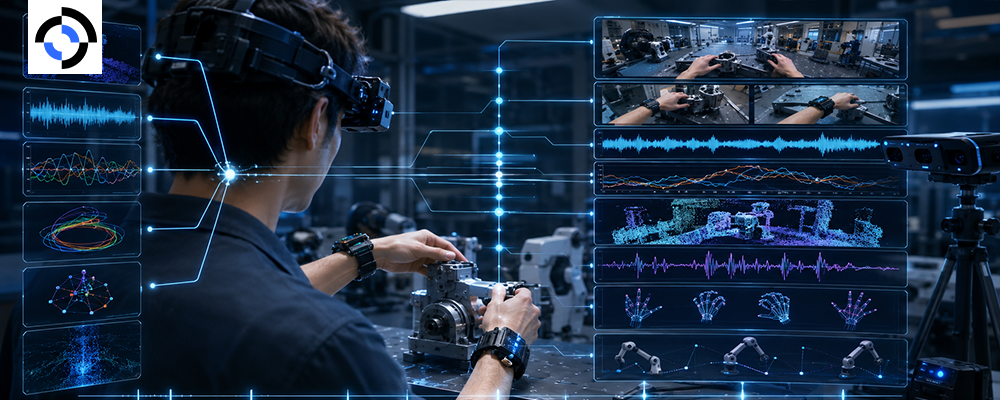
Buying the sensors is the easy part of multi-modal egocentric data capture. The hard part is that eight streams running at eight different rates have to agree on when things happened, to within a few milliseconds, across sessions that run for hours.
This guide covers why synchronization is the entire problem, what each stream uniquely contributes, the three ways to sync ranked by reliability, how to catch drift before it ruins a batch, and a build order that avoids the usual mistake.
Why sync is the whole problem
Multi-modal capture sounds like a hardware exercise: buy the sensors, mount them, press record. The hardware is the easy part. The difficulty is that six streams running at six different rates on three different clocks have to be related to each other precisely enough that a model can learn cause and effect.
Get that wrong and every stream is individually perfect and collectively useless. A force spike attributed to the wrong frame teaches the model that contact happens before the hand arrives.
The rule of thumb
Sync error should be small relative to the fastest thing you care about. For contact events, that is milliseconds. A dataset synced to within a video frame is not synced for manipulation.
The streams and what each contributes
| Stream | Typical rate | Uniquely provides |
|---|---|---|
| Head RGB | 30-60 fps | Scene context and attention direction |
| Wrist RGB | 30-60 fps | Contact detail during final approach |
| Depth | 15-30 fps | Distance and object geometry |
| IMU | 100-1000 Hz | Fast motion between camera frames |
| 6-DoF pose | 60-200 Hz | Where the camera was, per ego-pose |
| Force and torque | 500-1000 Hz | Contact quality; invisible to every camera |
| Audio | 44-48 kHz | Contact onset, breakage, mechanism clicks |
| Actions | Control rate | What was commanded |
Audio is the stream teams skip and later miss. A latch clicking, a glass ringing, liquid pouring: these are precise, cheap, high-rate contact signals that no camera provides.
Three ways to sync, in order of preference
- Hardware trigger. One signal drives capture across devices. The gold standard, requires sensors that accept external triggers, and worth specifying at purchase.
- Shared clock with timestamping at source. Every device stamps its own samples from a common time source. Very good, and the realistic choice for most builds.
- Post-hoc alignment on a shared event. A clap, a flash, a deliberate tap visible and audible across streams. Workable, and it corrects offset but not drift.
What does not work is assuming a constant rate and counting samples. Devices drop frames silently, buffers stall under load, and by the end of a long session the streams have separated by an amount nobody measured.
Drift, and how to catch it
Offset is a constant error and easy to correct. Drift accumulates and is far more damaging, because a dataset can be well synced at the start of a session and badly synced at the end, with nothing in the files indicating where it went wrong.
- Sync-check at both ends. A shared physical event at the start and end of every session gives you a measured drift figure per session.
- Record the figure in metadata. It becomes a filter criterion later rather than a reason to discard a whole batch.
- Log actual sample timestamps, never inferred ones. Nominal rate is a setting, not a measurement.
- Alarm on dropped samples. A stream that quietly loses ten percent of its samples looks normal in review.
These checks belong in automated QA at collection time, which is the argument in the robotics data QA pipeline.
What to do when a modality is missing
Real programmes end up with partial data. A rig loses its depth sensor for a week; a batch was recorded before force sensing was fitted. The instinct is to discard those episodes. Usually that is wrong.
Record modality availability per episode as explicit metadata, and treat missing streams as a known condition rather than an absence. Models can be trained on subsets, and an episode missing depth is still fully useful for anything that did not need depth. What ruins a dataset is not missing modalities; it is missing modalities that were never recorded as missing, so nobody can tell which episodes have what.
For a programme that reached production quickly with disciplined multi-stream capture, our mobile manipulation case study covers a 90-day path from cold-start to production.
A practical build order
- Start with head RGB, wrist RGB, and actions on one clock. Prove sync before adding anything.
- Add force and torque next if the task involves contact at all.
- Add pose, which you may already have free from a headset.
- Add depth if reach and geometry matter, per RGB-D guidance.
- Add IMU and audio last. Both are cheap and neither is the bottleneck.
Adding streams before sync is proven is the most common way to produce a large dataset nobody trusts.
Frequently asked questions
How tightly do streams need to be synced?
Tightly enough that the fastest event you care about lands on the right frame. Contact events are the strictest case, and they are measured in milliseconds rather than frames.
Can we sync in post-processing?
You can correct a constant offset if a shared event exists in the streams. You cannot reliably correct drift, and you cannot recover samples that were never timestamped.
Is audio really worth capturing?
It is cheap, high-rate, and often the clearest signal of contact onset and mechanism state. For the storage cost it is one of the better returns available.
What if our sensors cannot share a clock?
Use a shared physical event at the start and end of every session, measure the drift, and record it. It is a workaround rather than a solution, and it is much better than assuming alignment.
Multi-modal capture is a synchronization discipline wearing a hardware costume. The sensors are the easy purchase; the clock architecture is what determines whether the data trains anything. If you want a sensor stack reviewed before you commit, tell us what you are building.