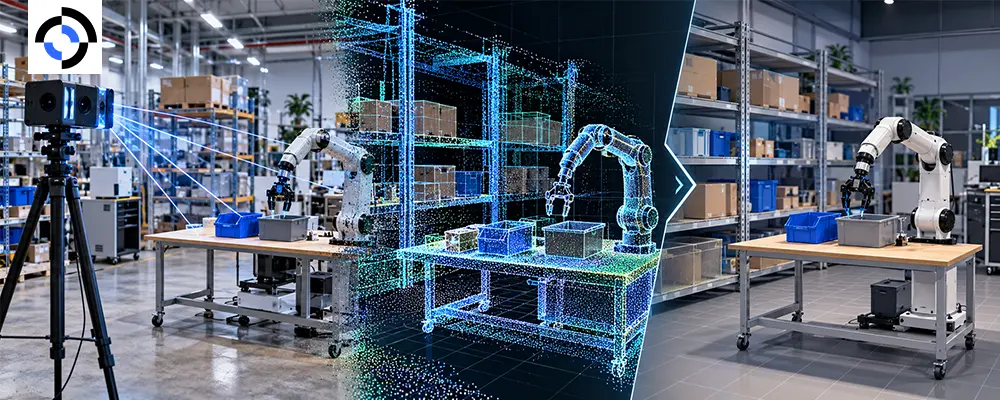
Most simulated environments are invented. A digital twin is the opposite: a simulation built from a real place, so the robot trains in a scene that looks, measures and behaves like the one it will work in. Done well, digital twin robotics closes part of the reality gap before the first training run.
This guide walks through the real-to-sim pipeline: how scans become 3D scene reconstruction, how raw geometry becomes physics-ready simulation asset creation, and where the effort pays off. For how twins help plan collection, see our guide to digital twins for data collection planning.
What a robot-ready twin needs
A pretty mesh is not a twin. A twin that supports policy training needs four things:
- Accurate geometry: metric scale, correct dimensions and real clearances
- Collision shapes: simplified, watertight geometry the physics engine can handle
- Physical properties: mass, friction and joint limits for articulated parts
- Appearance: textures and materials good enough for a perception model to treat as plausible
Miss any one and the twin fails in a specific way. Wrong scale breaks reach, bad collision shapes cause jitter, guessed friction breaks grasps, and flat materials widen the visual gap.
The real-to-sim pipeline
- Capture. Walk the space with a depth or LiDAR rig and a calibrated camera set, or photograph objects from many views. Record scale references and lighting. Plan coverage so occluded areas, such as under shelves and behind doors, are not left to guesswork.
- Reconstruct. Photogrammetry, LiDAR mapping or neural methods turn captures into geometry. Neural radiance fields, introduced by Mildenhall and colleagues, excel at “synthesizing novel views of complex scenes,” though a mesh remains the usual input to physics engines.
- Clean and scale. Remove noise, fill holes, align to a metric frame and separate the scene into objects.
- Make it physical. Generate collision geometry, assign mass and friction, and rig articulated objects such as doors, drawers and hinges.
- Assemble and export. Compose assets into a scene in the format your simulator expects, such as USD, URDF or MJCF.
- Validate against the real world. Replay logged real trajectories in the twin and compare outcomes.
Static scenes versus manipulable objects
Scanning a room is the easy part. The hard part is the objects robots touch. Static scenery can be a single mesh. Manipulable objects need individual assets with plausible mass and friction, and articulated objects need correct joint axes and limits.
Budget effort accordingly. Invest in the small set of objects your task involves rather than every item in the room.
Where digital twins earn their cost
- Collection planning: test camera placement and reachability before moving hardware.
- Synthetic environment generation at scale: vary layouts, lighting and object placement inside a faithful base scene instead of an invented one.
- Safe failure data: simulate collisions and edge cases you would never stage on a real robot, as in our guide to synthetic data for rare failure scenarios.
- Evaluation: run policy tests in a twin of the deployment site before rollout.
- Customer-specific sites: warehouses, kitchens and clinical spaces where on-site training is slow or restricted.
Pitfalls that undermine a twin
- Overfitting to the twin. A policy trained in one twin learns that room. Randomize around it, using the parameters covered in our guide to domain randomization for manipulation.
- Scale errors. A few percent of scale error becomes a missed grasp. Verify against known dimensions.
- Stale twins. Furniture moves and shelves restock. Version twins and re-scan on a schedule.
- Mistaking looks for fidelity. A photorealistic twin with wrong friction still fails at contact. Validate physics, not just visuals.
Real data is still the anchor
A twin is a hypothesis about the real site, and real demonstrations from that site are how you test it. Roborax combines on-site collection with simulation through our synthetic and sim-to-real service, so the twin and the data validate each other. Choosing the engine matters too, and our comparison of Isaac Sim, MuJoCo and Gazebo covers the trade-offs.
Frequently asked questions
Q: Photogrammetry, LiDAR or neural reconstruction?
A: Photogrammetry suits objects and textured scenes, LiDAR gives reliable metric geometry for large spaces, and neural methods give strong appearance. Many pipelines combine LiDAR for geometry with image-based methods for texture.
Q: How accurate must a twin be?
A: Accurate enough that the quantities your policy depends on, such as reach distances and contact geometry, match reality. Verify by replaying real trajectories rather than relying on a single millimeter figure.
Q: Can we build a twin without scanning?
A: Yes, from CAD files or floor plans, but you lose real clutter, wear and lighting. Scans capture the messiness that makes real sites hard.
A twin is only as useful as the validation behind it. If you are planning a real-to-sim pipeline for a specific site or product line, tell us what you are training and we will scope the capture and the real-world validation set together.