
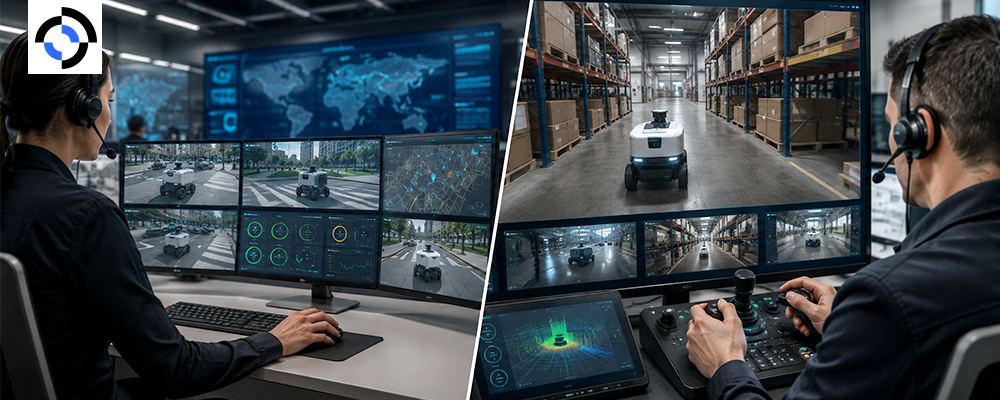
Two teams can both say they run teleoperation for their robot fleet and be doing entirely different jobs. The remote assistance vs remote driving distinction determines your latency requirements, your staffing ratio, your safety case, and increasingly your regulatory position.
This guide sets out the difference precisely, explains why the autonomous vehicle industry has drifted decisively toward assistance, covers where remote driving is still genuinely needed, and how to design a system that keeps the two modes separate.
The distinction in one line
In remote assistance, the human answers a question and the robot decides what to do with the answer. In remote driving, the human is the one moving the vehicle.
That sounds like a technicality. It changes the latency budget, the operator skill profile, the safety architecture, the regulatory position, and the shape of the data you end up with.
Side by side
| Remote assistance | Remote driving | |
|---|---|---|
| Who controls motion | The robot | The human |
| Human output | A decision or a path suggestion | Continuous control input |
| Latency tolerance | Seconds | Milliseconds |
| Effect of a dropped link | Robot waits safely | Robot loses its driver mid-motion |
| Operator load | One operator, many robots | One operator, one robot |
| Skill required | Situational judgement | Vehicle control under degraded feedback |
| Scales with fleet size | Yes | Poorly |
| Data produced | Labelled decisions at failure points | Control trajectories |
The staffing line is the commercial one. Assistance lets a single operator supervise many robots because attention is only needed at discrete moments. Driving occupies one operator completely for the duration, so the model stops scaling almost immediately.
Why the industry has drifted toward assistance
The clearest public statement of this position comes from Waymo, which told Senator Ed Markey in a February 2026 letter that it does not use remote driving where a human performs the dynamic driving task. Its remote agents supply guidance the vehicle can accept or reject rather than steering it directly. Waymo has also described a recovery tool for stuck vehicles limited to 2 mph with fixed steering, which by its own account had not been used on a public road.
The reasoning is not complicated. Remote driving over a cellular link means variable latency, a narrow field of view, and no physical feel for the vehicle. Those are exactly the conditions under which human control degrades, and the consequences arrive at road speed. Remote driving incidents have since appeared in regulatory crash filings, which has sharpened the industry’s caution considerably.
The latency argument is the same one we make for collection cells in teleoperation latency budgets, with higher stakes: a bad demonstration wastes an episode, a bad remote driving input hits something.
Where remote driving is still needed
Assistance does not cover everything. Some situations genuinely require a human to move the machine.
- Recovery from a state the policy cannot plan out of. Wedged against an obstacle, or oriented in a way the planner cannot resolve.
- Clearing a hazard. Moving off a live carriageway or out of a doorway, where waiting is the worse option.
- Low-speed manoeuvring in confined space. Loading bays, lifts, service corridors.
- Controlled environments. Warehouses and industrial sites where the network is yours and bystander risk is managed, as in industrial teleoperation.
Note what these have in common: low speed, short duration, and a defined objective. That is the envelope. Remote driving as a general operating mode is a different proposition from remote driving as a bounded recovery tool, and the industry has converged on the second.
Designing the split properly
- Make assistance the default and remote driving an explicit escalation with its own authorisation step.
- Cap the driving envelope. Speed limit, steering limits, and a maximum duration after which control reverts.
- Fail safe on link loss in both modes, and never continue on last command.
- Show latency continuously. An operator who cannot see the delay will act as though there is none.
- Log which mode was used per event, because the two produce different data and should never be pooled unlabelled, per log design.
- Track escalation rate from assistance to driving. A rising rate means your assistance tooling is too weak, not that your robots got worse.
What each mode gives you as data
Assistance produces labelled decisions at the exact points where the policy was uncertain. That is close to ideal supervision: the state, the question the robot asked, and the answer a competent human gave. It maps directly onto improving the planner.
Remote driving produces control trajectories through difficult situations. Useful for imitation learning, and carrying every artifact of a human operating under latency with poor situational feedback, which is the distortion described in human demonstration vs teleoperation data.
Both feed the loop in from intervention to training data, and they should be tagged distinctly so a training run can weight or exclude either.
How wide the range really is
California’s 2024 disengagement reporting gives a sense of the spread between mature and early-stage deployments. Waymo reported roughly one disengagement per 9,793 miles. May Mobility, operating shuttles, reported intervention roughly every 0.66 miles.
That is a vast gap between operators in the same industry in the same year, and it is the clearest available evidence that intervention rate rather than fleet size determines whether remote operations is a modest overhead or the dominant cost of the business. We work through the implications in intervention rate.
For a programme where operating discipline moved a measurable outcome, our mobile manipulation case study covers a 90-day path from cold-start to production.
Frequently asked questions
Is remote assistance the same as a safety driver?
No. A safety driver is physically present and can take over immediately. A remote assistant is not in the vehicle, works through a network link, and in most designs cannot take direct control at all.
What latency does remote assistance tolerate?
Far more than driving, because the output is a decision rather than continuous control. Seconds are usually workable, which is what makes the mode viable over public networks.
Can one operator really supervise many robots?
In assistance mode, yes, because attention is needed only at discrete events. The practical ratio depends on intervention rate and resolution time rather than on any fixed number.
Which mode should we build first?
Assistance, with a tightly bounded driving fallback. Building driving first tends to entrench it as the default, and it is the mode that does not scale.
The two modes look similar on an org chart and behave completely differently in operation and in cost. If you are designing a remote operations function and want the split reviewed before you build tooling, tell us how your fleet is instrumented.