
Depth Camera Calibration Best Practices for Data Teams
For robots operating in the physical world, seeing an object is only the beginning. A robot must also understand how far away it is, where

Home / Data services / Teleoperation
VR, exo, and bilateral leader-follower rigs. The shortest path from human intent to robot training data.
Teleoperation is the process of a human operator controlling a robot in real time — through VR headsets, exoskeletons, or leader-follower rigs — while every joint position, force reading, and camera frame is logged at high frequency. The result is egocentric demonstration data: the exact trajectories a policy needs to learn the task.
Building a teleop program in-house means sourcing rigs, hiring operators, and standing up QA — months before a single trajectory ships. We eliminate that ramp.
Why outsource teleop?
Your ML team should be training policies, not debugging rigs. We handle collection so you ship models faster.
4 weeks from scoping call to production data.
12 active pods across three continents.
99.4% SLA on delivery timelines.
Where we collect
41+ delivery centers across 12 countries. Every program runs from a Roborax hub near your target time zone.
Asia Pacific
India · Philippines
Americas
USA · Canada · Colombia · Jamaica · El Salvador · Belize
EMEA
UK · Albania · Kosovo · Morocco
Every teleoperation session produces the four primitives a VLA or manipulation policy actually trains on.
Full kinematic logs at 30Hz, per-joint position, velocity, and torque.
Tool-center-point pose in your robot frame, calibrated per-rig.
Wrench data from force-torque sensors, time-aligned to joints.
Wrist + scene cameras, frame-perfect with joint timestamps.
Four weeks. Same process whether you bring your rig or use ours.
Recreate your rig in our pod, or set up the program on yours. Calibration captured.
Two-week training on your tasks and your acceptance criteria. Gold-set bar locked.
Small-batch collection with daily QA review. Criteria adjusted before scale.
Full pod producing trajectories against SLA. Daily throughput dashboard.
Bring your stack or use ours. Either way the output is the same format.
VR teleop
Leader-follower
UR3 / UR5e / UR10e
Research arm
Tactile gloves
Pipeline standard
FAQ
We have active programs on humanoid platforms, bimanual arms, mobile manipulators, and industrial arms. If your platform is not on that list, bring it to us — we have onboarded novel hardware in under a month.
We draw from our global operator network across 41 delivery centers. Operators go through platform-specific training, a calibration phase, and a quality gate before contributing to your program. We do not use untrained crowd workers for teleoperation.
Each session produces synchronized video streams, joint state data, end-effector trajectories, and any additional sensor modalities you specify — all timestamped and packaged in your preferred format.
Yes. We provide a live observation portal for all dedicated programs. You can watch sessions in real time, flag demonstrations for review, and send feedback directly to the program manager.
Failed demonstrations are flagged, classified by failure mode, and either discarded or retained as negative examples depending on your specification. Failure-recovery sequences can also be captured on request.
There is no hard minimum, but programs under 500 trajectories are typically not cost-effective with a dedicated team. For smaller initial batches we recommend a hybrid model to validate task design before scaling.
From the blog
How to Scale Teleop Data Collection Without Losing QualityScaling without sacrificing data consistency or operator accuracy.
From the blog
VR Teleop vs. Physical DemonstrationWhich method produces better training data and when.
Tell us the rig, the task, and the volume. Four weeks to production.
FROM THE FIELD

For robots operating in the physical world, seeing an object is only the beginning. A robot must also understand how far away it is, where


What a wearable capture rig must carry, why field logistics stall programmes more than engineering does, consent in shared spaces, and quality controls that work.

A robot may have excellent sensors, sophisticated actuators, and a powerful learning model—but if the data used to train that robot is poorly synchronized, the

A robot can see an object without understanding how it feels. A camera can identify a cup, estimate its position, and guide a robotic hand
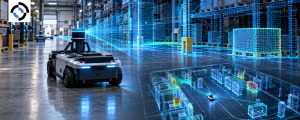

A mobile robot cannot navigate a warehouse, factory, hospital, or outdoor environment from camera images alone. It needs to understand distance, geometry, obstacles, surfaces, and
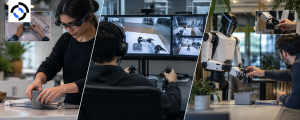
Human demonstration and teleoperation produce different action labels with different traps. Plus the third category, intervention data, that most teams never budget for.
Seven services. One synchronized pipeline.
In-person task demos for imitation learning.
RGB-D, LiDAR, force, and tactile streams.
Bounding boxes, segmentation, action labels.
Domain-randomized scenes and sim transfers.
Held-out test sets and success-rate scoring.
Rare scenarios your policy will face in production.