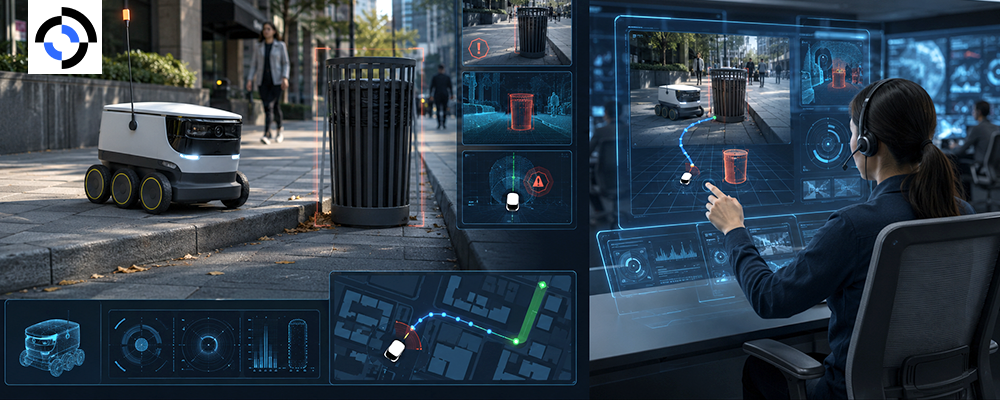
A delivery robot stops at a kerb it cannot interpret. It is not damaged, it has not crashed, and it is not going anywhere. Somewhere a customer is waiting and a clock is running. Remote operations for delivery robots is the function that decides how long that lasts.
This guide covers the three modes of remote intervention and why the distinction matters, what a well-run intervention actually looks like, the economics that determine whether a fleet can scale, and the mistakes that make the function more expensive than it needs to be.
Robots do not fail dramatically
The failure people imagine is a robot doing something alarming. The failure that actually fills your operations queue is a robot doing nothing at all.
It reaches a kerb it cannot read. Someone has parked a bin across the path. A crowd forms and never clears. A gate looks open and is not. The policy does the safe thing, which is to stop, and now a delivery is late and a robot is sitting on a pavement waiting for a human to have an opinion.
Remote operations is the function that supplies that opinion, quickly and consistently, and records what happened in a form worth keeping.
The three modes, and why the distinction matters
| Mode | What the human does | Latency tolerance |
|---|---|---|
| Monitoring | Watches, does not act | High |
| Remote assistance | Answers a question the robot asked | Moderate |
| Remote driving | Directly controls motion | Very low; risky over public networks |
Most incidents need assistance rather than driving. “Is this path clear”, “is that a real obstacle”, “which side should I pass” are decisions, and a decision tolerates far more delay than steering does. Systems that default to driving inherit all the latency risk of teleoperation for problems that never required it. We work through this in remote assistance vs remote driving.
What a well-run intervention looks like
- Detection. The robot requests help, or a monitor notices it has not moved. Self-reported requests are better, because the robot knows why it stopped.
- Context load. The operator gets the situation, not just a live feed: what the robot was trying to do, what it believed, and the seconds leading up to the stop.
- Decision. Resolve by guidance if possible. Escalate to direct control only where guidance genuinely will not work.
- Resolution. The robot resumes autonomy. Time-to-resume is the number that matters commercially.
- Classification. Root cause assigned there and then, from a short fixed list, by the person who handled it.
- Capture. The whole event stored as structured data, per the intervention loop.
Step two is where most stacks are weakest. An operator handed a bare video feed has to reconstruct the situation before acting, and that reconstruction time dominates total resolution time far more often than the decision itself.
The economics nobody models properly
Remote operations is usually budgeted as a support cost, measured in operators per robot. That framing hides the two things that actually determine whether a fleet scales.
- Intervention rate. How often the fleet needs a human at all. This drives headcount far more than fleet size does, and it is covered in intervention rate.
- Resolution time. How long each event occupies an operator. Halving this halves the staffing requirement at the same intervention rate.
A fleet whose intervention rate is falling can grow without proportional headcount. A fleet whose rate is flat is buying linear cost with every robot it adds, which is the point at which the business case usually stops working.
The second lever is often easier. Much of resolution time is context-loading and escalation confusion rather than genuine decision difficulty, and both are fixable with tooling and process.
What we run
We provide remote monitoring and intervention for an autonomous mobility company operating sidewalk delivery robots and self-driving passenger vehicles. Public-space operation is the demanding case: uninvolved members of the public, unpredictable environments, and no ability to pause the world while you think.
- Escalate on a clock, not on judgement. If an event is unresolved within a set window, it escalates automatically. Removing discretion under pressure is what makes handling consistent across operators and shifts.
- Buffer well before the trigger. Causes precede symptoms. A buffer that starts at the moment of failure usually misses the reason for it.
- Classify at resolution time. The operator who handled it assigns root cause immediately, from a controlled vocabulary. Retrospective classification by someone who was not there is slower and less accurate.
For a programme that moved from cold start to production quickly under real operating constraints, our mobile manipulation case study covers a 90-day path to production.
Where teams get it wrong
- Treating it as customer support. Different skill, different tooling, different failure consequences.
- Free-text incident notes. “Robot stuck near entrance” cannot be counted, clustered, or fixed.
- No fail-safe on link loss. The robot must stop safely, never continue on last command.
- Hiding latency from the operator. An operator acting confidently through an unnoticed delay is the clearest predictor of an incident, per latency budgets.
- Short sensor retention. Data kept for debugging and deleted before anyone asks whether it was trainable.
Frequently asked questions
How many operators does a fleet need?
It is a function of intervention rate and resolution time, not robot count. Two fleets of the same size can differ by an order of magnitude in staffing depending on how often they need help and how long each event takes.
Can remote operators be offshore?
Often yes, subject to data residency and regulatory constraints, which vary by jurisdiction and by whether the robot operates in public space. Coverage across time zones is one of the main reasons to distribute the function.
Is remote operations a permanent cost or a temporary one?
It shrinks per robot as autonomy improves, and it does not go to zero. The tail keeps generating novel situations, which is precisely why the function pays for itself as a data source.
What should we log if we are just starting?
Trigger type, autonomy state at handover, resolution type, time to resolve, and root cause from a fixed list. Those five fields turn an incident log into a dataset.
A stuck robot is a support ticket if you log it badly and a training example if you log it well. Same event, same cost, very different asset. If you want your remote operations setup reviewed, tell us how your fleet is instrumented.