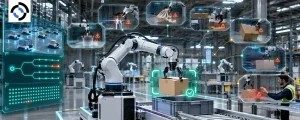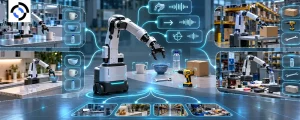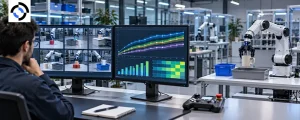
A deployed fleet generates more data in a week than most collection programs gather in a year, and almost all of it is uneventful. The value sits in a thin slice: the near misses, retries and failures that reveal what the policy cannot yet do. Edge case data mining is the discipline of finding that slice without storing, labeling or training on everything.
This guide covers how to detect rare events in robot fleet data, run failure log analysis that finds root causes, and turn the findings into targeted data collection.
Why fleet logs beat guesswork
Deliberate edge-case collection is an attempt to approximate the real failure distribution. A fleet samples it directly. But fleets also produce volume, and volume without selection is just cost: bandwidth, storage and labeling. The mining job is selection.
Burr Settles put the principle plainly in his survey of active learning: a model can do better if it is “allowed to choose the data from which it learns.” Fleet mining applies the same idea at the scale of an operation.
Signals that flag an event
| Signal | Source | What it catches |
| Human intervention or takeover | Remote operations and handover logs | Autonomy failures |
| E-stop, safety trip, force-limit hit | Robot controller | Hazardous events |
| Retries, loops, timeouts | Policy and task state | Stalled or confused behavior |
| Low confidence or high uncertainty | Model outputs | Out-of-distribution inputs |
| Proprioceptive anomalies | Joint states, motor current, tracking error | Hardware and contact surprises |
| Embedding novelty | Encoder distance from the training set | Unseen scenes and objects |
| Customer reports | Support tickets | Failures the robot did not notice |
No single signal is enough. Interventions are precise but miss silent failures, while novelty detectors are broad but noisy. Combine them.
A mining pipeline that scales
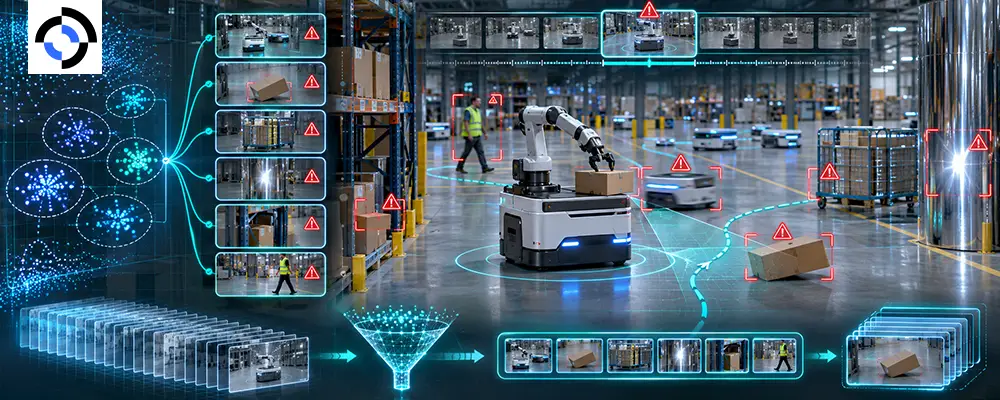
- Trigger on the robot. Uploading everything is impractical, so cheap rules decide what to keep. Save a window of data before and after each trigger.
- Add random baseline samples. They let you estimate how common events are and keep the model from learning only from the weird.
- Upload with context: video, sensor streams, policy state, location and firmware version.
- Cluster and deduplicate by embedding and metadata, so one recurring spill becomes one case with a count rather than 400 clips.
- Triage into a failure taxonomy, as described in our guide to incident triage for robot fleets.
- Prioritize by frequency, severity and fixability.
- Specify targeted collection for the top clusters.
- Retrain and verify on a frozen edge-case set.
Failure log analysis that finds root causes
Look beyond the failure itself. Ask what changed in the scene, which firmware was running, which site it happened at and what time of day it was. Slice failure rates by site, hardware revision, object type and lighting. A cluster concentrated at one site points to the environment, while a cluster spread across sites points to the policy.
Pair logs with the human operator’s resolution notes, captured as structured fields rather than free text: trigger type, time to acknowledge, resolution type and root cause. Structure is what makes an intervention trainable. Our guides to robot fleet intervention rate and the intervention data training loop show how.
Pitfalls to design around
- Selection bias. Mining only failures leaves the model with no picture of normal operation, so keep the baseline sample.
- Label cost explosion. Cluster first and label representatives, not every clip.
- Privacy and residency. Fleet video can capture people and private spaces. Plan retention, redaction and data residency before the first upload.
- Feedback loops. Triggers based on model uncertainty depend on how well calibrated the model is, and they shift as the model changes.
- Forgetting. Retraining on edge cases alone can degrade core behavior, so mix them with the core dataset.
From mined events to targeted collection
A mined event is a single instance. Targeted collection builds a distribution around it: variations in lighting, object, position and operator, plus recovery behaviors. Roborax turns mined clusters into collection specs and runs them through teleoperation, human demonstration and hybrid teams, delivered through our long-tail and edge-case capture service. For failures too rare or risky to stage, see synthetic data for rare failure scenarios.
Frequently asked questions
Q: What share of logs should we keep?
A: Keep triggered clips plus a random baseline, and set the baseline rate from your storage budget and the event rate you need to estimate. There is no universal percentage.
Q: Can synthetic data replace mined events?
A: It can multiply them, for example by varying lighting around a mined failure, but the real event anchors realism.
Q: How do we avoid labeling everything we mine?
A: Cluster and deduplicate first, label a representative set per cluster, and label more only where clusters prove ambiguous.
Your fleet already knows where the policy is weak. If you want help turning logs into a ranked backlog and a targeted collection plan, tell us what you are training and we will scope the first campaign with you.