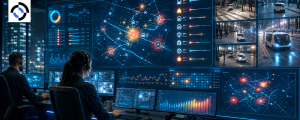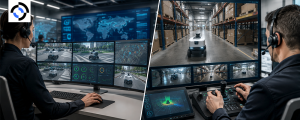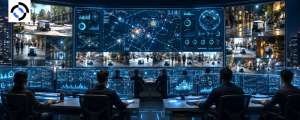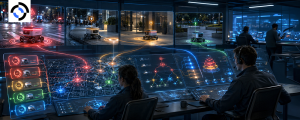
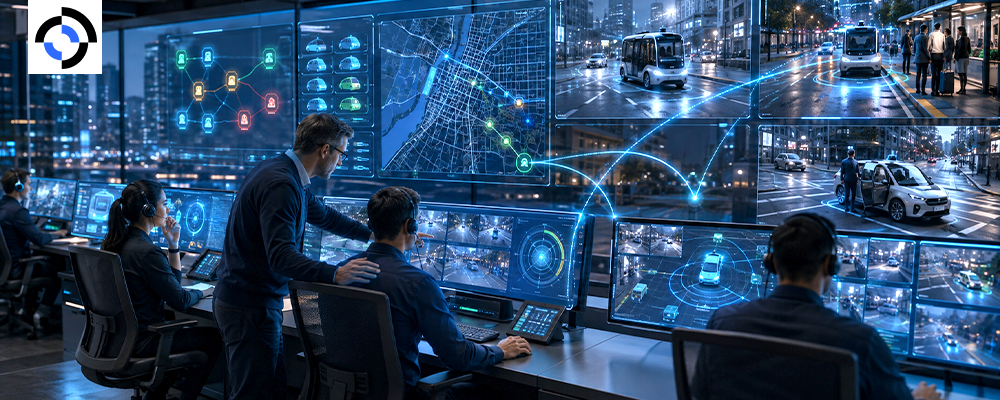
Autonomous vehicles are supervised, not unsupervised. Behind a driverless fleet sits a team of people watching, advising, and occasionally intervening. Autonomous vehicle remote supervision is now an expected part of the safety case rather than an implementation detail.
This guide covers why AV supervision differs from other remote operations work, what the role actually involves, how teams are tiered, what the selection and training profile looks like, and the constraints that decide where supervisors can sit.
Why AV supervision is a distinct discipline
A sidewalk robot that stops is an inconvenience. A passenger vehicle that stops is a lane blockage with people inside it. The consequences of a slow or wrong decision scale with mass and speed, and that changes everything about how the function is staffed.
The regulatory position has firmed up alongside it. NHTSA’s 2025 AV Safety Framework treats teleoperation as a safety enhancement for Level 4 deployment, and a majority of US states with AV legislation now include specific teleoperation provisions. Supervision has moved from an implementation detail to something regulators expect to see documented.
What the role actually is
The common misconception is that a remote supervisor is a driver sitting somewhere else. In most mature deployments they are not driving at all.
| Function | What the supervisor does |
|---|---|
| Monitoring | Watches fleet state and flags anomalies |
| Remote assistance | Answers questions the vehicle raises about ambiguous situations |
| Rider support | Speaks to passengers, resolves confusion, handles distress |
| Incident coordination | Liaises with emergency services and field teams |
| Bounded recovery | Low-speed extraction within a tightly capped envelope |
Rider support is the line people forget when scoping. A passenger vehicle carries humans who have questions, get anxious, and occasionally need help getting out. That is a customer-facing skill layered on top of a technical one, and it is not the same person’s natural strength.
The assistance-versus-driving distinction underpins all of this and is covered in remote assistance vs remote driving.
The staffing shape
Most operations settle on tiers rather than a flat pool.
- Tier one: monitoring and routine assistance. The bulk of headcount, handling the majority of events, working across many vehicles at once.
- Tier two: complex assistance and recovery. Smaller, more experienced, authorised for bounded control and unusual situations.
- Tier three: incident command. Handles collisions, emergency-services interaction, and anything with regulatory reporting implications.
- Rider support. Sometimes separate, sometimes merged into tier one, and always a distinct skill.
- Field response. Physical recovery, which no remote tier can substitute for.
The ratio between tiers follows from escalation rate. If tier one escalates frequently, either the tooling is too weak or the authorisation boundary is drawn too tight, and both are cheaper to fix than adding senior headcount.
Who is good at this
The instinct is to hire drivers. Driving skill turns out to be a weak predictor, because the job is rarely driving.
- Situational awareness through degraded feeds. Building an accurate mental picture from limited camera angles and telemetry, quickly.
- Calm decision-making under time pressure without rushing into the wrong action.
- Procedural discipline. Following escalation rules when improvising feels faster. This is the single strongest predictor of consistent performance.
- Communication. Clear, calm speech with an anxious passenger or an emergency responder.
- Tolerance for long quiet periods punctuated by sudden demand, which is a genuinely unusual attentional profile.
Air traffic control, dispatch, and monitoring-heavy operations roles map onto this better than professional driving does. Our approach to selection and scoring is covered in operator quality and in hiring and training remote robot operators.
Training that reflects the actual work
- System behaviour first. What the vehicle does on its own, and why it stops. An operator who does not understand the autonomy will misread its requests.
- Scenario drills from real interventions. Replay actual recorded events rather than invented ones. Your intervention log is your training corpus, per the intervention loop.
- Escalation under load. Practise the moment when three events arrive at once, because that is when procedure breaks.
- Degraded conditions. Poor video, high latency, partial telemetry. Train for the bad link, not the good one.
- Passenger interaction. Distress, confusion, and hostility, rehearsed rather than encountered cold.
- Recurrent assessment. Skills decay in a role where the difficult events are rare by design.
Where supervisors can physically sit
This is the constraint that most often shapes the operating model, and it is not purely technical.
- Jurisdictional rules. Requirements vary by state and country, and some regimes expect supervision within defined boundaries.
- Latency to the fleet. Assistance tolerates distance far better than control does, which is another argument for keeping direct control bounded and rare.
- Data residency. Camera feeds from public roads carry privacy obligations that differ by region, as covered in compliance.
- Local context. Reading a street scene correctly benefits from knowing the place, the signage conventions, and the driving culture.
- Language. Passenger interaction has to happen in the rider’s language, which shapes where you recruit.
These pull in different directions, and most operations end up distributing supervision across several delivery locations rather than centralising it.
What to measure
- Time to acknowledge, by severity band
- Time to resume autonomy, which is what riders experience
- Escalation accuracy, in both directions: escalating too early and too late
- Decision reversal rate, where a later operator undid an earlier call
- Rider-reported outcomes on events involving passenger contact
- Recurrent-assessment scores, tracked over time rather than at onboarding
For a programme where paired capture and disciplined operations moved a hard perception metric, our aerial perception case study reports a 3x detection rate from paired drone-and-ground capture.
Frequently asked questions
Do remote supervisors need a driving licence?
Requirements vary by jurisdiction, and some regimes expect it for anyone authorised to move the vehicle. As a selection criterion it predicts far less than procedural discipline and situational awareness do.
How many vehicles can one supervisor cover?
In assistance mode, many, because attention is needed only at discrete events. In any mode involving direct control, one. That difference is why the assistance boundary is a commercial decision as much as a safety one.
Can AV supervision be outsourced?
Commonly it is, within the residency and regulatory constraints that apply to the deployment. What cannot be outsourced is the safety architecture itself, which stays with the vehicle operator.
What happens if the network drops mid-event?
The vehicle must reach a safe state on its own, without the supervisor. Any design where a dropped link leaves the vehicle depending on a human is a design problem rather than a staffing one.
Supervision is now part of the AV safety case, which means it has to be staffed, trained, and evidenced rather than improvised. If you want a supervision model reviewed against your deployment and jurisdiction, tell us how your fleet is instrumented, or read more about our remote operations work.