
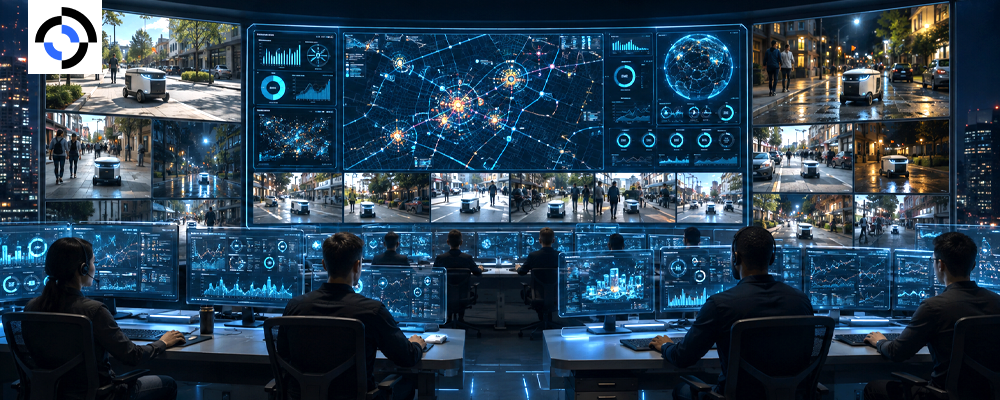
A sidewalk robot fleet does not stop at six in the evening, and neither can the people watching it. Sidewalk delivery robot monitoring is a 24/7 operational problem where demand is uneven, incidents arrive in bursts, and the environment is full of people who never agreed to be there.
This guide covers why coverage is not simply headcount divided by shifts, the five numbers that actually determine staffing, what makes sidewalk operation distinctive, and how to build a coverage model that survives a bad Saturday.
Coverage is not headcount divided by shifts
The naive model is to divide the day into three shifts, staff each one, and call it covered. That model fails on contact with a real fleet for two reasons.
First, demand is not flat. Sidewalk robots work when people are out: lunch, evening, weekends, bad weather. Interventions cluster in exactly those windows.
Second, interventions arrive in bursts rather than evenly. A road closure or a market day produces ten events in a minute and nothing for an hour. Staffing to the average leaves you badly short precisely when it matters, which is why peak concurrency rather than average load is what you actually staff against.
The five numbers that determine coverage
| Input | What it drives |
|---|---|
| Intervention rate per robot-hour | Total event volume, per intervention rate |
| Mean resolution time | How long each event occupies an operator |
| Peak concurrency | Operators needed at the worst moment, not the average |
| Target acknowledgement time | How much queueing you are willing to tolerate |
| Operator effective utilisation | Realistic attention capacity, well below 100 percent |
The last one is the one plans get wrong. An operator cannot be productively occupied every minute of a shift on this work. Sustained vigilance degrades, and a supervision role run at high utilisation produces slower and worse decisions, not more of them.
Sidewalk robots are their own operating problem
They are not small delivery vans and they are not warehouse AMRs. The environment has properties that shape the whole coverage model.
- Uninvolved members of the public. Nobody signed anything. Pedestrians, children, and dogs interact with the robot on their own terms.
- Infrastructure designed for people. Kerbs, temporary signage, café furniture, bins on collection day. None of it is mapped and much of it moves.
- Public network dependency. Latency varies by street, by hour, and by crowd density, which constrains what can be done remotely at all.
- Deliberate interference. People block, push, ride, and occasionally steal these robots. It is a normal operating condition rather than an edge case.
- Weather. Rain on a lens and low winter sun both degrade perception in ways that raise intervention rate predictably.
Several of these are forecastable. Bin collection days, market days, school run times, and sunset angle are all knowable in advance, and a coverage model that ignores them is choosing to be surprised on a schedule.
Building the coverage model
- Model demand hourly, not daily. Intervention volume by hour of day and day of week, from your own data rather than from an assumption.
- Staff to a percentile, not a mean. Pick the load level you intend to handle without queueing, and accept that beyond it events wait.
- Set an acknowledgement target per severity. A robot blocking a doorway and a robot idle in a quiet street are not the same urgency.
- Overlap shift handovers. Active events must transfer with context, which takes minutes and cannot happen at the instant a shift ends.
- Build an escalation tier. A smaller pool of senior operators for events the first tier cannot resolve, covered in incident triage.
- Keep a field response path. Some situations are not solvable remotely at all. Physical recovery time belongs in the model.
Follow the sun, or follow the fleet
Two ways to cover 24 hours. Distribute operators across time zones so everyone works daytime hours, or run night shifts locally.
The distributed model is generally better for quality. Night-shift vigilance work degrades measurably, and the events that need judgement do not stop at night. It also gives you surge capacity, since a neighbouring region can absorb a burst.
The constraints are real, though. Data residency rules may limit where operators can sit, local knowledge matters for interpreting a street scene, and language matters when an operator has to speak to a member of the public through the robot. Our delivery locations and compliance pages cover how we handle that.
What we run
We provide remote monitoring and intervention for an autonomous mobility company operating sidewalk delivery robots and self-driving passenger vehicles. Three things matter more than the shift pattern.
- Zone-level reporting. Intervention rate is intensely geographic. One construction site can dominate a month, and a fleet average hides it entirely.
- Rotation within shifts. Operators rotate between active supervision and lower-intensity work, because sustained monitoring degrades attention faster than most rosters assume.
- Clock-based escalation. Unresolved after a set window, an event escalates automatically. Consistency under pressure comes from removing discretion, not from adding training.
For a programme that reached production quickly under live operating constraints, our mobile manipulation case study covers a 90-day path from cold-start to production.
What to monitor besides the robots
- Queue depth and wait time, which reveal understaffing before intervention rate does
- Operator load distribution, since averages hide one person carrying a shift
- Network quality by zone, because latency problems look like robot problems
- Escalation and field-dispatch rates, as leading indicators of tooling gaps
- Recurring locations, which are usually route problems rather than policy problems
Frequently asked questions
How many robots can one operator monitor?
There is no fixed ratio. It follows from intervention rate, resolution time, and peak concurrency. A quiet suburban deployment and a dense city centre can differ by an order of magnitude on identical hardware.
Do we need 24/7 coverage if robots only run in daylight?
Not for supervision, but you still need a path for overnight incidents such as a stranded or tampered-with robot. Coverage can be thin outside operating hours; it should not be absent.
How do we handle a burst that exceeds staffing?
Queue by severity and let low-urgency events wait, rather than degrading response for everything. Decide the severity ordering in advance so it is not improvised under load.
Should monitoring sit with the same team as data collection?
They are different disciplines and benefit from shared infrastructure. The operator skill profile differs, while the logging, quality tracking, and escalation tooling overlap almost completely.
Coverage models built on averages fail on the days that matter most. If you want yours sized against real peak load before you commit to headcount, tell us how your fleet is instrumented, or read more about our remote operations work.