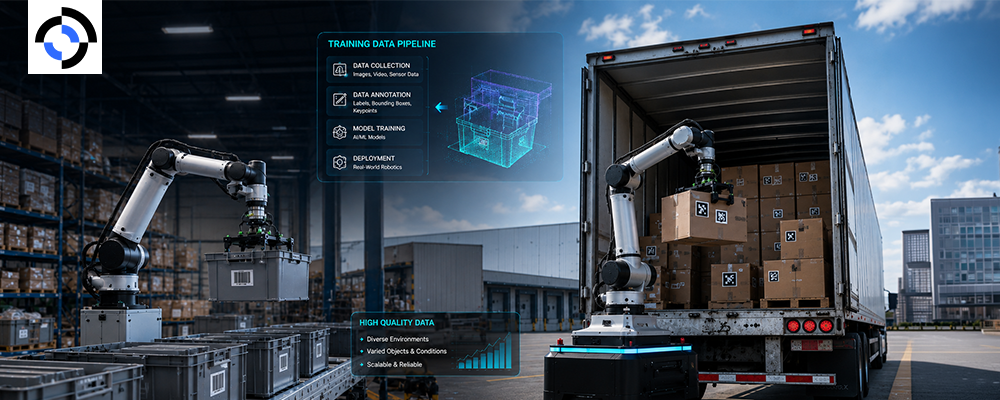
Warehouses look like the easy case for robotics: structured, indoors, repetitive. Then the robot reaches into a tote of mixed goods. Logistics robot training data is difficult precisely because the environment is controlled and the inventory is not.
This guide covers the task spectrum from tote transfer to trailer unloading, what capture programmes usually miss, why throughput pressure belongs in the data, and how deployment feedback closes the loop.
Logistics looks structured and is not
Warehouses are the environment robotics teams reach for when they want something controlled. Fixed layouts, known racking, predictable lighting. That framing holds until the robot touches inventory.
Inventory is not controlled. A tote contains whatever arrived that morning: bagged goods, crushed cartons, shrink-wrapped multipacks, items in the wrong orientation, one product with three packaging variants because a supplier changed. The environment is structured and the objects are not.
That is why warehouse programmes routinely hit lab-benchmark numbers and then underperform on the floor, which is the argument in what warehouse picking data strategies miss.
The task spectrum
| Task | Difficulty driver |
|---|---|
| Tote-to-tote transfer | Clutter and object separation |
| Each-picking from mixed bins | Unbounded object set; the hardest common case |
| Carton handling | Weight varies, crushed edges defeat suction |
| Bagged goods | Deformable, no stable grasp geometry |
| Palletising | Placement precision and stack stability |
| Trailer unloading | Confined space, shifted loads, poor lighting |
| Induction and singulation | Throughput pressure; errors compound downstream |
Trailer unloading is the least structured task in the building: loads shift in transit, lighting is poor, the space is confined, and the robot works against a wall of goods that may collapse.
What capture programmes usually miss
- Packaging variants per SKU. Instance-level identity, not product category.
- Damaged and non-conforming goods. Crushed corners and torn film are normal, not exceptional.
- Grasp failures and recovery. Slips, drops, double-picks. This teaches retry behaviour.
- Force during placement, not just during grasp, per force capture.
- Bin state over time, since each pick changes the scene for the next.
- Throughput context. A pick under time pressure differs from a leisurely one, and deployment is the former.
Deployment feedback is the real advantage
Warehouse robots run continuously in one building. That makes logistics the easiest vertical in which to close the loop between deployment and collection.
Every failed pick is a labelled example of a situation the policy could not handle, in the exact environment you care about. Clustered by root cause, those failures tell you which objects and configurations to collect against, which is the process in from intervention to training data.
The gap is instrumentation rather than opportunity. Most warehouse systems log a pick failure as a throughput metric and discard the sensor context that would make it trainable.
For a programme where targeted collection against a specific failure class moved a hard number, our warehouse policy case study tracks deformable-item success from 61 to 84 percent.
Collecting on a live floor
- Shadow the existing process first. Record human picking before introducing a robot.
- Use real inventory, including damaged stock. Curated object sets teach a curated world.
- Collect across shifts and seasons. Product mix changes; one month is narrower than it looks.
- Respect the safety envelope, per industrial teleoperation.
- Buffer locally. Site networks rarely permit large outbound transfers.
- Agree redaction in advance, since cameras capture staff at work.
Frequently asked questions
How many SKUs do we need in a dataset?
Enough to cover the property space rather than the catalogue. Shape, weight, rigidity, surface finish, and packaging type matter more than product count. A hundred well-chosen items can outperform a thousand similar ones.
Does data transfer between warehouses?
Task structure and failure taxonomies transfer well. Specific racking, lighting, and inventory do not, which is why multi-site collection beats deep collection at one site.
Is suction or gripping better for data collection?
Collect on whichever you deploy. Grasp strategy data does not transfer between end-effector types, so this is an embodiment decision rather than a data one.
Can synthetic data cover warehouse picking?
Partially for rigid goods in clutter. Deformable packaging and damaged stock remain poorly simulated, so those need real capture, per sim-to-real planning.
Logistics is the vertical where deployment and collection can feed each other most tightly, and most programmes never connect them. If you want that loop designed into your operation, tell us what you are building.