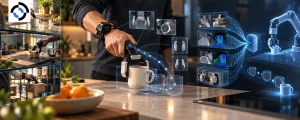
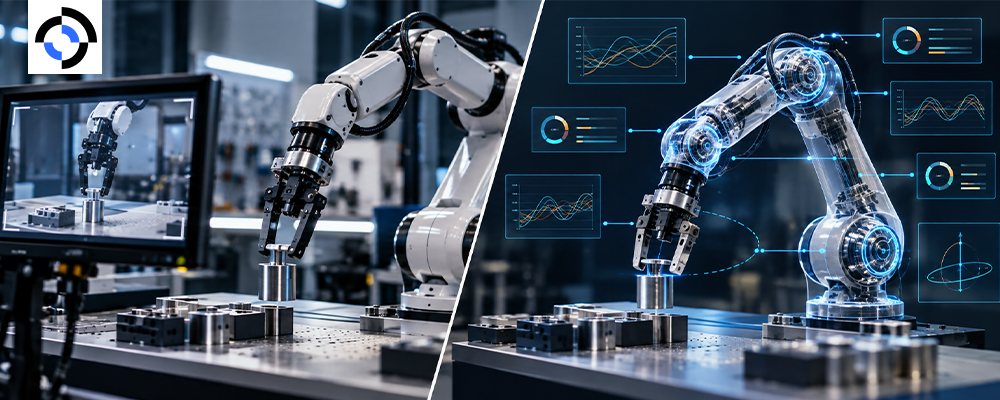
A robot can see an object. It can identify its position. It can even plan a path toward it. But vision alone cannot tell the robot exactly how its own joints are moving, whether an actuator is under unexpected load, or how its physical state is changing during an interaction.
That is where proprioceptive data becomes essential.
Joint-state logs give robotics AI systems an internal view of the machine: joint positions, velocities, accelerations, torque, motor current, encoder readings, and other actuator-level signals. When combined with visual, depth, tactile, force, and teleoperation data, these signals can turn isolated observations into rich examples of robotic behavior.
The importance of this data is growing alongside robotics deployment. According to the International Federation of Robotics (IFR), 542,000 industrial robots were installed worldwide in 2024, more than twice the number installed a decade earlier. The operational stock reached approximately 4.66 million industrial robots, up 9% year over year.
As more robots generate increasingly complex streams of operational data, the challenge is no longer simply collecting information. It is creating datasets that allow AI systems to understand the relationship between what a robot sees, what its body is doing, what action it takes, and what happens next.
What Is Proprioceptive Data in Robotics?
Proprioception describes a robot’s ability to sense its own physical configuration and movement.
For a robotic arm, this may include:
- Joint position and angle
- Joint velocity and acceleration
- Motor current
- Joint torque
- Encoder readings
- End-effector pose
- Actuator temperature
- Controller commands
- Measured versus commanded states
- Timestamped state transitions
Think of proprioception as a robot’s internal sense of body awareness.
An RGB camera might show a robotic gripper approaching a box. Proprioceptive data can reveal the precise joint configuration that produced that movement. If the gripper encounters resistance, torque or current measurements can provide additional evidence that something unexpected occurred.
This distinction is fundamental to physical AI training.
Why Joint-State Logs Add Value to Robot Training
1. They Connect Perception With Action
A useful robotics dataset should capture more than what the robot observes. It should also capture what the robot does.
Consider a robot learning to pick up an object. A camera records the object and the gripper. Joint-state logs capture the arm’s trajectory, while controller data records the commands issued during the maneuver.
Together, these streams can create a much richer training sequence:
Perception → Robot State → Action → Outcome
This relationship is valuable for imitation learning, behavior cloning, reinforcement learning, and other robot-learning approaches because the model receives information about both the environment and the robot’s response.
2. They Preserve Information During Visual Occlusion
Robots frequently operate in environments where cameras cannot maintain a complete view of every component.
A robotic arm may block its own gripper. An object may be hidden behind another object. A warehouse robot may enter an area where visual coverage is limited.
Joint encoders, however, continue reporting the robot’s internal state.
That makes proprioceptive signals a useful complementary modality. Even when external perception becomes temporarily incomplete, the dataset can retain information about how the robot’s configuration is changing.
3. They Add Temporal Context
Robotic behavior is inherently time-dependent.
Imagine two frames showing a gripper in exactly the same position. In one sequence, the gripper may be moving toward an object. In another, it may be retracting after a successful grasp.
The image alone may not provide sufficient context.
Joint velocity, acceleration, and trajectory information can distinguish these situations. Consequently, joint-state logs allow training datasets to represent motion and transitions, rather than merely static positions.
For physical AI, this temporal dimension can be critical.
Combining Proprioception With RGB-D Data
Proprioceptive information becomes even more valuable when synchronized with external sensors.
An RGB-D camera setup can provide RGB imagery and depth information, while robot encoders provide the machine’s internal configuration. The combination allows training systems to associate environmental geometry with robot movement.
For example:
- RGB image: What does the robot see?
- Depth data: Where is the object in 3D space?
- Joint states: Where are the robot’s joints?
- End-effector pose: Where is the gripper?
- Action data: What movement did the controller execute?
- Outcome: Was the task successful?
This creates a multimodal representation of the robot’s experience.
However, synchronization and calibration become critical. Research on RGB-D systems emphasizes that accurate intrinsic and extrinsic calibration is important for robotics applications, because calibration determines the geometric relationship between the RGB and depth sensors.
In other words, an advanced sensor calibration robotics pipeline is not merely an engineering detail. It directly affects the reliability of the resulting training data.
Why Depth Sensor Accuracy Matters
Depth information can provide the 3D context that RGB imagery lacks, but inaccurate depth can introduce errors into perception and downstream robot-learning tasks.
Research on depth-sensor calibration has found that systematic distortion can affect algorithms using depth information and demonstrated advantages from calibrated sensor data.
For robotics datasets, this means depth sensor accuracy should be considered alongside joint-state quality.
Suppose a camera indicates that an object is 50 centimeters away while the robot’s calibrated coordinate system places the object somewhere else. If these streams are incorrectly aligned, a learning system could associate the wrong robot movement with the wrong environmental position.
Roborax therefore views calibration, synchronization, and data quality as interconnected components of robotics data preparation.
What Should Joint-State Logs Capture?
Simply recording joint positions is not enough for a high-quality training dataset.
Robotics teams should consider capturing:
- Joint position
- Joint velocity
- Joint acceleration
- Torque and current
- Encoder values
- Commanded joint states
- Measured joint states
- End-effector pose
- Controller state
- Precise timestamps
- Robot configuration
- Task and episode IDs
- Success/failure outcomes
- Calibration metadata
The distinction between commanded and measured state can be especially valuable.
If a controller commands a specific joint position but the physical robot does not achieve it, that discrepancy may contain important information about friction, load, collision, mechanical resistance, or control limitations.
Rather than treating such records as unusable noise, robotics teams can turn them into valuable examples of real-world robot behavior.
Turning Failures Into Training Signals
One of the biggest advantages of joint-state data is its potential for failure analysis.
Imagine a robot repeatedly failing to pick up an object. Video might show the gripper closing incorrectly. But joint torque, motor current, velocity, and position logs could provide additional clues about what happened immediately before the failure.
These signals can help identify patterns associated with:
- Failed grasps
- Unexpected collisions
- Object slippage
- Joint-limit interactions
- Excessive resistance
- Controller instability
- Mechanical anomalies
- Incomplete trajectories
For AI training, these failure cases can be highly valuable.
A dataset containing only successful demonstrations may teach a robot what desirable behavior looks like. A dataset containing carefully structured failures can additionally help it learn what situations to avoid or how to recover.
The Growing Need for Robotics-Ready Data
The scale of robotics deployment makes this increasingly important. IFR President Takayuki Ito described the automation transition as being marked by “a huge surge in demand.” IFR also reported that 2024 represented the second-highest annual installation count in industrial robotics history.
As robotic systems become more capable, their datasets will also become more multimodal.
The future training stack is unlikely to rely on a single sensor. Instead, it will increasingly combine:
Vision + Depth + Proprioception + Force/Tactile Data + Actions + Outcomes
For robotics developers, the challenge is ensuring that these streams remain synchronized, accurately calibrated, consistently labeled, and usable at scale.
How Roborax Helps Build High-Quality Robotics Training Data
At Roborax, we help robotics teams transform complex robot experiences into structured, machine-learning-ready datasets.
Our approach can support multimodal robotics workflows involving:
- Proprioceptive and joint-state data
- RGB and video data
- RGB-D sensor streams
- LiDAR and 3D data
- Teleoperation demonstrations
- Human-robot interaction data
- Failure and edge-case datasets
- Multimodal synchronization and quality assurance
Rather than treating each sensor stream as an isolated dataset, Roborax focuses on preserving the relationships between perception, robot state, action, and outcome.
That context is what makes raw robotic data useful for training increasingly capable physical AI systems.
Conclusion
A robot does not experience the world through cameras alone.
It also experiences the world through its own body.
Joint-state logs provide that internal perspective, capturing how the robot moves, responds, accelerates, interacts, and sometimes fails. When synchronized with visual and depth information, proprioceptive data can provide the temporal and physical context required to build richer robotics training datasets.
As Takayuki Ito noted, the global robotics industry is experiencing a “huge surge in demand.” The next challenge is ensuring that the data generated by this growing robotic ecosystem is structured well enough to train intelligent, adaptive machines.
Roborax helps robotics innovators turn raw sensor streams, joint-state logs, demonstrations, and real-world robot experiences into high-quality training data designed for the demands of Physical AI.
Ready to Build Better Robotics Training Data?
Partner with Roborax to transform your robot’s sensor and joint-state data into structured, synchronized, and training-ready datasets. Connect with our robotics data experts today and build the data foundation for your next generation of intelligent robots.
Frequently asked questions
Q: Is proprioceptive data useful for human demonstration data too?
A: Less directly, sincethere’s no robot joint state to log during a human demonstration. It becomes relevant again once the demonstration is retargeted onto a robot embodiment, at which point the retargeted joint states should be logged with the same rigor as teleoperation data.
Q: Does every task need full torque logging?
A: Torque or current sensing matters most for contact-rich and force-sensitive tasks. Purely positional tasks, like navigation, can often train well on position and velocity alone.
Q: How does proprioceptive data relate to force-torque sensor data?
A: They’re related but distinct — proprioception is the robot’s sense of its own joints, while force-torque sensing typically refers to dedicated sensors at the wrist or end effector measuring external contact forces. Many programs use both.
Skipping proprioceptive logging is one of the quietest ways to undercut a training program. Talk to Roborax about building a capture pipeline where every modality — vision, proprioception, and contact — is logged and aligned from day one.
- Related reading
External reference