If you have started shopping for robot training data, you have run into the phrase egocentric data collection. It sounds technical. The idea underneath it is simple: record the task from the point of view of whoever is doing it, not from a camera bolted to the wall.
This guide explains what egocentric data is, why robot learning teams keep asking for it, what a complete capture setup records, and how to tell usable egocentric data from data that will quietly waste your training budget.
What egocentric data collection actually means
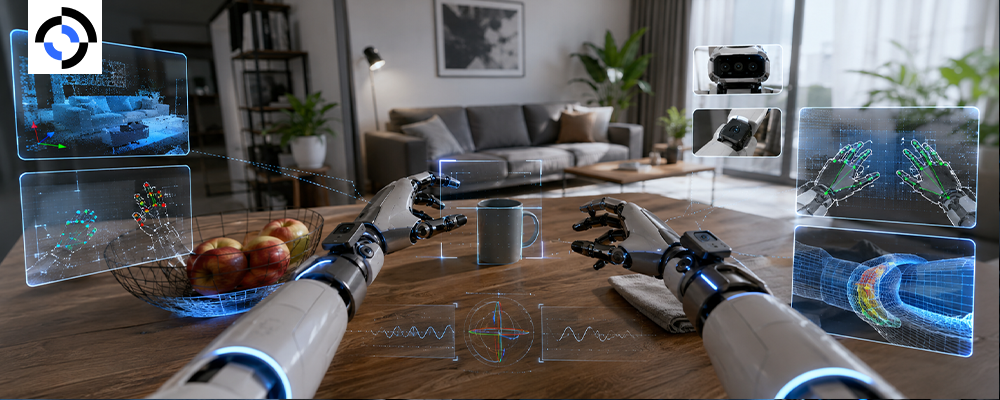
Egocentric means “from the self.” An egocentric camera travels with the actor. It sits on the head, on the chest, or on the wrist, and it sees roughly what the actor sees. The opposite is exocentric capture, where a fixed camera watches the scene from outside.
For robot learning this distinction matters more than it sounds. A robot policy sees the world through cameras mounted on the robot. If your training data was shot from a tripod in the corner of the room, you are asking the model to learn from a viewpoint it will never have at deployment.
The three viewpoints, side by side
| Viewpoint | Camera position | Captures well | Weakness |
|---|---|---|---|
| Exocentric | Fixed tripod or wall mount | Full scene context, whole-body posture | The actor’s own body blocks the workspace |
| Egocentric (head) | Eye level, moves with the actor | Attention, gaze direction, scene as the robot will see it | Motion blur, no view of the actor’s own body |
| Wrist-mounted | Forearm or gripper | Contact detail, grasp geometry, fine alignment | No scene context; disorienting on its own |
Serious programs record at least two of these at once. Head plus wrist is the most common pairing, and we cover the trade-off in detail in our guide to wrist-cam versus head-cam viewpoints.
Why first-person data trains better policies
Three reasons come up again and again.
1. The observation space matches
A policy trained on head-mounted and wrist-mounted footage learns from the same optical geometry it will face in production. Cameras sit in roughly the same place. Field of view is similar. The distribution shift between training and deployment shrinks, which is the single biggest reason lab results fail to survive contact with a real environment.
2. You get an attention signal for free
Where a head camera points is a rough proxy for where the person is looking. That is a supervision signal you cannot recover from a fixed camera. It tells the model which object mattered at each moment of a long task.
3. Occlusion works in your favor instead of against you
With an exocentric camera, the actor’s own torso and arms block the most important part of the frame at exactly the moment of contact. With egocentric capture, the hands are in frame and the contact is visible.
None of this makes exocentric footage useless. Most mature programs collect both and use the third-person view for scene reconstruction and evaluation benchmarks. But the egocentric stream is what the policy learns from.
What a complete egocentric capture records
Video alone is rarely enough. A dataset built for manipulation needs synchronized streams across several modalities, which is why we treat this as a multimodal sensor capture problem rather than a video problem.
| Stream | Typical rate | Why it matters |
|---|---|---|
| RGB video, head | 30-60 fps | Primary observation and scene context |
| RGB video, wrist | 30-60 fps | Contact and grasp detail |
| Depth | 15-30 fps | Object geometry and reach distance |
| Hand and finger pose | 60-120 Hz | The action label for dexterous tasks |
| 6-DoF head pose | 60-200 Hz | Grounds the video in 3D space |
| IMU | 100-1000 Hz | Motion smoothing and blur correction |
| Force and torque | 500-1000 Hz | The only signal that reveals contact quality |
| Task and event labels | Per event | Segment boundaries, success or failure, retries |
If any of these are missing, you can still train something. You just cannot train everything. Programs that skip force-torque capture discover the gap the first time they attempt a contact-rich task.
Four ways teams collect egocentric data
1. VR headset teleoperation
An operator wears a headset and drives the robot directly. The headset streams the robot’s own camera feed back to the operator, and hand tracking maps operator motion onto the robot’s arms. The recording is egocentric by construction, because the operator is literally seeing through the robot.
We run programs like this for a humanoid robotics developer building general-purpose home and service robots, capturing everyday household tasks through headset-driven teleoperation. The detail is in our write-up on VR headset teleoperation for everyday tasks.
2. Wearable capture rigs
A human performs the task while wearing a head-mounted camera array and hand tracking, with no robot involved. Throughput is much higher than teleoperation because you are not limited by robot hardware. The catch is the embodiment gap: human hands are not robot grippers, so the action labels need retargeting before a policy can use them.
3. In-the-wild wearable capture
Contributors wear a camera through ordinary daily life and upload what they record. This produces enormous scene diversity at low cost per hour, which suits a crowdsource delivery model. It is weak on task structure and consent management is a real workload, not a formality.
4. Cameras mounted on a teleoperation rig
Standard leader-follower rigs record head and wrist views alongside joint trajectories. This is the workhorse for bimanual manipulation and the setup behind most published ALOHA-style collection programs.
How to tell good egocentric data from bad
Six checks separate a dataset that trains from a dataset that sits on a drive.
- Time sync. Every stream shares one clock, with drift under a few milliseconds. Unsynchronized streams are close to worthless for manipulation.
- Calibration. Intrinsics and extrinsics are recorded per session, not assumed from a spec sheet.
- Failures included. A dataset with only clean successes cannot teach recovery. Retries and near-misses are labeled, not deleted.
- Scene diversity. Lighting, clutter, and object instances vary across sessions rather than repeating one staged setup.
- Operator variance is measured. You know which operator produced which episode and how they score. This is the core of any real operator quality program.
- Consent is documented per contributor. Faces, homes, and bystanders appear in egocentric footage. See our approach to operator consent.
Five mistakes that ruin an egocentric dataset
- One camera only. Head view without wrist view loses contact detail; wrist without head loses context.
- Auto-exposure left on. Brightness swings as the head turns, and the model learns lighting instead of task structure.
- No calibration pass per session. Small rig shifts across weeks turn into systematic error the model cannot see.
- Deleting failures. Recovery behavior is the most valuable and most commonly discarded data you collect.
- Staging every scene identically. Perfect repeatability produces a model that memorizes rather than generalizes. Deliberate variation is why long-tail capture is a separate discipline.
For a programme built on paired head-and-wrist capture, our humanoid foundation model case study documents a 3x sample-efficiency result.
Frequently asked questions
Is egocentric data the same as first-person video?
Nearly. First-person video usually refers to the RGB stream alone. Egocentric data collection for robotics means that stream plus synchronized pose, depth, force, and action labels.
How much egocentric data does a manipulation policy need?
It depends far more on task variety than on raw hours. A narrow single-object task can work with a few hundred well-controlled demonstrations. A general home-robot behavior needs tens of thousands across many object instances and layouts.
Can I use public egocentric datasets instead of collecting my own?
Public sets are excellent for pretraining perception. They rarely contain the action labels or the embodiment you deploy on, so most teams pretrain on public data and fine-tune on custom capture. Our comparison of real, synthetic, and hybrid data covers where each fits.
Does egocentric data work for non-humanoid robots?
Yes. Wrist-mounted capture transfers well to industrial arms and mobile manipulators. Head-mounted capture is most valuable where the robot has a similar sensor placement to a person.
Egocentric capture is not a camera choice. It is a decision about whether your training data will share a viewpoint with your deployed robot. If you are planning a program and want to pressure-test the sensor stack before you commit, tell us what you are building and we will map the capture setup against it.