
Every robotics deck in 2026 mentions vision-language-action models. Most explanations start with transformer architecture and lose the reader by the second paragraph. You do not need the maths to make good decisions about them.
This guide explains what a VLA does, why language turned out to belong inside a robot controller, how it differs from the classical stack, what it is trained on, and what all of that means if you are the one collecting the data.
The one-sentence version
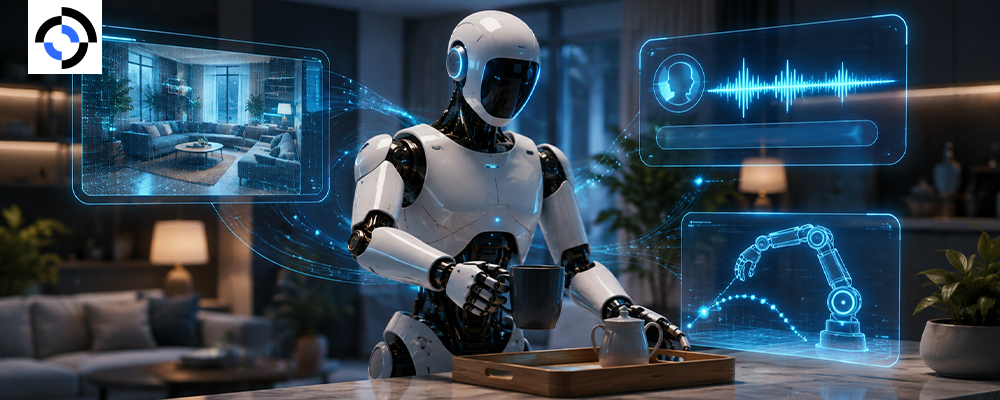
A vision-language-action model takes in what the robot sees and an instruction in plain language, and outputs the next movement. Vision in, language in, action out. That is the whole idea.
What makes it notable is that the same model handles all three. Older systems bolted together a perception module, a planner, and a controller, each built separately and each able to fail in its own way. A VLA collapses that stack into one learned mapping.
Why language turned out to matter
Language looks like a strange thing to put inside a robot controller. Its value is that it carries structure the robot would otherwise have to learn from scratch.
A model that has read a great deal already knows that mugs have handles, that liquids spill, that knives are held by the handle, and that “tidy the table” implies several sub-steps. None of that had to be demonstrated. It arrives with the language model and gets grounded by the robot data.
Grounding is the hard part
Knowing that mugs have handles is not the same as knowing where this mug’s handle is, in this lighting, from this angle, and what joint angles will reach it. Connecting abstract knowledge to specific motor commands is grounding, and it is exactly what demonstration data provides.
This is why VLA programs cannot shortcut data collection. The language priors are free. The grounding is not.
How a VLA differs from what came before
| Classical stack | VLA model | |
|---|---|---|
| Structure | Separate perception, planning, control | One end-to-end model |
| Task specification | Coded rules or waypoints | Plain-language instruction |
| New task | Engineering work | Often a new instruction, sometimes new data |
| Failure diagnosis | Traceable to a module | Hard; the model is one object |
| Data appetite | Modest | Large and specific |
| Generalization | Poor outside the spec | The entire selling point |
The trade is diagnosability for generalization. A classical stack tells you which module broke. A VLA gives you a policy that sometimes handles a situation nobody wrote code for, and very little insight into why it failed when it does.
What a VLA is actually trained on
Three ingredients, layered.
- Web-scale vision and language. Pretraining that supplies common sense and object knowledge. Not robot data at all.
- Robot demonstrations with action labels. Episodes pairing observations with the commands that produced them. This is where grounding happens, and where your budget goes.
- Language annotations on those episodes. Each demonstration needs a description of what was being done, ideally at more than one level of granularity.
That third ingredient is the one teams forget. A perfectly recorded trajectory with no instruction attached teaches motion but not what the motion was for. Our post on VLA data requirements goes through this in detail.
Where the action part gets awkward
Language models output tokens. Robots need continuous joint or end-effector commands. Bridging that is an open design question, and the common approaches each cost something.
- Discretize actions into tokens. Bin the continuous range and treat each bin as a word. Simple and effective, but the binning choice is permanently baked into the dataset, as covered in trajectory formats.
- Predict action chunks. Output a short sequence of future actions rather than one step. Smoother, and less reactive to sudden change.
- Attach a separate action head. Keep the language backbone and train a continuous output layer on top. More flexible, more moving parts.
Whichever route, the action representation in your dataset must match. Collect in one convention and switch later and you split your corpus in two.
What this means if you are collecting data
Four practical consequences.
- Instructions are data. Record what the operator was asked to do, in natural phrasing, per episode and per sub-step.
- Vary the phrasing deliberately. “Pick up the mug”, “grab the cup”, “get me that mug” should all appear. A model trained on one phrasing per task learns the phrasing, not the task.
- Breadth beats depth. VLAs earn their keep on generalization, which comes from many objects and scenes rather than many repetitions.
- Cross-embodiment data helps more than it used to. Pooling across robots improves these models measurably, which is why cross-embodiment data went from niche to central.
For a programme built along these lines, our humanoid foundation model case study documents a 3x sample-efficiency result.
Frequently asked questions
Is a VLA the same as a robot foundation model?
Closely related. Foundation model describes the training strategy, broad pretraining then adaptation. VLA describes the input and output shape. Most robot foundation models are VLAs, and the terms get used interchangeably.
Do we need a VLA for a single repetitive task?
Usually not. For one well-defined task in a controlled cell, a narrower policy is cheaper, faster, and far easier to debug. VLAs pay off when the task list is open-ended.
Can we fine-tune an open VLA instead of training one?
That is the common path and the sensible one. You still need demonstrations on your own embodiment, but far fewer than training from scratch would demand.
Why do VLAs fail in ways that seem obvious?
Because language priors and physical grounding can disagree. The model knows what a drawer is and may never have felt one resist. Failures cluster where semantic knowledge outruns physical experience.
VLAs move the hard problem from engineering to data. The model architecture is increasingly something you can adopt; the grounded demonstrations for your embodiment are not. If you are planning a programme and want the data mix sized against a VLA target, tell us what you are building.