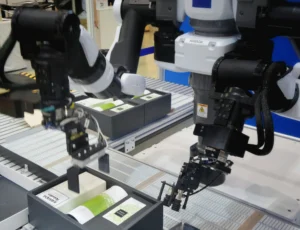


Warehouse Picking Robots: What Your Training Data Strategy Is Missing
Warehouse robot training data programs consistently underperform their lab benchmarks in production. The reason is almost never the model architecture. It is almost always a
Mobile manipulation data covers long-horizon tasks where a robot must navigate, reach, grasp, and interact across real environments — kitchens, offices, retail floors, and homes. Each episode chains 5–15 primitive actions into sequences your policy learns end-to-end.
Long-horizon is hard
Mobile manipulation episodes are 10–60x longer than tabletop pick-and-place. Our operators are trained for sustained, multi-step demos without quality drift.
5 mobile platforms.
12 task domains.
30+ specialized operators.
Where we collect
41+ delivery centers across 12 countries. Every program runs from a Roborax hub near your target time zone.
Asia Pacific
India · Philippines
Americas
USA · Canada · Colombia · Jamaica · El Salvador · Belize
EMEA
UK · Albania · Kosovo · Morocco
Four streams that capture what happens between picking the object and finishing the task.
Multi-step task captures, 5–30 minutes per episode, with goal annotations.
Combined movement and contact logs in a single timeline. Your fusion stack ready.
Per-episode occupancy and semantic maps for retraining or replay.
Operator recovery from mid-task failure, labeled for imitation or RL.
A four-stage pipeline designed for real homes, kitchens, and offices — not lab benchtops.
Real homes, kitchens, offices, or studios. Lighting and clutter matched to deployment.
Bring up your mobile manipulator. Calibration and SLAM verified.
Multi-step task captures with operator decision points logged.
Targeted re-capture of failure modes from your production model logs.
Research workhorses and production deployments.
Research
Research
Legacy
Quadruped
Bimanual
Research
Four verticals. One data partner.
Whole-body trajectories across 24 platforms.
Pick-pack-place across real SKU diversity.
Procedure-grade demos on surgical platforms.
ALOHA, Stretch, TIAGo, Spot+Arm, and custom.
RGB-D, LiDAR, force, and tactile streams.
Remote operator-driven data collection.
FAQ
From the blog
Warehouse Picking Robots: What Your Training Data Strategy Is MissingData requirements for grasping, picking, and placing.
From the blog
The Embodied AI Data FlywheelWhy mobile manipulation programs need continuous data investment.
Tell us the platform, the environment, and the task length. Four weeks to first long-horizon batch.
FROM THE FIELD

Warehouse robot training data programs consistently underperform their lab benchmarks in production. The reason is almost never the model architecture. It is almost always a


Surgical robot training data has requirements that no general-purpose robotics data program is built to meet out of the box. Sub-millimeter precision, HIPAA compliance, and

A robotics data quality assurance pipeline is not a checklist or a review meeting. At production scale, robotics data quality requires automated validation, per-operator metrics,

Robot data annotation is not image labeling with a different name. The temporal structure of robot trajectories, the grounding in physical task semantics, and the

Sim-to-real robot training with synthetic data is one of the most powerful techniques in embodied AI — and one of the most misunderstood. The gap

The embodied AI training data problem is structurally different from the language model data problem. Language models learned from the internet. Embodied AI must learn