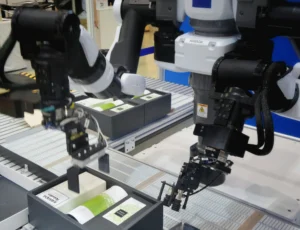


Warehouse Picking Robots: What Your Training Data Strategy Is Missing
Warehouse robot training data programs consistently underperform their lab benchmarks in production. The reason is almost never the model architecture. It is almost always a

Home / Data services / Long-tail and edge-case capture
Targeted collection for failure modes identified from your production model logs.
Long-tail capture is the targeted collection of demonstration data for the specific failure modes your production model struggles with — transparent objects, wet surfaces, occluded reaches, deformable materials, and other scenarios that rarely appear in general-purpose datasets.
Staging rare scenarios in-house is expensive and slow. We maintain prop libraries, environment rigs, and trained operators who specialize in the hard cases.
Why outsource edge-case capture?
Your lab is optimized for the common case. We maintain dedicated environments for the uncommon ones — wet benches, transparent object libraries, clutter generators.
100+ edge cases captured per week.
7 days from log analysis to training data.
4x improvement on targeted failures.
Where we collect
41+ delivery centers across 12 countries. Every program runs from a Roborax hub near your target time zone.
Asia Pacific
India · Philippines
Americas
USA · Canada · Colombia · Jamaica · El Salvador · Belize
EMEA
UK · Albania · Kosovo · Morocco
Four outputs that turn long-tail from a discovery phase into an iteration loop.
Classified failure modes from your production logs, ranked by frequency and severity.
Capture plans designed to hit each failure class. Spec-locked before collection.
Scenes designed to break your current policy. Useful for safety and robustness.
Post-injection tracking. Each captured failure is monitored for recurrence.
The seven-day loop that turns production failures into resolved cases.
Analyze your production logs. Cluster failures. Identify patterns and frequencies.
Build a collection plan for each failure class. Acceptance criteria defined.
Targeted teleop or sensor capture against the spec. Daily QA review.
Add to your training set. Track post-deployment recurrence rate.
Log analyzers and capture rigs working as one loop.
Production logs
Reusable cases
Targeted teleop
Failure binning
Post-injection
Your pipeline
FAQ
From the blog
Humanoid Robot Training Data: How Much Do You Actually Need?When long-tail and edge-case data becomes the bottleneck.
From the blog
Warehouse Picking Robots: What Your Training Data Strategy Is MissingDeformable items and edge cases in warehouse robotics.
Send us your production logs. We classify, scope a capture plan, and start the cycle.
FROM THE FIELD

Warehouse robot training data programs consistently underperform their lab benchmarks in production. The reason is almost never the model architecture. It is almost always a


Surgical robot training data has requirements that no general-purpose robotics data program is built to meet out of the box. Sub-millimeter precision, HIPAA compliance, and

A robotics data quality assurance pipeline is not a checklist or a review meeting. At production scale, robotics data quality requires automated validation, per-operator metrics,

Robot data annotation is not image labeling with a different name. The temporal structure of robot trajectories, the grounding in physical task semantics, and the

Sim-to-real robot training with synthetic data is one of the most powerful techniques in embodied AI — and one of the most misunderstood. The gap

The embodied AI training data problem is structurally different from the language model data problem. Language models learned from the internet. Embodied AI must learn
Seven services. One synchronized pipeline.
VR and leader-follower robot control logging.
In-person task demos for imitation learning.
RGB-D, LiDAR, force, and tactile streams.
Bounding boxes, segmentation, action labels.
Domain-randomized scenes and sim transfers.
Held-out test sets and success-rate scoring.