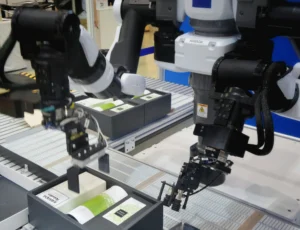



Warehouse Picking Robots: What Your Training Data Strategy Is Missing
Warehouse robot training data programs consistently underperform their lab benchmarks in production. The reason is almost never the model architecture. It is almost always a

Home / Data services / Evaluation benchmarks
Held-out test sets, scenario libraries, and scoring infrastructure for model release gates.
Evaluation benchmarks are held-out test sets, scenario libraries, and automated scoring infrastructure that tell you whether a model is ready to ship. They turn “it seems to work” into a pass/fail gate with numbers you can defend.
Building a benchmark that actually predicts real-world performance requires curated scenarios, physical test setups, and statistical rigor. We maintain the library so you run evals, not build them.
Why outsource benchmarks?
Internal benchmarks drift toward what your model is already good at. We maintain independent, adversarial test sets designed to find the gaps.
50+ benchmarks built for partners.
2,000+ scenarios in the library.
100/day automated eval runs.
Where we collect
41+ delivery centers across 12 countries. Every program runs from a Roborax hub near your target time zone.
Asia Pacific
India · Philippines
Americas
USA · Canada · Colombia · Jamaica · El Salvador · Belize
EMEA
UK · Albania · Kosovo · Morocco
Four artifacts that turn a model release into a confident decision instead of a gut feel.
Isolated scenarios your model has never seen. Leakage check enforced.
Curated scenes covering production distribution and known edge cases.
Aggregation, statistical significance, and per-scenario breakdowns.
Replayable runs that catch silent regressions between model versions.
Four stages that produce a benchmark you can actually defend in a safety review.
What does success look like for this release? Pass/fail and metric thresholds.
Curated scenarios from real + synthetic. Coverage matrix locked.
Run your model against the set. Per-scenario results plus aggregate metrics.
Release-grade scorecard with regression flags. Replayable for any future model.
Isaac eval, Habitat Lab, custom runners. Open splits or your own.
Sim harness
Your stack
Embodied AI
Public splits
Real-robot eval
Stats reports
FAQ
From the blog
The QA Pipeline Every Robotics Data Team NeedsSuccess-rate measurement, regression suites, and policy scoring.
From the blog
From Imitation Learning to RL: How Your Data Strategy ChangesEvaluation requirements shift significantly between training regimes.
Tell us the deployment domain and the metrics that matter. Six weeks to scorecard.
FROM THE FIELD

Warehouse robot training data programs consistently underperform their lab benchmarks in production. The reason is almost never the model architecture. It is almost always a


Surgical robot training data has requirements that no general-purpose robotics data program is built to meet out of the box. Sub-millimeter precision, HIPAA compliance, and

A robotics data quality assurance pipeline is not a checklist or a review meeting. At production scale, robotics data quality requires automated validation, per-operator metrics,

Robot data annotation is not image labeling with a different name. The temporal structure of robot trajectories, the grounding in physical task semantics, and the

Sim-to-real robot training with synthetic data is one of the most powerful techniques in embodied AI — and one of the most misunderstood. The gap

The embodied AI training data problem is structurally different from the language model data problem. Language models learned from the internet. Embodied AI must learn
Seven services. One synchronized pipeline.
VR and leader-follower robot control logging.
In-person task demos for imitation learning.
RGB-D, LiDAR, force, and tactile streams.
Bounding boxes, segmentation, action labels.
Domain-randomized scenes and sim transfers.
Rare scenarios your policy will face in production.